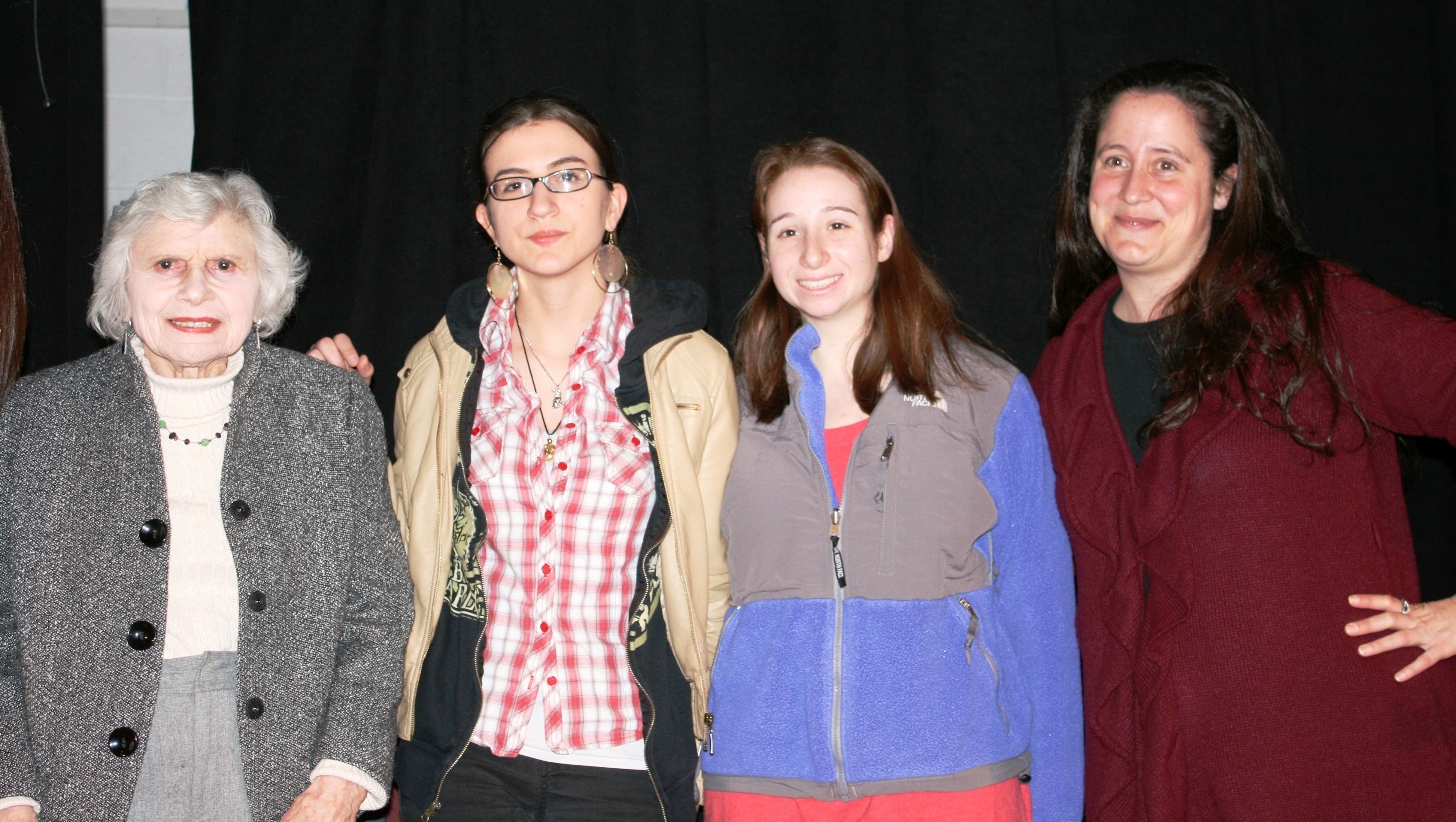


Students and faculty filled the The Harvey School auditorium Friday morning to hear the first-hand account of Holocaust survivor Lola Margulies' struggle for survival.
Sitting alone against the backdrop of a black curtain, Margulies, shoulders sloped forward from age, addressed approximately 400 people at the Katonah campus in a steady, matter-of-fact tone as she described being interned in a ghetto and living with the fear of being deported to a death camp following Germany’s invasion of Poland after declaring war on Russia in 1941.
Margulies is one of the region’s few remaining Holocaust survivors and speaks at schools on behalf of The Holocaust and Human Rights Education Center (HHREC), an interfaith, not-for-profit organization serving Westchester, Fairfield and Putnam Counties. The mission of the organization is to teach the lessons of the Holocaust and encourage students to speak up and act against all forms of bigotry and prejudice. More than 1,750 teachers have drawn upon HHREC’s vast resources.
Find out what's happening in Bedford-Katonahfor free with the latest updates from Patch.
Harvey students listened quietly as Margulies put a personal face on one of humankind’s greatest atrocities. She was only 11 years old – younger than most Harvey students – when the Germans invaded her hometown of Skalat, Poland. She described “waiting for death” and losing all hope of survival during the war. When she was hiding in a farm house chicken coop, she realized the chickens had more freedom than she and her family. She used a bucket for a toilet and wondered how to survive in what she described as a “grave for the living.” One of the hardest parts was living in a state of starvation.
At one point when she was separated from her parents, a peasant offered to help her but she became hysterical and the peasant left in fear of being caught. Only later did she realize that peasant was turning Jews over to the Germans for money.
Find out what's happening in Bedford-Katonahfor free with the latest updates from Patch.
But she went on because there simply was no other way.
Eventually, Margulies and people from her town escaped to the woods where she and her immediate family hid 10 feet beneath the ground in a bunker they dug with their hands for nine months before the Russian army liberated her in 1944. Three years later she moved to the United States.
“She shared her incredible story of survival and she told our students never to let human rights violations of any kind go unchallenged,” said Harvey history teacher and Human Rights Club adviser Amy Gignesi, Ph.D. Harvey student Helena Belloff, a Human Rights Club member, was instrumental in securing Margulies’ appearance.
“Margulies told them to be aware and pay attention, and fight against prejudice and injustice,” said Gignesi.
The lessons of survival and sacrifice Margulies imparted could be applied to anyone’s life and inspire bold acts of courage. That is the reason Holocaust survivors, like Margulies, believe it is a duty to remember and speak. Elie Wiesel, author of “Night,” has often described the process of speaking about the Holocaust as an attempt to “communicate the incommunicable.” Some Harvey students are currently reading “Night” in their English classes.
Throughout the day, Gignesi said her students expressed amazement at Margulies’ story. “In class we explored her message in the context of current human rights issues in the world, and outside of class, a number of students approached me to tell me how moved and inspired they were,” Gignesi said.