Politics & Government
Hurricane Earl Gaining Momentum
Could bring driving rain, strong winds to area by week's end.



As September rolls in, so does hurricane season.
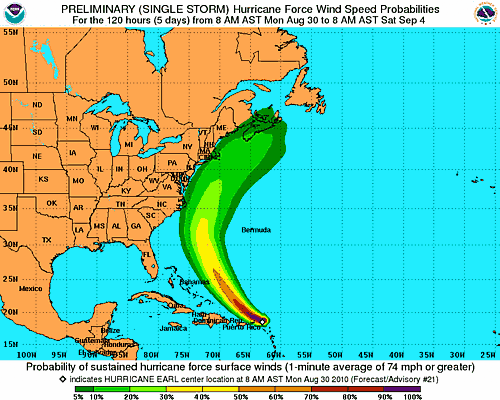
Hurricane Earl is gaining momentum toward the southeast coastal region and has been dubbed the second major hurricane of the 2010 season, just behind Hurricane Danielle.
Though Bellmore is not in its direct path, the storm could bring driving rain and strong winds come Friday. County Executive Ed Mangano said the Nassau County Office of Emergency Management (OEM) has begun its 120-hour hurricane window as it prepares for the possibility of Earl reaching Long Island.
Find out what's happening in Bellmorefor free with the latest updates from Patch.
"A tremendous amount of communication will go into preparing and responding to a major weather event like a hurricane," said Mangano. "The first steps have been taken today."
However, preparations for such a storm have been long underway.
Find out what's happening in Bellmorefor free with the latest updates from Patch.
Back in July, the Long Island Power Authority (LIPA), National Grid, Red Cross, New York State officials and the Offices of Emergency Management of Nassau and Suffolk counties conducted a hurricane drill, as they do every year to prepare for such significant weather events.
LIPA president Kevin Law said it's not a matter of "if" but "when" a hurricane will hit the region after studying recent summer weather patterns.
Commissioner of OEM Jim Callahan added that Long Island is "long overdue" for a hurricane, noting that every 17 years, a hurricane should hit the island. The last hurricane, however, that hit Nassau County was a category one named "Gloria" back in 1985.
Hempstead Town Supervisor Kate Murray marked the beginning of the 2010 hurricane season with a special preparedness presentation to seniors.
"We want to ensure that all residents, especially seniors who are particularly vulnerable, are prepared in the event that our area is hit by a hurricane this year," says Murray. "Experts are predicting that as a result of rising water temperatures and changing weather patterns we are more likely than ever to have a hurricane hit the northeast."
Though hurricane season runs from June through November, August and September are considered the two most active months. Supervisor Murray said the town too has established an emergency disaster preparedness plan and coastal evacuation route.
Further, town senior centers have emergency power, town vehicles can assist with evacuation, Hempstead's Swift911 emergency notification system can help provide information/directions to deal with storm issues and the town's website (www.toh.li) can offer updates on conditions and town actions, Murray advised.
"These are all simple preparation measures that will help in the event of severe weather conditions," said Murray. "Having a plan of action can save lives."
There are several easy but important steps residents can do to prepare themselves for the season. According to the National Weather Service's hurricane preparations and precautions checklist, a family disaster plan checklist is a must:
- Discuss the type of hazards that could affect your family. Know your home's vulnerability to storm surge, flooding and wind.
- Locate a safe room or the safest areas in your home for each hurricane hazard. In certain circumstances the safest areas may not be your home, but within your community.
- Determine escape routes from your home and places to meet. These should be measured in tens of miles rather than hundreds of miles.
- Have an out-of-state friend as a family contact, so all your family members have a single point of contact.
- Post emergency telephone numbers by your phones and make sure your children know how and when to call 911.
- Check your insurance coverage. Flood damage is not usually covered by homeowners' insurance.
- Stock non-perishable emergency supplies and a disaster supply kit.
The American Red Cross advises that two disaster preparedness kits are ideal –one for home and one to take with you as a "go bag" in case you need to evacuate. Include in your disaster preparedness kit:
- Water – at least one gallon per person per day
- Food – Non-perishable items you'd want to eat – such as canned food (and a manual can opener), energy bars peanut butter and other nutritious foods that require no refrigeration, preparation or cooking and little or no water.
- First Aid Kit – Pack a "how to" guide as well.
- Medications – Essential prescription and non-prescription items and medical information.
- Crank radio and flashlight or battery-powered radio and flashlight (with extra batteries), and a 12-hour glow stick.
- Clothing – A change of clothes, rainwear, sturdy shoes and protective gloves for everyone.
- Personal items – Remember specific items such as eye glasses or contact lenses and solution, personal care and hygiene items, extra (charged) cell phone batteries and comfort items such as toys or books.
- Money – Have cash. ATMs and credit cards won't work if the power is out.
- Important family documents in a waterproof, portable container – Copies of drivers' licenses, wills, birth and marriage certificates, insurance policies, proof of residence (deed or lease), recent tax returns, credit card and bank account numbers, social security cards, passport numbers, home inventory list.
- Special items for infants, elderly, pets or loved ones with special needs.
- Written instructions on how to turn off electricity, gas and water if authorities advise you to do so. (Remember you'll need a professional to turn them back on.)
Additional hurricane information is available on the Nassau County website at http://www.nassaucountyny.gov/hurricane.htm. Visit http://www.lipower.org/stormcenter/safety.html for storm safety and preparedness tips from LIPA.
Get more local news delivered straight to your inbox. Sign up for free Patch newsletters and alerts.