Politics & Government
Bronxville in Program to Replace Trees Lost During Sandy: Mayor
Input of planting locations from village residents is needed, the mayor said.


Written By Mayor Mary Marvin:
BRONXVILLE, NY — The arrival of Hurricane Matthew and its path of destruction highlights the power of nature and its consequences.
Forever blessed that the epic storms of Irene and Sandy did not cause loss of life locally, the damage to our environment is still in evidence today in the form of loss of vegetation.
Find out what's happening in Bronxville-Eastchesterfor free with the latest updates from Patch.
Here at home, the Village alone lost over 50 municipal trees with an even greater number lost or damaged on private property.
We are still trying to recover. To that end, we participated in a program customized for the southeast New York customers of New York State Power Authority (NYPA) to address the regional loss of street trees.
Find out what's happening in Bronxville-Eastchesterfor free with the latest updates from Patch.
Up to a certain number, for every tree purchased, NYPA will match our order with another tree of the same shape and size selected from a list prepared by state arborists.
We will be taking delivery of 32 trees in the coming two weeks and planting them throughout the Village with a concentration on the residential “right of ways.”
We ask for your input as to planting locations by emailing Village Administrator Jim Palmer at jpalmer@vobny.com. As residents, we rely on you to help us remember where trees were lost in your neighborhoods or where an appropriate open space exists.
In tandem, and with advice from our garden groups, local experts and Design Review Committee members, we will also be planting trees appropriate to pedestrian traffic in the business district.
This summer saw many trees die in our business district resulting in unattractive stumps and unsightly tree pits. Professional arborists told us they were probably the wrong “street tree” when planted as the root systems most likely died due to space constraint. As example, oak trees would need 20 foot wide sidewalks for the size of the tree pits they need to flourish.
Our commercial district trees actually increase business traffic. Studies show that the more trees and landscaping a business district has, the more business will flow in. A tree lined street also slows traffic – enough to also allow drivers to look at store fronts instead of whizzing by.
As an added plus, urban trees grow in value as they age while most other municipal assets including roads and sewers decline in value.
Trees on private property produce even greater monetary value. Studies have demonstrated that 10 percent to 23 percent of the value of a residence is based on its tree stock. A municipality also captures some of this monetary value as enhanced property values increase assessed values and the resulting tax base.
Trees also provide important symbolic links with the past and are important often simply because they have lived through eras with which we have few other connections left.
“Street” trees serve architectural and engineering functions even beyond the aesthetic value and their environmental impact is far reaching. They enhance building design, reduce glare and reflection, screen unsightly areas, muffle urban noise and reduce the “heat island effect” caused by pavement and commercial buildings.
Their effect on the environment cannot be overstated:
- Trees help to trap and hold particulate pollutants (dust, ash pollen and smoke) that can damage human lungs.
- Trees act as natural air conditioners; the evaporation from a single tree can produce the cooling effect of ten room size air conditioners operating 20 hours a day.
- A canopied neighborhood vs. a treeless one ensures a difference of 6 to 8 degrees in lowered summer temperatures.
- If you plant a tree today on the westside of your home, in five years energy bills will be 3 percent less and in 15 years the savings will be nearly 12 percent.
- Trees as windbreaks can reduce residential heating costs by 10 percent to 15 percent.
- Trees absorb and block sound, almost as effectively as stone walls, reducing noise pollution by as much as 40 percent.
- Trees screen unattractive views and soften the harsh outlines of masonry, metal, asphalt, steel and glass.
- Trees fight soil erosion, conserve rainwater and vastly reduce water runoff after storms.
- A mature leafy tree produces as much oxygen in one season as ten people inhale in a year.
- Trees filter sewage, reduce the effects of animal waste, clean roadside spills and clean water runoff.
- Trees reduce UV-B exposure by about 50 percent, thus providing protection particularly to children who spend a vast amount of their day outdoors.
And remember, Buddha attained enlightenment while meditating beneath a ficus tree.
Trees by Joyce Kilmer
I think that I shall never see
A poem lovely as a tree.
A tree whose hungry mouth is prest
Against the earth’s sweet flowing breast;
A tree that looks at God all day,
And lifts her leafy arms to pray;
A tree that may in Summer wear
A nest of robins in her hair;
Upon whose bosom snow has lain;
Who intimately lives with rain.
Poems are made by fools like me,
But only God can make a tree.
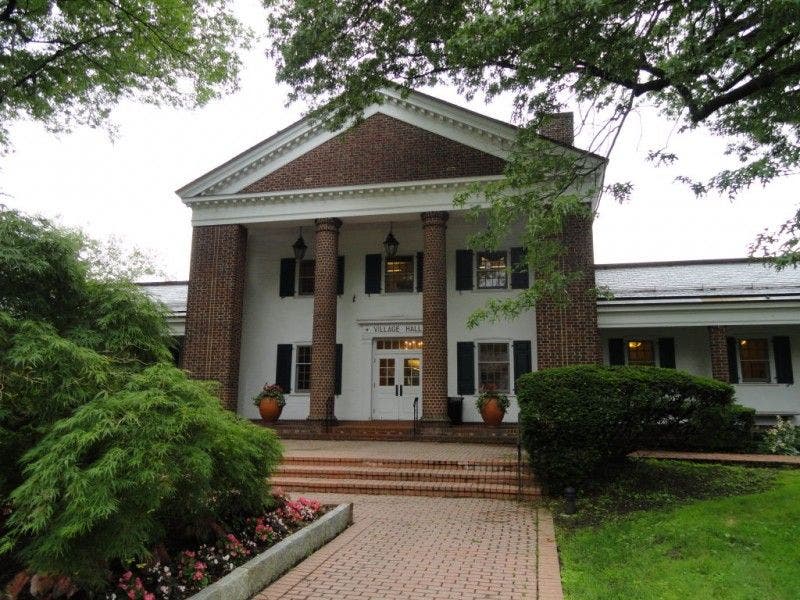
Photo credit: Google Maps.
Get more local news delivered straight to your inbox. Sign up for free Patch newsletters and alerts.