Community Corner
Mayor Marvin: Further Explanation of Bronxville's Flood Mitigation Project
In this week's column, Bronxville Mayor Mary Marvin continues her discussion of the village's flood mitigation project.


Written by Bronxville Mayor Mary Marvin
Last week’s column on the FEMA Flood Mitigation project quite naturally generated additional inquiries, so the following is FEMA Part II ~
How Often Will the Pumps Be Tested?
Find out what's happening in Bronxville-Eastchesterfor free with the latest updates from Patch.
During the first 12-months following installation, testing will be performed on a monthly basis. Each pump will be started and run for 10-15 minutes once per month, time to be determined by the school. After the first year of installation and an established record of testing and performance, the frequency of testing will decrease to once every three months depending on actual operational demand.
How Will the Fuel For the Pumps Be Stored?
Find out what's happening in Bronxville-Eastchesterfor free with the latest updates from Patch.
The fuel storage system is designed to meet/comply with New York State Department of Environmental Conservation (NYSDEC) and the Westchester County Petroleum Storage safety provisions desired to prevent spillage. In addition, corrosion resistant materials, tank gauges, fuel filters, and air emissions equipment will also be components of the storage system.
Fuel transfer is only expected to be done in a semi-annual or annual basis.
Why is Diesel Fuel Being Used to Operate the Pumps Instead of Gas?
Because of the required volumetric pumping rate, engines of a certain size are required and engines of the required size are not available for operation with gas.
What is the Noise Level Generated By the Pumps?
Since they will be extremely well insulated per the design requirements, the noise level at a distance of 100 feet is expected to be 60 to 65 decibels. The nearest point of the school building is approximately 125 feet from the pump station with a similar distance to the nearest residences. (By way of comparison, the noise from a typical lawn mower measured at 100 feet is 80 decibels.)
How Much Backfill Soil Will the Network of Pipes Displace?
Based on the results of on-site testing of the soil to be removed, (which constitutes 2.5% of the total soil volume on the field), it consists primarily of fine sands and organic silts which typically exhibit poor drainage characteristics and are unsuitable as structural backfill material.
How Will An Underground Piping Network Be Maintained Under a School Field?
The proposed piping network has been designed with several access man-ways to allow for periodic inspection and maintenance per a design approved by current New York State Stormwater standards.
How Does Storm Runoff Relate to the type of Field Surface?
The proposed flood mitigation system, including the storage piping network, is a closed system that will not directly receive runoff from the fields regardless of field type, be it natural or synthetic.
When is This System Actually Operational and How Will it Affect the Levels of the Bronx River?
The flood mitigation system will only be operational during significant storm events similar to those in 2007 and 2011. An impact analysis predicated the potential effect of the Flood Mitigation Plan on the Bronx River using the actual rainfall and Bronx River flow data from both major storms.
These events were logically chosen since each resulted in the specific type of flooding that the grant proposes to mitigate and each was extremely significant in magnitude. Based on the completed impact analysis, the historic rate of peak river flow will remain unchanged as a result of the mitigation project.
Is There a Plan to Mitigate the Ancillary Effects of the Ongoing Construction?
The project is highly regulated as it should be.
A scheduling/phasing and safety construction management plan is a required component of the project including:
- Specific plans to minimize disruption to pedestrian and vehicular traffic
- The isolation of the construction area via a fully closing chain link fence
- Constricted hours of operation for debris and excavated material removal
- Protocol for dust suppression.
As to dust, the heavier dust producing work will be completed in the colder months when the children do not play outdoors. Concurrently implemented will be dust suppression procedures, including covering any stockpiled soil, watering down soil during day periods and sweeping/washing of all blacktop and impermeable surfaces.
Will Trees Have to Be removed?
Yes, but all parties are seeking ways to minimize the number and scope of trees removed, and the proposed landscaping plan will at a minimum replace the number of trees removed as well as additional screening of the pump facility.
Check Valves:
Each of the two existing stormwater conveyance lines that deliver runoff to the Bronx River have steel plates at their discharge point which allows water to flow out of the pipes but does not allow water to flow into the pipes (in the event that the River water is higher than the discharge point. These valves (which operate like a flap with a hinge at the top) are functioning and tested regularly (both were checked as recently as last week). The smaller, shorter conveyance line has an additional check valve located near the intersection of Midland and Pondfield. This valve was also just inspected and cleaned and will be evaluated for possible replacement.
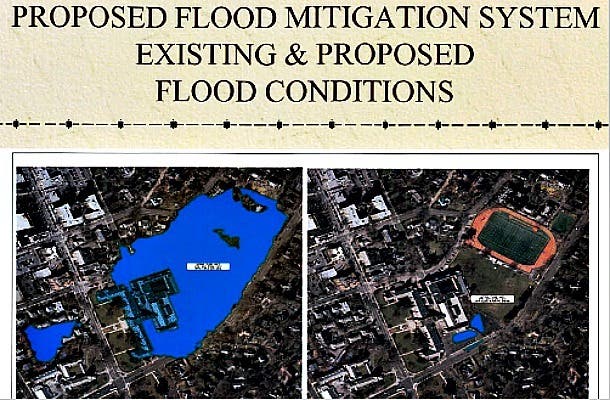
Given All the Anticipated Disruption What is The Expected Benefit?
I think this is a case when a picture does tell the story (see photo above).
Photo credit: Village of Bronxville
Get more local news delivered straight to your inbox. Sign up for free Patch newsletters and alerts.