Politics & Government
The Tax Game Between Bronxville and Albany
In this week's column, Mayor Marvin discusses the jockeying between villages and state government to try to keep taxes low.


Written by Bronxville Mayor Mary Marvin
As we prepare the tax bills for mailing next week, every resident will see a reduction, albeit quite small, on the Village’s side of the tariff.
We pride ourselves on being as efficient as we can with a very streamlined staff. We have significantly fewer DPW employees, police officers and administrative personnel than we have had in decades.
Find out what's happening in Bronxville-Eastchesterfor free with the latest updates from Patch.
Contrary to the mantra we hear from Albany, New York State local governments are neither too plentiful nor inefficient. New York actually ranks 37th nationwide in the number of governmental entities per 1,000 residents.
The ongoing local governments’ maximization of efficiency to the point of austerity has resulted in a steadily declining number of municipal employees, uniform and non-uniform, not just in Bronxville but statewide.
Find out what's happening in Bronxville-Eastchesterfor free with the latest updates from Patch.
Data from the New York State Comptroller’s Office verifies that local governments have exercised much greater spending restraint than our state government. To bolster local governments and offset local spending cuts, New York State has historically shared state revenue through a program called AIM or Aid and Incentive for Municipalities.
Despite a proven correlation between state revenue sharing increases and local property tax decreases, the last increase in AIM funding was in the 2008 – 2009 state budget. Since that time, it has decreased by 14% in real dollars. As a result, the entire AIM appropriation in the upcoming state budget ($715 million) is actually 65% less than just the increase in school aid in the same budget.
It is beyond frustrating because it seems that the elected officials and the average tax payers they represent are not deemed a “special interest group” nor a constituency whose voices are heard in Albany.
This year most communities made up the deficits through a slight unexpected decrease in the cost of local pension contribution. Despite the momentary reprieve, pensions are still 172% (nonuniformed personnel) and 83% (police and firefighters) higher than the 45 year average. The growth, despite one positive blip on the screen, is still unsustainable.
So where do we find revenue if not from the State or an unexpected steady decrease in pension and health contributions, all of which are unrealistic?
Many elected officials support legislation that would permit municipalities, at local option, to impose charges on tax exempt properties to defray the cost of services that local governments provide such as police and fire, lighting, sewers and road repair.
Another possible revenue source would be to increase the tax, again at local option, that municipalities can impose on utility companies operating within one’s boundaries.
Under current NYS law, cities and villages, but not towns, have the option of imposing a gross receipts tax (GRT) on the gross operating income of utilities at a rate of 1%. As point of fact, Buffalo, Rochester and Yonkers already have the ability to impose the tax at a rate of 3% and currently do so. Other communities are asking for parity.
In addition, in recognition of the predominance of wireless technology and to promote equity in the tax treatment of the various types of telecommunication providers, both the state government and the City of New York have made changes to their similarly antiquated statutes to include cellular services under the taxable umbrella. Again, local government should be treated similarly.
Given the never ending stream of unfunded mandates and a sluggish economy against a backdrop of an increased demand for quality public services, the concept of shared services has new value.
Many municipalities, including our own, have been working together and sharing resources / joint purchasing – be it road resurfacing services, heavy equipment sharing, police training and tactical teams and office supplies for decades.
The current challenge is to identify new areas for sharing that result in maintaining or improving delivery of the service while achieving cost sharing.
There are clearly many more areas or “low hanging fruit” that if we joined with our neighbors would produce volume discounts – the purchase of highly specialized equipment that is never used 24/7 and administrative supplies come to mind immediately.
Issues of greater magnitude would require an inclusive community conversation because there are definite trade-offs such as:
- the loss of local character/unique identity and some local autonomy
- differing expectations of each community and fear that services will drop to the least common denominator
- the expected level of service, be it police response time or backyard garbage pick up
Because school districts and municipal governments operate under separate rules of governance, some of the logical intra community cooperative efforts between a local school and village are stymied.
That being said, I believe it is incumbent upon all of us to, like a Venn diagram, review where we can overlap constructively.
Some of the seminal issues to be overcome must be:
- Are the expected savings demonstrable and meaningful?
- Is the arrangement mutually beneficial and not a “bailout” for one of the parties?
- Do the parties to the agreement have a short-term escape clause if the result does not meet expectation?
Given that we truly have reached a “tipping point” as to the level of taxation, Albany has to help us by changing taxation rules to grant local options, and flexibility and we must engage in meaningful dialog with all service providers.
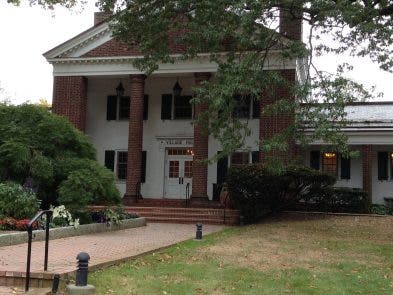
Photo: Bronxville Village Hall
Get more local news delivered straight to your inbox. Sign up for free Patch newsletters and alerts.