Community Corner
Charles Liteky’s Pilgrimage
"Renunciation" is his story as a Catholic military chaplain, Vietnam hawk, Medal Of Honor recipient and civilian warrior for peace.

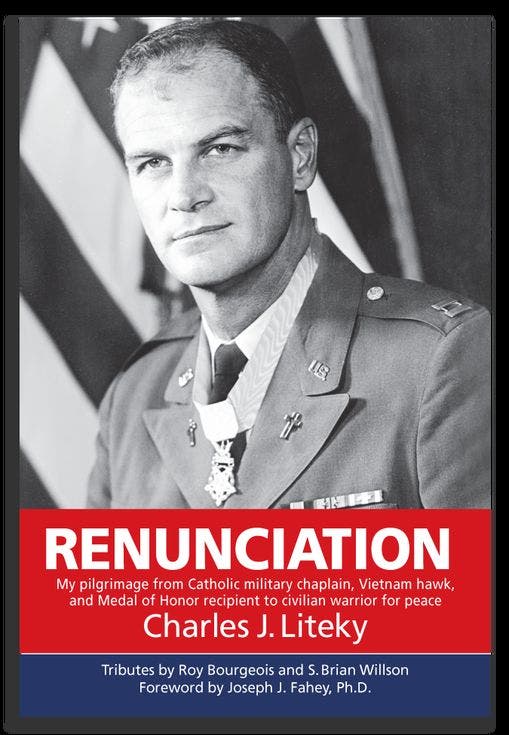
On July 29, 1986, Charles J. Liteky returned his Congressional Medal of Honor. His posthumously published memoir, Renunciation, provides his reason for placing the award at the base of the Vietnam Veterans Memorial in Washington, D.C. Liteky is the only recipient of the award who is believed to have returned it in a demonstration of political dissent.
Liteky passed away this past January, shortly after receiving assurances from friends that his story would be published. The narrative follows his personal pilgrimage from a Roman Catholic priest, military chaplain and Vietnam hawk to a civilian warrior for peace.
Renunciation is available on Amazon.com in paperback and ebook. The book also can be ordered directly from the new Charles Liteky website. Learn more about the Charles Liteky story on the website and follow on Facebook.
Find out what's happening in Brooklynfor free with the latest updates from Patch.
Training In Brooklyn
At the beginning of the 1960s, Liteky was ordained by the Missionary Servants of the Most Holy Trinity, a religious congregation in Silver Spring, Maryland. Several years later, as the war in Vietnam escalated, Liteky became a U.S. Army chaplain. Training brought him to Brooklyn.
Find out what's happening in Brooklynfor free with the latest updates from Patch.
During September 1966, Liteky arrived at the school that was located in the shadows of the Verrazano Narrows Bridge. He joined more than 100 Protestant ministers, Jewish rabbis and Catholic priests. They were enrolled in a two-month officer’s indoctrination course, learning how to dress, salute superior officers, return salutes of enlisted personnel and handle an automatic weapon.
“From the start,” according to Liteky in Renunciation, “I resisted the temptation to become a clerical soldier, but I had no problem with using a weapon for protection of self or others if needed. Primarily, I was there to serve Catholics, but secondarily, I was expected to be available to everyone, irrespective of rank or religion. The chaplaincy expanded the field of people I could serve and I enjoyed it.”
Bravery In Vietnam And At Home
Liteky received the United States’ highest military honor for actions of bravery on December 6, 1967. He served with the 199th Infantry Brigade. As he faced combat for the first time, he neglected shrapnel wounds and, without a weapon, helmet or flak jacket, exposed himself to mortars, land mines and machine guns to rescue 23 wounded colleagues who had been ambushed by a Vietcong battalion. He evacuated injured soldiers and administered last rites to the dying.
The Medal of Honor was awarded to Liteky for the lives he saved on the battlefield. He never thought that he deserved the medal any more than the many other courageous medics and soldiers who placed their lives in danger for their colleagues. These men included the medics who died on that same day.
Years after leaving the priesthood and the U.S. Army, Liteky was horrified upon learning about the murder of four missionary women in El Salvador by that country’s national guard. He and others soon opposed the training of Latin American officers at the School of the Americas (now the Western Hemisphere Institute for Security Cooperation) at Fort Benning near Columbus, Georgia. Liteky later served two federal prison terms (1990 and 2000) for civil disobedience -- his ministry of protest -- for trespassing at the Fort Benning training school. The reasons for his actions during the war and after were, according to Liteky, “to save lives.”