Politics & Government
Overhaul Of Storm Protection Plan Outrages Downtown Residents
Amid the ongoing planning process, some neighbors have formed a new group called the East River Alliance.


EAST VILLAGE — A massive $1.45 billion project designed to avoid a repeat of the devastation Hurricane Sandy wreaked on Downtown Manhattan will close the East River Park for years — and has left many locals furious.
Nearly seven years after the storm left Downtown basements flooded and the South Street Seaport a virtual no-go area for months, the city has yet to break ground on the East Side Coastal Resiliency project that's intended to protect residents from the impacts of climate change.
Last fall, the city overhauled the project after years of community planning, opting for a new design that would bury the East River Park with eight to 10 feet of soil. The new design would require the park to be rebuilt and closed for 3.5 years.
Find out what's happening in East Villagefor free with the latest updates from Patch.
The city says it expects to break ground next March.
For more East Village news, subscribe to Patch's daily neighborhood newsletter here.
Find out what's happening in East Villagefor free with the latest updates from Patch.

City presentation on the previous and current flood protection plan for East River Park, which moves flood protection infrastructure to the water's edge instead of FDR Drive. Image via City of New York community presentation on Feb. 28.
When the plan changed, locals felt blindsided and were outraged, they said.
“Every action from the city seems to foster [a] sense of mistrust," said Frank Avila-Goldman, a community activist of the recently formed East River Alliance. "It seems like people were caught off guard [and] nothing is wholly transparent.”
Some neighbors, including Avila-Goldman who lives in Gouverneur Gardens Cooperative, have likened the de Blasio administration's overhaul to Gov. Andrew Cuomo's L train reversal.
In an attempt to coalesce various East River Park stakeholders, neighbors formed the East River Alliance — a new community group which voted last Wednesday against the project as it stands.
"We feel that this new plan that the city is trying to push through over a five-month period does not meet the needs and values of the community, nor did it involve community input," said Ayo Harrington, on the Alliance's stewardship committee and a former Community Board 3 member. "We are not going to allow this attempt to fast-track [the project] and shove it down our throats."
But since the Alliance kicked-off meetings last December, some have criticized the group for not properly including the community most impacted by a storm and the project itself — New York City Housing Authority residents.
Nancy Ortiz, tenant association president at the Vladeck Houses, feels the Alliance has bypassed her leadership within NYCHA with the group's own outreach efforts through posting fliers in and around developments with what she sees as exaggerated misinformation about the plans and a focus on the ecology of the park instead of waterfront residents.
"All of a sudden there's this big push to get the NYCHA [residents] involved," Ortiz said. "We know what's best for our respective developments."
For Ortiz, the previous plan that largely lined the FDR Drive with walls — some permanent, some that would "flip-up" prior to a storm — were an issue from the get-go.
"We're happy they're getting rid of the walls," Ortiz said.
With dozens of NYCHA building along the East River, NYCHA residents in the neighborhood are the most directly impacted by future storms and construction.
"We're the waterfront," Ortiz said. "We're the wall. We get hit first."
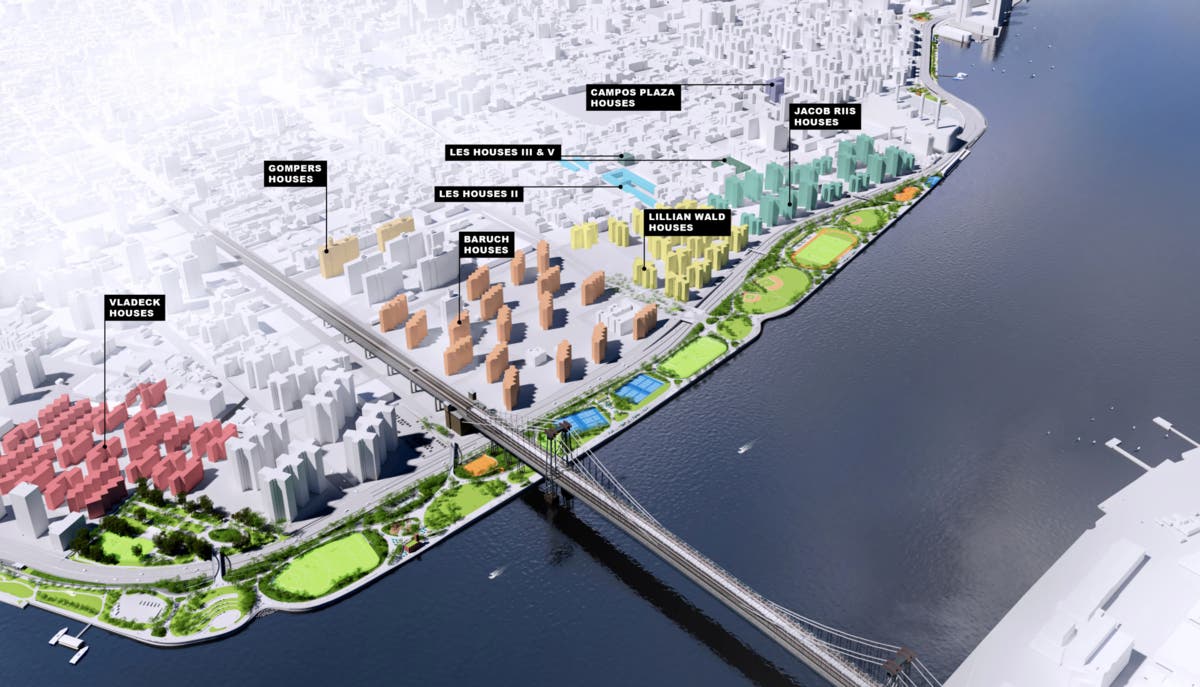
An overview of NYCHA developments along the East River. Image via City of New York community presentation on Feb. 28.
Many Alliance members recognize and emphasize this, saying NYCHA residents need to be included in the larger community conversation and negotiation with the city, members have told Patch and said at an Alliance meeting last Wednesday.
Harrington of the Alliance said,"There can never be enough outreach to make certain that NYCHA residents who are, for the most part, most impacted by both construction and floods, be involved in our organization."
The fledgling Alliance, however, doesn't lack NYCHA representation altogether, said one member who's a co-chair on the Alliance's outreach committee, Jasmin Sanchez.
"We have a seat at this table," Sanchez said, a Baruch resident and former City Council candidate who ran against Rivera in 2017. "I'm a voice for NYCHA."
Tenant leaders cannot represent all NYCHA residents, Sanchez said. Alliance leadership has also said the group plans to form a NYCHA committee in the future to add to its four other committees.
The tensions between East River Park stakeholders are becoming, in part, a debate between accepting the city's new design involving the park's closure or outright opposing it.
Some, like Ortiz, are embracing the new plan and focusing their demands on safety and mitigation. Others are skeptical of the plan — but know that something must be built, some said at last Wednesday's Alliance meeting.
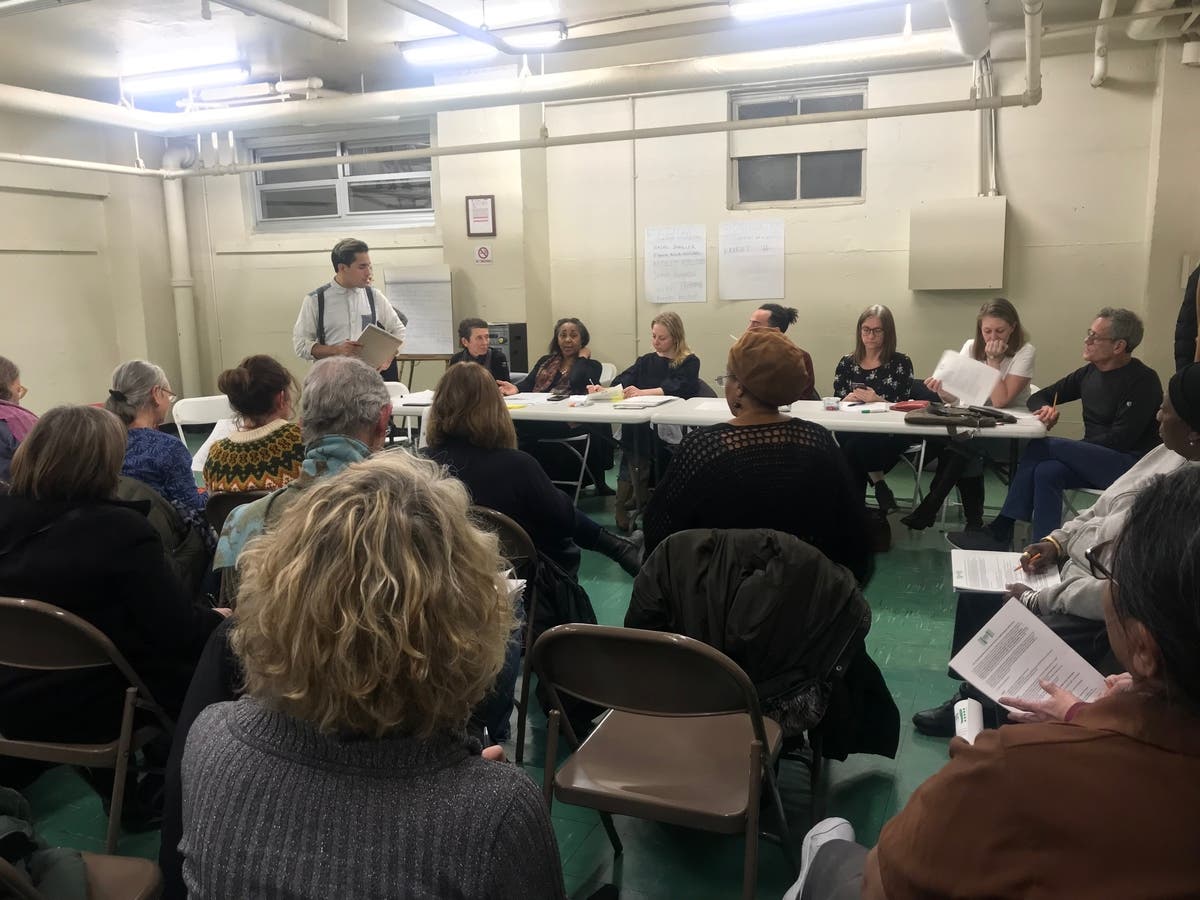
An East River Alliance meeting on Feb. 27. Image via Sydney Pereira
Even the Alliance, which has voted to oppose the current design, includes various demands regarding the park construction and closure.
The Alliance's position, a loose framework expected to adapt throughout the process, voted against the current project plan proposed by the Department of Design and Construction, the project's lead agency, and the Parks Department.
The group strongly opposes closing the park in full and wants the city to phase construction periods in order to keep parts of the East River Park open. They also demand at least 5 percent of the project budget of $1.45 billion be dedicated to additional recreation and open space during the park's closure.
Months after the initial announcement, the DDC's commissioner Lorraine Grillo apologized for the city's shoddy communication at a City Council hearing spearheaded by Councilmember Carlina Rivera, who will have a critical say in the project as it goes through the review process known as the uniform land use review procedure (ULURP).
Regarding where lack of communication with the community happened, Grillo says, "That's on me. I take responsibility for that and I apologize."
— Sydney Pereira (@sydneyp1234) January 23, 2019
The Parks Department has promised a mitigation plan for alternative open spaces. The city has previously touted the design will protect residents one hurricane season sooner, protect the park itself from flooding and minimize construction woes at FDR Drive.
Meanwhile, design details trickle out at various city presentations.
The exhaustive design renderings for the project include various points where the city wants to maintain access to the water, implement additional drainage systems to account for future heavy rainfall, replace pedestrians bridges, among other subtleties. For cyclists, city representatives said at a recent CB 3 meeting the Department of Transportation is planning to move the existing bike path inland. The amphitheater in the park — beloved by seniors living in NYCHA developments for shows — will be replaced, as well as the Corlears Hook Park and bridge.
As Christine Datz-Romero of the Lower East Side Ecology Center put it, “This is a huge park that is used by so many different entities and groups."
“It's going to affect this neighborhood so crazily," she said. "Sometimes I feel like — yes we talk with each other, we have a lot of meetings, but there is a lot of people out there that we haven’t reached. And that worries me a little bit."
Get more local news delivered straight to your inbox. Sign up for free Patch newsletters and alerts.