Community Corner
Beep's Town Hall On Ebola Draws Throngs of Residents, Media
Brooklyn Borough President Eric Adams invites medical experts to discuss deadly African virus that has stirred local fears

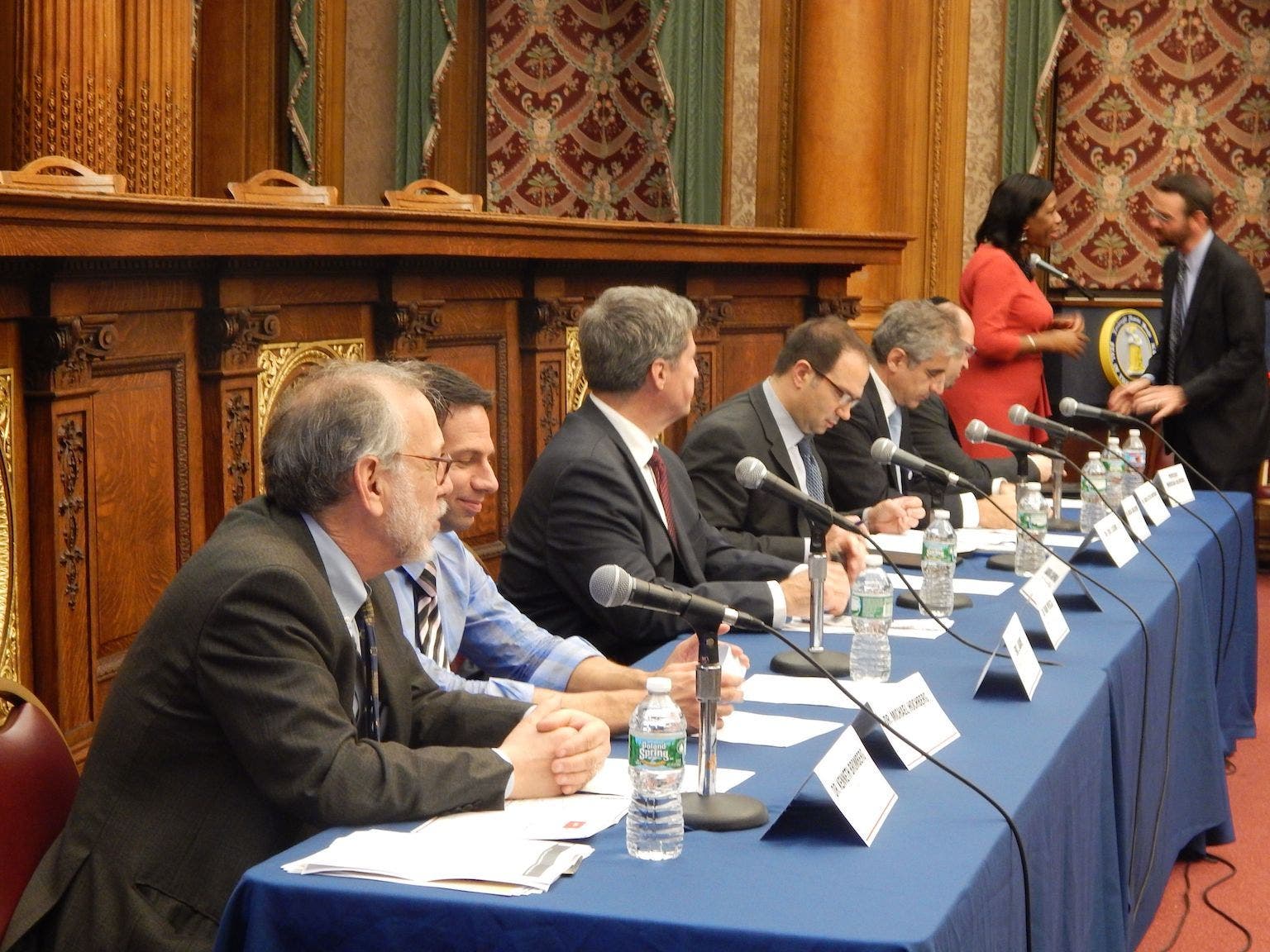
At the invitation of Borough President Eric Adams, last night Brooklyn Borough Hall was packed with media, local residents and curiosity seekers who braved a downpour for pointed information about the dangers posed by Ebola and Enterovirus D68.
A distinguished panel, headlined by Professor Mordechai Goldfeder, Director of the Health and Medical Unit, NYC Office of Emergency Management, sought to allay anxiety about the twin diseases while emphasizing that information was key to managing Ebola hysteria. Dr. Frank Proscia, president of the Doctors Council for the Service Employees International Union, the largest healthcare union in North America, stated flatly that “the risk of an outbreak of Ebola in the US is extremely low.”
The assembled experts and local politicians’ primary message was that the New York City health care system is prepared for any possible threat that Ebola might pose. Besides the obvious health concerns, panelists mentioned discrimination toward West Africans who live and work in our city; all agreed that the chances are virtually nil that anyone able to walk around is at risk of spreading the virus.
Find out what's happening in Fort Greene-Clinton Hillfor free with the latest updates from Patch.
“Every [hospital] staff member is being taught: ‘Think Ebola.’”
Dr. Frank Proscia, president of the Doctors Council for SEIU
Opening the discussion, Mr. Adams stressed the need for Brooklyn residents to be uninformed about Ebola, a virus that—based upon the four television crews and massed news media last night—has captured the attention of New York City residents.
Find out what's happening in Fort Greene-Clinton Hillfor free with the latest updates from Patch.
The Beep mentioned Ryan White, the now-deceased Indiana teenager who contracted HIV in 1984 and subsequently became the face of AIDs due to discrimination Mr. White face as a result of ignorance about how the AIDs virus spread.
Mr. Adams’ point regarding discrimination due to ignorance became a meme repeated throughout the evening.
Dr. Karen Maybank, Assistant Commissioner, NYC Department of Health and Mental Hygiene, opened her presentation with a dose of reality: the current Ebola outbreak is the worst that the world has known. According to Dr. Maybank, there have been more than 3,000 deaths world-wide due to the disease, but only one known death on US soil.
Dr. Maybank balanced this fact with another: it’s difficult to get Ebole; because it is not an airborne virus, the only way it can be transmitted is through direct contact with the fluids of an infected individual .
Making reference to the situation in Dallas, where Thomas Duncan, a Liberian national became the only known Ebola death in America, Dr. Maybank was adamant that none of the relatives that Mr. Duncan lived with while in Texas contracted the virus that ultimately killed him.
Nina Pham and Amber Vinson, the two nurses who tested positive after treating Mr. Duncan, were in contact with him when he was most ill, explained Dr. Maybank. Ebola—with an incubation period of roughly three weeks—is most contagious in the late stages of infection, underscoring that the greatest threat of infection is to medical professionals who treat Ebola patients.
Stressing that NYC hospitals are working around the clock to ensure they are prepared, Dr. Maybank announced that a public service campaign—meant to inform the public about stigma and discrimination against certain groups due to Ebola fears—will begin in the next week.
“Having contact with someone from West Africa who’s asymptomatic is not a way that you’re going to get Ebola.”
Dr. Mordechai Goldfeder, Health and Medical Unit, NYC Office of Emergency Management,
A key observation was that Nigeria, which has experienced a serious Ebola outbreak, took control of a potentially disastrous situation through education and by addressing citizens’ concerns.
Dr. Maybank said plainly that while there have been 155 calls about suspected Ebola infection, there currently are no cases of the virus in New York City. Saying that City hospitals do have the capacity to identify a potential patient with Ebola, Dr. Maybank emphasized that her staff are taking extreme measures to protect against any incidents.
Dr. Ghassan Jamaleddine of Kings County Hospital, who is organizing the City’s Health and Hospital Corporation response, said that NYC hospitals began preparing for Ebola weeks in advance of Mr. Duncan arrival in the US, and are now repeatedly drilling any employees who might be involved with the virus.
Outlining the City’s plan of action, Dr. Jamaleddine said that at risk patients will be routed to designated hospitals—primarily Bellevue Hospital in Manhattan due to it’s long history with infections diseases—based on symptoms and identified travel history.
In regards to the Dallas nurses who tested positive, Dr. Jamaleddine explained their infection was likely due to a failure to maintain the rigorous protocol for removing the Personal Protective Equipment (PPE) that shields medical personnel working with infected patients. The CDC is now examining this protocol, and Dr. Jamaleddine made clear that city hospitals will take extra precautions with its medical personals’ PPE.
Dr. Eric Legome, Chief of Emergency Medicine , Kings County Medical Hospital, spoke specifically what at-risk patients will experience when they arrive at a NYC hospital. Any patient contact will be carefully choreographed and any patient who is truly high-risk will be taken care of at Bellevue.
One other key point made by Dr. Legome: anyone who walks into an emergency department will likely NOT be infected enough to be a significant threat. Medical personnel will immediately isolate any at risk patients to prevent further infection.
“Mother nature is the best bio-terrorist.”
Dr. Kenneth Bromberg, The Brooklyn Hospital Center
Enterovirus D68—which poses a greater viral threat to City residents’ health—was also on the agenda, and Dr. Kenneth Bromberg, Chair of Pediatrics, The Brooklyn Hospital Center, led off with the comment that “Mother nature is the best bio-terrorist.”
Dr. Bromberg then chronicled the history of Enterovirus—a respiratory illness in the same family as Polio—at Brooklyn Hospital including 7 positive cases the hospital treated. Dr. Bromberg made plain that the greater viral threat in New York is from Influenza, commonly known as “the flu” which does far more health damage than it’s relative. Dr. Bromberg’s advice to all was to get a flu shot to eliminate the more pressing, though easily treatable,medical threat posed by Influenza.
Dr. Frank Proscia; President of SEIU’s Doctor’s Council, closed out the panel presentation by stating “It’s [Ebola] been around since 1976, it’s been controlled before and it’s going to be controlled again.”
Stressing “extreme collaboration” between the CDC, the departments of health and hospital systems, Dr. Proscia cited intensive training and intensive drills being conducted by the nation’s healthcare system to combat Ebola.
“Every staff member is being taught: ‘Think Ebola,’” Dr. Proscia said.
Given last night’s turnout and heightened media attention, it’s safe to say that many Brooklyn residents are doing just that.
PHOTO CAPTION: Panelists assembled for Brooklyn Borough President Eric Adams’ Town Hall on Ebola and Enterovirus
PHOTO CREDIT: Michael Randazzo for Patch