Business & Tech
BWS Spreads the Solar Conversion Message
Built Well Solar Corp. hosts dozens of information seminars to educate property owners on the benefits of converting to solar panels.

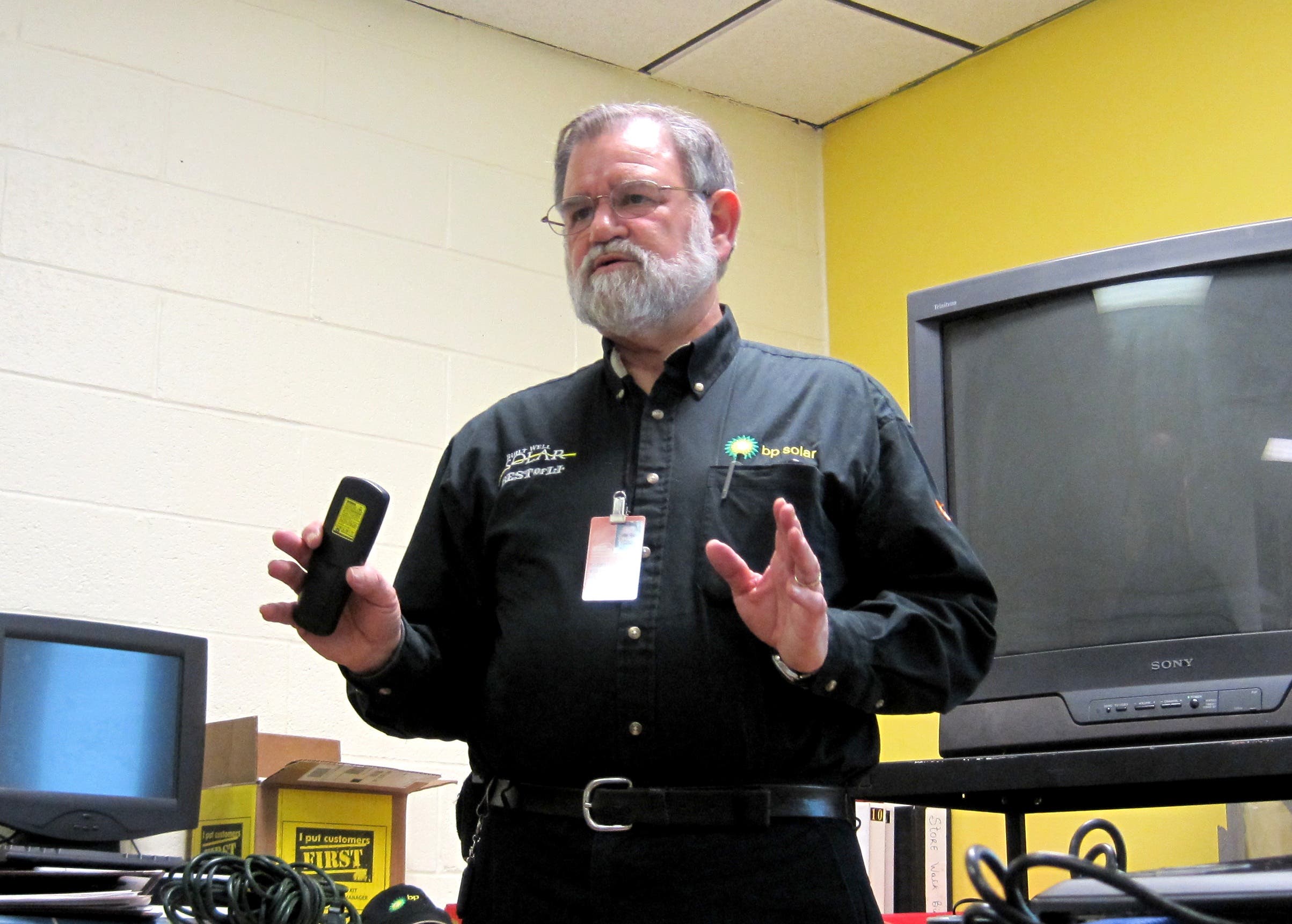
Solar energy is increasingly becoming an option for many homes and businesses across Long Island. A local installation company, Built Well Solar Corporation (BWS) is hosting dozens of information seminars for local property owners to share the benefits and dispel some common misconceptions of converting to solar energy.
BWS is a full-service designer and authorized Long Island Power Authority (LIPA) installer of British Petroleum (BP) manufactured solar systems with contracting available through local Home Depot stores.
"BP is one of the largest manufacturers of solar panels, which sounds crazy because you think of them as an oil company, but they know the handwriting on the wall," said Barry Wilans, sales associate for BWS.
Find out what's happening in Garden Cityfor free with the latest updates from Patch.
Wilans was on hand for dozens of information seminars being given throughout Nassau and Suffolk counties. The seminars also address specific questions from property owners on solar conversion.
"Some cities do this, supplement their electrical supply, it's very doable; Long Island and the entire area are finally getting into [solar]," said Wilans. "The United States is actually late; much of Europe and the Middle East, much of it is powered by solar."
Find out what's happening in Garden Cityfor free with the latest updates from Patch.
A photovoltaic (PV) solar-electric system, designed by BP, converts collected energy from the sun to electricity that is returned to LIPA's power grid.
Wilans said, "Solar is not the answer to everything, it doesn't fit into every application, but it fits a lot of them and Long Island is perfect for solar."
As the panels generate energy, the excess is redirected back to the grid, supplying the surrounding homes and buildings. The excess electricity runs the electric meter backwards, crediting the account for use later. The home or business will use these "credits" at nighttime or during cloud cover.
"Will we ever eliminate gas, oil, coal? No, we'll always need those as a fuel; the need is to make our consumption of them less. There's no panacea here, no instant answer and there's no product that is going to do that, but solar is a part of it," Wilans said.
The return on the initial investment is not instant; it takes, on average, six years. Someone that may be turned off by the initial costs should consider the sum of their monthly electric bills with an average of seven percent increases each year as imposed by LIPA. By applying the amount of the monthly electric bill toward the initial cost, within seven years, the system has paid for itself and the location of the system is then relatively free from an electric bill for the life of the solar system.
The panels are maintenance-free and include a 25-year warranty. BWS provides free annual inspections of the unit for 10 years, with extendable warranties optional. The panels are temperature and moisture resistant, able to withstand 110 mile an hour winds and the blow of golf ball sized hail at 50 miles an hour.
Generally, the start-to-finish process of the installation is up to nine months, depending on the zoning requirements, permits, engineering and other measures.
"There is no town on Long Island, even in incorporated villages, that won't let you [install solar]," said Wilans. "Some are more difficult than others, but they all will let you."
The Village of Garden City has had solar panel installation codes on the books for five years, according to Building Superintendent Mike Filippon. Currently, two homes in the village have panels, he said, and an application is before Garden City's review board.
Back in November, Filippon attended a conference hosted by Kevin Law, president and CEO of LIPA that kicked off the Long Island Unified Solar Code Initiative. A panel consisted of representatives from planning commissions of both Nassau and Suffolk counties, the Long Island Regional Planning Council, the Long Island Solar Energy Industries Association and Renewable Energy Long Island, a not-for-profit organization that promotes clean, sustainable energy use and generation for Long Island, seeking public participation in energy policy decisions to encourage energy efficiency, use of renewable energy sources, and to protect our environment, economy and public health.
"The purpose of this conference was to begin to try and have all municipalities on Long Island to develop a single, unified set of regulations for solar code installations because they feel some of the regulations actually form an impediment, their words not mine, to getting these things approved in a timely fashion," Filippon said. "We suggested that the elimination of requiring a permit might be a desirable thing - and I was surprised to see that some towns have actually adopted that already, specifically the Town of Babylon - and I don't particularly agree with that."
The installed inverter box switches direct current (DC) from the solar panels to alternating current (AC) to your circuit breaker in your house, controlling the flow rate of electricity to your house. The electric meter will be changed to a digital meter during the installation.
The inverter box is connected directly to LIPA's grid. The inconvenience, the system will not work during a blackout and will automatically shut itself off for the duration. Solar panels are not generators, they do not collect and hold electricity for later usage.
The goal of tailoring a system to each location is to get the home or business owner as close to a zero bill from LIPA, not to mass-produce electricity for profit.
"There is no cookie cutter design for this system, everything is custom designed for each location," said Wilans.
Each location is surveyed as well as the history of electrical usage at the specific location. During the consultation, the optimal placement of the panels will be taken into consideration for shade, slope of the roof and it's exposure to sunlight and more.
Some common misconceptions are appearance, cost and tax impact. Each design is custom to the property owner's approval. The costs appear overwhelming upfront, but are easily justified with tax credits, incentives and the overall savings on a 25-year electric bill. Wilans mentioned that the system increases the value of the property without increasing the tax base.
"BWS has gone through all of the security checks; Home Depot is exceedingly careful about who they hire to do things," said Wilans.
BWS has been in business for over 9 years. There is no subcontracting on installation projects; BWS employs all of the workers that participate in the installation. The BWS Web site boasts: "We have designed and installed more PV systems on Long Island than most other solar-electric companies combined, and more in Nassau County than anyone else."
According to Filippon, "You're going to see more and more solar installations. I think it's going to take some time to shake out and develop some sort of regulations that we can all be comfortable with. There are some 2,000 installations already on Long Island. Apparently we are a very good geographical location that makes these systems work well."
For information and a free, no obligation consultation about a solar installation for your home, business, school district, non-profit or other site, call 516-695-1000 or e-mail info@builtwellsolar.com.