Neighbor News
Clavin, Muscarella & Ra Demand Answers on 1,4-Dioxane Regulations
Officials join with Water Providers to Press for Funding to Protect Ratepayers and Prevent a Water Crisis
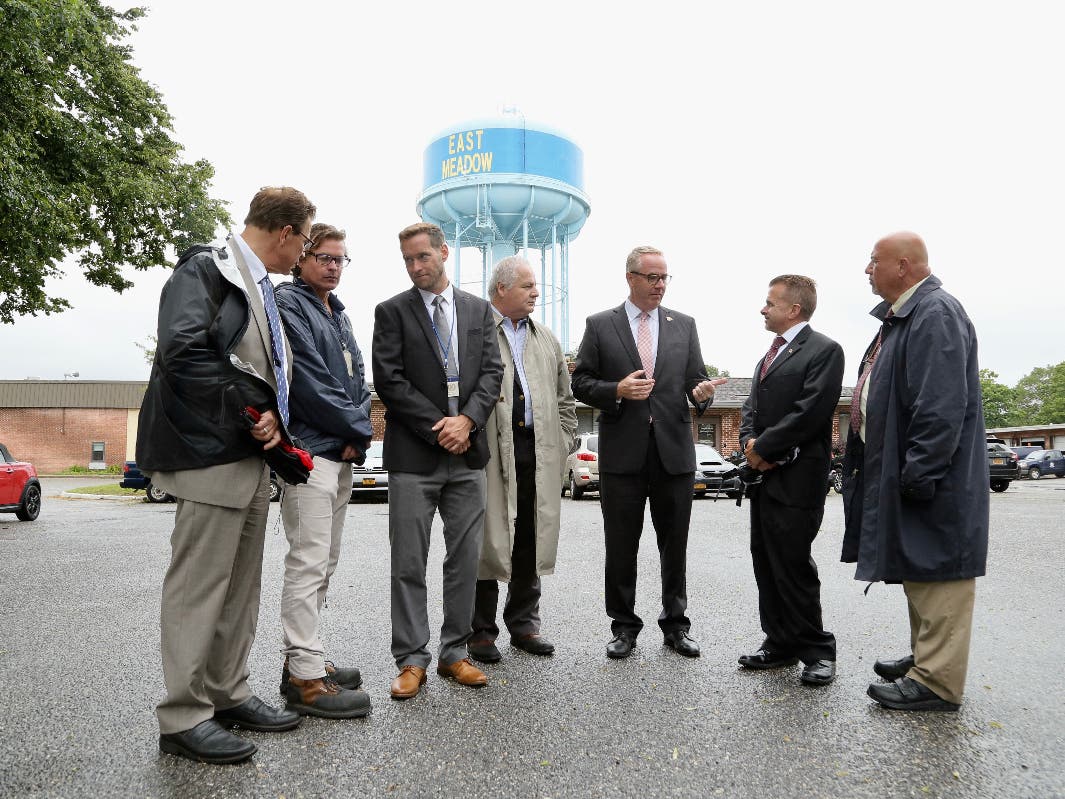


Hempstead Town Receiver of Taxes Don Clavin, Councilman Tom Muscarella, Assemblyman Ed Ra and representatives from local water providers held a news conference at the Town of Hempstead Water District’s headquarters in East Meadow to demand answers from the New York State Health Commissioner regarding potential regulations on the treatment of the contaminant identified as 1,4-dioxane. Without a boost in state funding, the officials said, mandated treatment regulations could cost town water providers well over $200 million combined, unfairly placing the lion’s share of the burden on taxpayers/ratepayers.
The officials are responding to the New York State Drinking Water Quality Council’s recommendations to the Health Commissioner, which outlined strict treatment requirements on 1,4-dioxane that could go into effect as early as January of 2021. To remediate this issue, water districts primarily on Long Island would have to embark on expensive and time-consuming treatment processes that water experts say would not likely meet the proposed January 2021 deadline even if they were to commence work today. As a result, officials fear that they may be forced to shut down a significant amount of wells that may not comply with the new requirements by the deadline. Equally important, water providers indicate that the cost of treatment must be fully covered by New York State or local water customers could be confronted with shocking rate increases.
“Every day of indecision by the Health Commissioner is a critical day wasted while our water districts could be implementing protocol that could expedite the compliance process,” Clavin said. “We need our state representatives to address this potential crisis now. Hardworking taxpayers and ratepayers deserve safe and plentiful drinking water without having to dive deeper into their pockets. Our state bureaucracy is putting that at risk, and we are here to demand action. While some may ask why a Town Receiver is speaking out on this issue, I am committed to protecting our taxpayers. Hempstead Town provides water to tens of thousands of water customers, and those ratepayers are also taxpayers. What’s more, water customers can’t afford significant increases in their water bills. It is time for New York State to step-up and fully cover the cost of its mandates.”
Find out what's happening in Garden Cityfor free with the latest updates from Patch.
1,4-dioxane, a synthetic industrial chemical that is miscible in water, is found in consumer products including many shampoo and laundry detergent brands. It is currently an unregulated contaminant in New York State, and water experts have said that 1,4-dioxane is primarily an issue on Long Island and not detected elsewhere in the state.
Though the Governor recently included a $2 billion statewide clean water initiative in the recent state budget, Clavin, Muscarella and Ra said that Long Island’s water providers should be at the front of the line to receive this and any other available funds if the new 1,4-dioxane treatment requirements are enacted. What’s more, the officials said that the state must loosen their restrictions and allow for Long Island water providers to obtain more funding for this critical venture. Currently, water districts could be eligible to receive a maximum of $3 million in state grant money. But, water experts are estimating the 1,4-dioxane remediation process to cost at least $6 million per well, with some districts possibly having to address treatment at multiple wells.
Find out what's happening in Garden Cityfor free with the latest updates from Patch.
“My district is served by several water providers that could be faced with the daunting task of complying with brand new restrictions with unreasonable deadlines,” Muscarella said. “Access to clean and safe drinking water is a basic human necessity. I believe that the state needs to step-up to ensure that our providers have the resources to address this important issue so that our taxpayers are not stuck with the burden of millions of dollars in unfunded mandates.”
“Without a decision on treatment requirements and compliance deadlines, water districts are losing valuable time,” Ra said. “While our water providers are doing their due diligence to prepare as much as possible, they need accurate information about this critical issue to expedite for the sake of their customers and taxpayers. I’ll make sure my voice is heard in Albany, but my colleagues in the Long Island delegation need to join me to take action and ensure that we avoid an emergency once the regulations do go into effect.”
If the state sets restrictions according to the advisory council’s recommendations at 1 ppb (parts per billion) for 1,4-dioxane, the potential construction cost impacts to be absorbed by some of the local water districts to comply (not including undetermined operational and maintenance costs) would be:
- Water Authority of Western Nassau County: $70 million
- Town of Hempstead Water Department: $54 million
- Village of Garden City: $50 million
- Franklin Square Water District: $7 million
- West Hempstead Water District: $6 million
Over 37,000 customers are served by the Town of Hempstead’s water districts and 48,000 customers combined in the West Hempstead-Hempstead Gardens Water District, Franklin Square Water District, Garden City Water District and the Western Nassau Water Authority. For example, a typical taxpayer served by a Town of Hempstead Water Department District could see their water rates and water department tax rates nearly double to help pay for the projected $54 million treatment process and the additional operation and maintenance costs.
Clavin, Muscarella, Ra, and representatives from local water districts also urged the state to consider “phasing in” any new regulations to allow for more time to ensure a smooth treatment process. Otherwise, water districts are forced to scramble for revenue sources with little guidance from the regulators imposing the standards.
“These projected costs are certainly monumental for any municipal service provider, large or small,” Town of Hempstead Water Commissioner John Reinhardt said. “When it comes to remediating a potential contaminant, we’re ready to act, but we just need New York State to work with us on a reasonable plan that protects both the health and financial interests of our customers.”
“Nassau taxpayers have had enough when it comes to ‘sticker shock,’” Clavin said. “Whether it’s the state’s congestion pricing commuter tax and proposed utility rate hikes, taxpayers are continually being slammed and have nowhere to turn. If the state does not act now, taxpayers could once again have to contend with footing a major bill, while having to deal with an unfathomable shortage of available water due to the ineptitude of state bureaucracy.”
On Monday, June 17th, Receiver Don Clavin submitted letters to local state representatives to press for funding to help water providers pay for construction costs related to the state's proposed 1,4-dioxane regulations.


