Community Corner
Historic Dix Hills: Gaylore Cemetery
More questions than answers at historic cemetery.
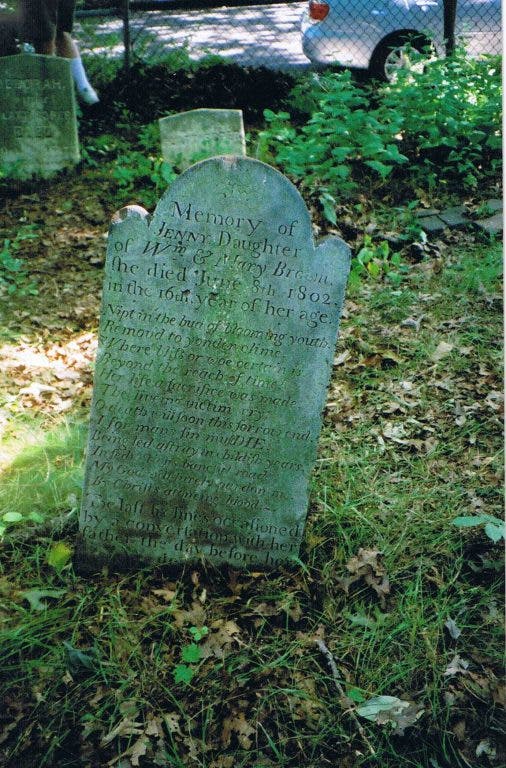


Tombstone inscriptions can tell you much more than just a name, birth date and death date.
Some can also tell you spouse names, children’s names or cause of death. The writing on your tombstone can be used as a way to share part of your life’s story with future generations. (See my previous article on the in Estee Lauder’s parking lot to learn about Elizabeth Smith’s tombstone and all the information she left on it.)
Jenny Brown, however, did not leave us a tombstone that answered questions and told a story. But instead the inscription on her stone, tucked away in Gaylore Cemetery at the intersection of Gaylore Drive and Old Country Road, leaves many questions unanswered. And unfortunately, reveals only clues about a story that has been lost in time.
Find out what's happening in Half Hollow Hillsfor free with the latest updates from Patch.
Jenny Brown died on June 8, 1802 at the age of 16. She was the daughter of William and Mary Brown. Her mother Mary died on Nov. 30, 1794 at the age of 31 and is also buried in Gaylore Cemetery.
William, Jenny’s father, is not identified on any of the readable stones at the cemetery, but there are two graves next to Jenny’s that are unidentified. There is a good possibility that one of those is William’s grave, as he is not listed as being buried in any of the other Huntington historic cemeteries.
Find out what's happening in Half Hollow Hillsfor free with the latest updates from Patch.
The part of the inscription on Jenny’s tombstone that makes her so interesting reads: “Nept in the bud of blooming youth removed to yonder clime, where blifs or woe certain is beyond the reach of time! Her life a sacrifice was made the living victim cry, oh death will soon this sorrow end, I for man’s sin must die. Being led astray in childish years in seduction’s baneful road. My God will surely pardon me, by Christ’s atoneing blood. The last six lines occasioned by a conversation with her father the day before her death.”
As this inscription is from 1802, I could not ascertain the event’s it refers to. And so we are left to guess at what exactly happened to poor Jenny Brown.
In addition to the Brown family, there are three “Sopers” buried in Gaylore Cemetery. Platt Soper died May 15, 1856 at the age of 82, and next to him his wife, Deborah, who died Oct. 6, 1847 who died at the age of 70. In addition, Levina Soper, the wife of John Soper, is buried there and she died on Dec. 12, 1859. Finally, Elizabeth, wife of Ezekiel Ketcham, who died on Feb. 15, 1853 at 51 years old, is buried there. Unfortunately, I could not find any information to explain the relation between the Browns, Sopers, and Ketchams.
In fact there was very little information on the Brown family in general. The 1873 map, however, shows a “J. Brown” residing near the cemetery. I was able to locate a William Brown, listed in the vicinity of his Dix Hills neighbors, on both the 1800 & 1820 Census Surveys. In 1800, the census reports that, in William Brown’s household there were three males—one under the age of 10, one between 16 and 26 years of age, and one 45 plus years of age (presumable William).
It also shows four girls living in the household—one under the age of 10, two between the ages of 10 and 16, (presumably one of these is Jenny), and finally one between the ages of 27 and 45. In 1820, the Brown household contains five males—three under the age of ten, one between 16 and 26 years of age, and one over the age of 45 (presumably still William). The 1820 census shows two females in the household—one between the age of 10 and 16, and one between the ages of 26 and 45. Finally, the 1820 census indicates that 3 people in the household were engaged in some form on manufacturing.
The area around the cemetery was developed by Gaylore Development Company, which is presumably, how the street got its name. The subdivision map, called Gaylore Manor, was filed on Nov. 4, 1954. Gaylore Manor was part of a larger subdivision called “Gay Lore at Huntington.” These 20 lots that were laid out in 1954 are the same lots that exist today, according to the Suffolk County Tax Map.
On Dec. 26, 1954 the New York Times reported that, “A new development of 103 ranch-type and split-level homes, known as Gay Lore at Huntington, LI, has been opened by Nicolas Piccione, builder… Two exhibit homes have been opened on Deer Park Road (Park Avenue), south of Jericho Turnpike… all homes are to be on quarter-acre plots….”
The article goes on to explain the amenities in the houses. The split-level style of house was priced at $13,980 and had three bedrooms on one-level, one and one-half baths, a domed ceiling and wrought iron raining in the living room, a separate dining room with built-in china closet, a finished recreation room with outside entrance and a Dutch door leading to the kitchen. There was also an attached garage.
The ranch house was priced at $12,590 and up, and also contains three bedrooms, a separate dining room, full basement, and one bathroom. An attached garage and covered sunroom were optional, and with them the house would comprise a length of 58 feet.
So while we will never know for sure what exactly happened to Jenny Brown, we know that the cemetery will remain safe under the watchful eyes of the residents of the Gaylore at Huntington neighborhood.