Community Corner
Wallace K. Harrison’s Modernist Estate
World-renowned architect made his home on Round Swamp Road.
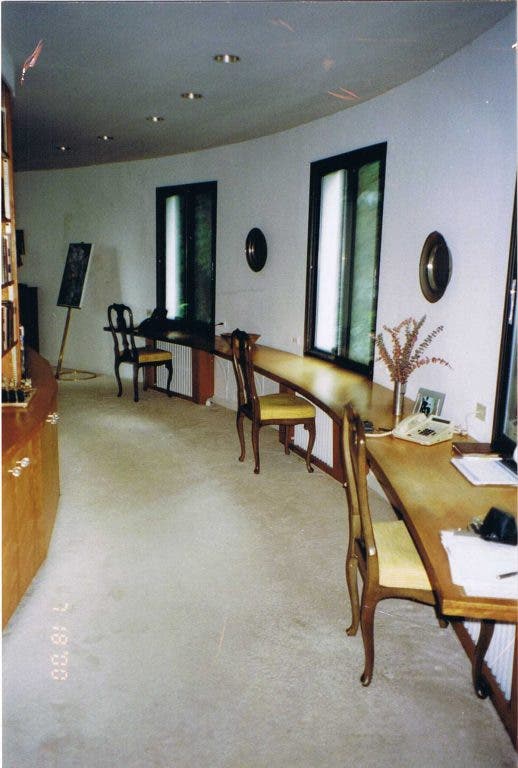


Located on Round Swamp Road between Equestrian Court and Highhold Drive, just south of the line dividing South Huntington and the Half Hollow Hills School District, is the historically landmarked Wallace K. Harrison Estate.
Wallace K. Harrison was a world-renowned architect whose impressive body of work includes the Time Life Building, Rockefeller Center, the master plan for the Lincoln Center of Performing Arts including The Metropolitan Opera House, the United Nations headquarters, the Perisphere and Trylon at the 1939 World’s Fair, and many more.
Harrison purchased 85 acres of land in 1929, and eventually sold off all but 11 acres for his house. While the majority of Long Island North Shore estates were done in the Beaux Arts style, Harrison went in the opposite direction and built a modern masterpiece done in the International style.
Find out what's happening in Half Hollow Hillsfor free with the latest updates from Patch.
According to the Huntington Historic Preservation Commission’s nomination report, “The house exhibits characteristics commonly associated with Modern Architecture including possessing simple geometric forms, flat roof, an emphasis on horizontality, simplified details, white in color and being situated as an object in the landscape.”
According to the description written for the National Register nomination, the estate, “has a rambling one-story flat-roofed concrete main house with a two-story circular living room near the center. The multi-bay residence has bands of windows and sliding glass doors. A raised patio surrounds sections of the dwelling, which follows the contours of the sloping site. A series of grassy ramps lead down from the house’s southwest corner to a large circular swimming pool.”
Find out what's happening in Half Hollow Hillsfor free with the latest updates from Patch.
The report goes to describe the studio as, “a two-story circular concrete studio located north of the main residence. The studio has a flat roof and a projecting entrance pavilion marked by floor-to-ceiling modern, single-pane windows.”
The original construction was completed in 1931. Initially Harrison had to borrow the money to purchase the land, and had little to build a home with, but by 1940 he was able to expand. At the time he added a “second, linear wing with generous bedrooms and baths to the main house,” according to Victoria Newhouse in Wallace K. Harrison, Architect.
Harrison often took work home with him, and by 1950 he, and the draftsmen who accompanied him, had outgrown the converted potato shed that had been serving as a studio. It was then that he built the circular studio building that complemented the design of the main house. (The circular living room in the main house was 32 feet in diameter, the studio 42 feet.)
The estate is the earliest example of International style architecture to be built on the East Coast, and one of the first to be built in America. Harrison, 1895-1981, was one of the leading architects of this style, which was popular from the late 1920s to the mid 1960s.
Harrison’s career began in 1916 in New York City where he worked as a draftsman for one of the most famous architecture firms of the Gilded Age estates, McKim, Mead, and White. In 1919, after serving in the Navy during World War I, he went to Paris to study at the Ecole des Beaux Arts. Returning to New York in 1923, he joined the firm Helme & Corbett, which later evolved into Corbett, Harrison & MacMurray, with whom he designed Rockefeller Center.
In 1941 he formed a new partnership with Max Abramoritz and Andre Fouilhoux. The latter passed away in 1945, and the firm was renamed Harrison & Abramovitz, and they worked together, transforming New York City, until 1979. In 1957, he received the highest honor for an American architect, the Gold Medal of the American Institute of Architects. On May 15, 1958 The Long-Islander reported that, “six homes will be open this year for the Service League’s fourth annual Spring House Tour.” The article goes on to list the Harrison estate as one of two exampled of “modern homes.”
According to the Victoria Newhouse book Wallace K. Harrison, Architect published in 1989 by Rizzoli, his Long Island estate was not just a home for his family, and a weekend workplace, but it was also a social and intellectual center as key figures from the 20th century would frequently visit.
Amongst these visitors and houseguests were Nelson Rockefeller, Robert Moses, LeCorbusier, Chagall, and Leger. Leger, a renowned 20th century artist, lived on the Harrison estate during the majority of World War II, and during this time painted a large mural in the living room and at the bottom of the swimming pool. Similarly, Mary Callery, the sculptor spent much time there and designed three statues specifically for the Harrison estate.
Hester Diamond purchased the estate on March 28, 1974 from the Harrison’s and immediately had it placed on the National Register of Historic Places. In 1984, the house passed ownership again, and during this time was decreased in size to about 3.5 acres, the result of a subdivision filed in 1985, which separated the studio from the main house, and created Laurel View Estates.
When these owners put in the house on the market in 2001, there was grave concern that it would be purchased by a developer for demolition. The New York Times ran an article on March 4, 2001 entitled “Unloved Masterpieces: Modernistic Homes that Critics Praise but Buyers Raze,” discussed this very issue and said that, “the very fact that the house is for sale is making preservationists nervous.”
And so the Town of Huntington Historic Preservation Commission responded. At its Jan. 28, 2002 meeting, the commission voted to recommend to the Town Board the designation of the estate. Though the owners at the time, had had the house on the market for three years, objected to the designation, the town went ahead and chose to protect the endangered estate in June of 2002.
Wallace K. Harrison’s picture appeared on the cover of the September 22, 1952 issue of Time magazine, with the headline: “He builds landmarks.” In light of this, it seems appropriate that the house which he designed and in which he designed the very buildings discussed in this article, was now protected for demolition with local landmark status. The studio unfortunately was no designated and was demolished.
The present owners, who purchased the home in 2003, have been excellent stewards of this historic gem. They have completely restored the house to its former glory. And the restoration was awarded the 2010 American Institute of Architects Long Island Archi Award. Several photographs of the estate as it looks today, as well as the story of it’s restoration can be found here: http://www.archdaily.com/95780/wk-harrison-estate-schappacherwhite/.
This is not the only story to be found on the Wallace K. Harrison Estate. Tune in next week to read the story of the Aluminaire House, a pre-fabricated house that he bought and moved to his property in 1931.