Crime & Safety
Harlem Council Rep Clashes With Community Board Over NYPD Funding
An East Harlem city councilmember is clashing with her community board after questioning calls to defund the NYPD, which the board supports.


EAST HARLEM, NY — Calls to defund the NYPD have caused a clash between East Harlem community board members who back major cuts to the police budget, and a neighborhood councilmember who has openly questioned such calls and suggested they were coming from outside the district.
The controversy, which came to a head last week after the councilmember, Diana Ayala, discussed the issue in a New York Times article, has fueled accusations that both sides are misrepresenting the community's views, and led to frustration with Ayala, who has spoken openly about losing loved ones to gun violence.
In June, following weeks of protests in the neighborhood set off by the killing of George Floyd, Community Board 11 passed a resolution calling for a $1.1 billion cut to the NYPD’s budget for the next fiscal year, one of just a few community boards citywide to do so.
Find out what's happening in Harlemfor free with the latest updates from Patch.
At a board committee meeting earlier that month, Ayala spoke favorably about a $1 billion cut, but cautioned that she couldn’t guarantee what would come out of the council’s negotiations. In the end, Ayala voted for the council’s unpopular 2021 budget, attacked by critics who said it merely reshuffled money without making major cuts to police.
Ayala’s vote disappointed some on the board who expected a fuller cut. Then, on Aug. 10, came the Times article, in which Ayala was quoted claiming that about 60 people from East Harlem had called her office in support of defunding, but “half were white or new to the community.”
Find out what's happening in Harlemfor free with the latest updates from Patch.
The comments touched a nerve for some on the board, who said Ayala had dismissed genuine support for defunding in the neighborhood, as evidenced by protests and the board’s own resolution. Among the critics was Jason Wu, a member of CB11 who was appointed by Ayala in 2018.
“I had called her office to give my position on the defund issue,” Wu, an attorney at the Legal Aid Society, told Patch. “No one asked me about my race, my ties to the community or years of residency.”
I live/work in this community which is why @DianaAyalaNYC appointed me to @ManhattanCB11. I am not white + I grew up in NYC + I'm from an immigrant working class family. I supported the resolution to #defundthepolice. This mischaracterization is troubling. https://t.co/F9S9MwbDaD
— jason wu, esq. (@CriticalRace) August 11, 2020
Board member Andrew Padilla, a journalist and researcher who introduced the resolution on defunding, said in an email that Ayala had “absolutely minimized local support for defundNYPD.”
In an interview, Ayala told Patch that the figure was only an estimate, given in response to a Times reporter’s question about whether support for defunding was widespread in her district.
“If anybody took offense to that, I apologize, because it was not my intent to sound dismissive,” she said. “But I cannot apologize for the fact that the response in the community was not necessarily in favor” of defunding, she added.
To Ayala, significant cuts to the police force are a nonstarter in a district which is grappling with a rise in gun violence. Ayala herself has felt its impact — when she was a teenager expecting her first child, the child’s father was shot and killed. More recently, her son was caught in the crossfire of a shooting in front of his building and nearly hit.
“I don’t want to be in the business of laying off police officers or school safety officers,” she said. “It would be irresponsible for me to pull police officers off the street when I know the challenges we’re facing. Does that mean I’m in favor of police brutality? Absolutely not.”
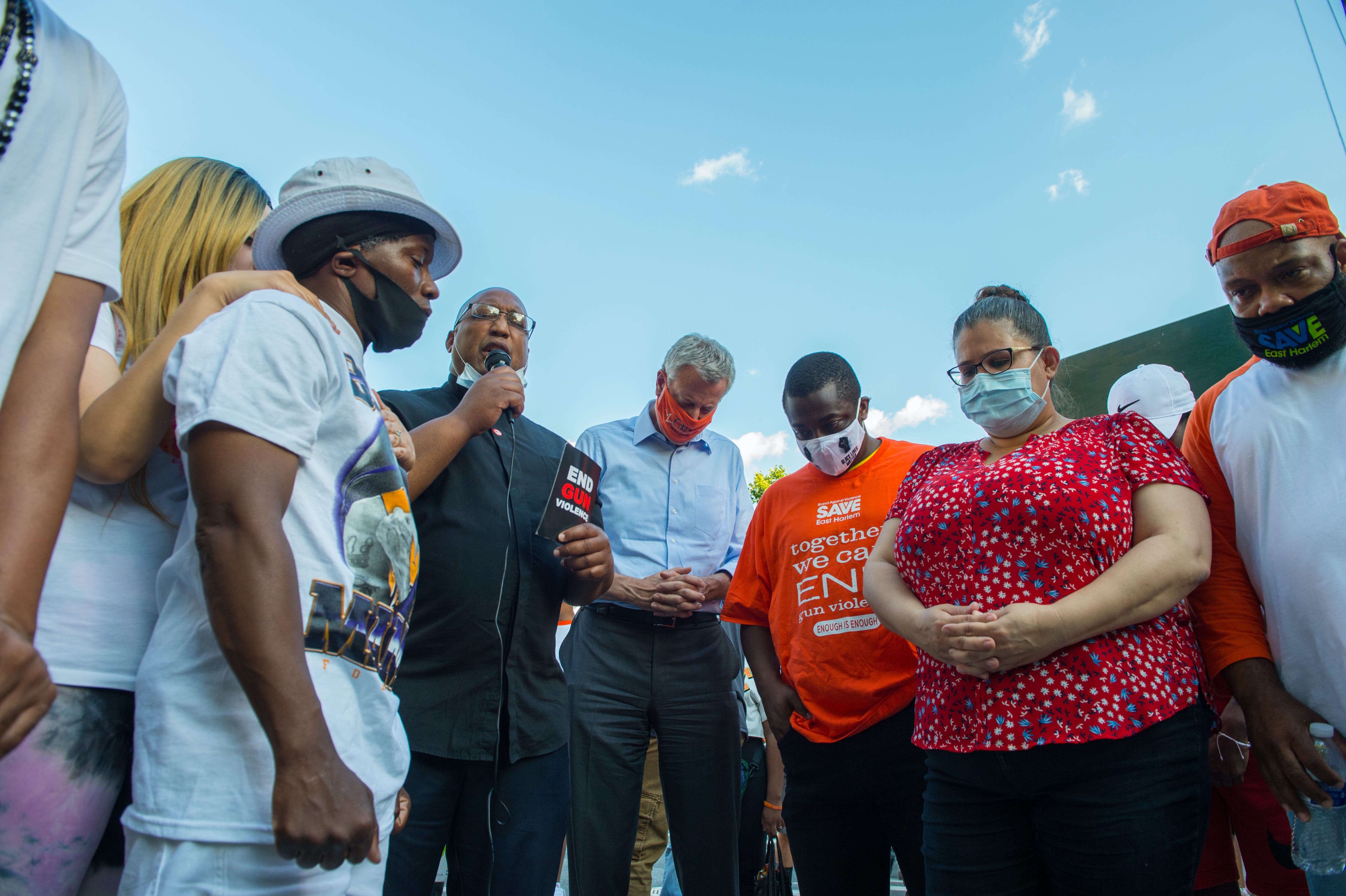
In conversations with local resident association presidents, Ayala said, “not one of them” has expressed support for defunding the NYPD. The board, she argued, had not done a sufficient job engaging the community on the issue.
Some members concede that the board may not fully represent those most likely to have run-ins with the police. Jeremiah Schlotman, an attorney and board member, said CB11 is racially diverse, but also includes growing numbers of young professionals and white members, reflecting the neighborhood’s demographic trends.
“There is probably an overrepresentation of income,” he said.
Both Ayala and the board members agree that cutting the police budget means little unless it is paired with a new investment in social services. Pastor Isaac Scott, an artist and activist who said he is CB11’s only formerly incarcerated member, pointed out that people’s support for defunding depends largely on how the question is put to them.
“There’s not a good job being done in talking about what the money is going to be used to do,” Scott said.
For his part, Wu argued that if more residents did get involved with the community board, it would only reveal more support for a reduction of police presence in the neighborhood.
Wu mentioned a November board meeting in which the board condemned the city’s planned crackdown on subway fare evasion. Several Black and Latino teenagers attended and spoke out against the policing plan, with some sharing anecdotes about negative encounters with the police, Wu recalled.
“They came to this meeting, they spoke up, and then they left,” Wu said. “And I’ve never seen them come back again.”
Get more local news delivered straight to your inbox. Sign up for free Patch newsletters and alerts.