Neighbor News
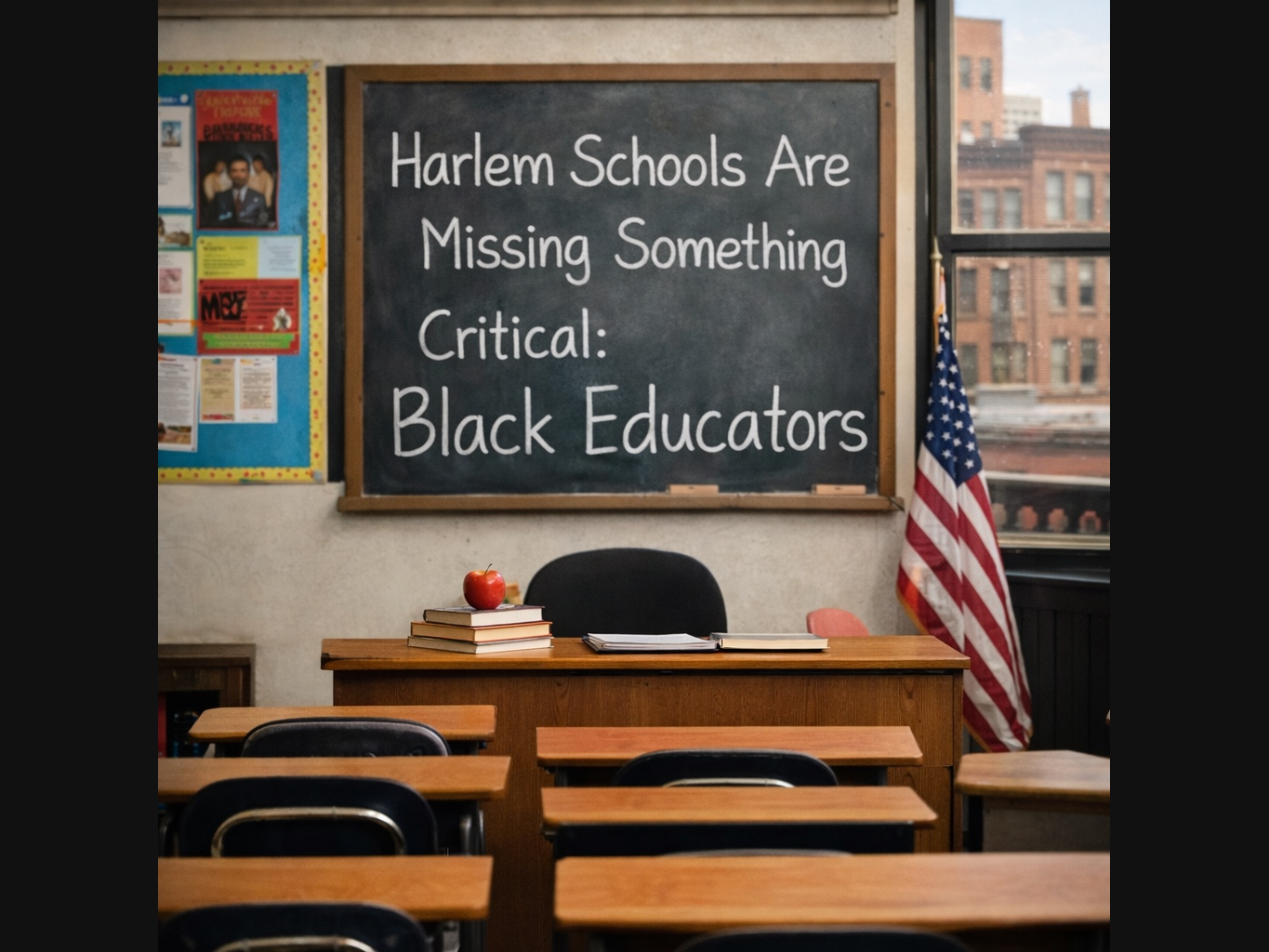
Harlem Schools Need More Black Educators. Our Children Deserve Representation
Harlem Students Deserve Teachers Who Reflect Their Community
The Harlem School Community and the Absence of Black Educator Representation
The Harlem school community is facing a serious and ongoing issue. There is a glaring lack of Black educator representation. This is not an attack on white teachers, nor is it a claim that white educators are incapable of teaching Black and Brown children. Many are dedicated, hardworking, and well intentioned. However, intention alone does not replace cultural understanding, lived experience, or representation.
There is a major deficit of Black educators in Harlem schools, and that absence matters.
Find out what's happening in Harlemfor free with the latest updates from Patch.
Research and lived experience consistently show that student success rates are higher when Black students are taught by Black educators or attend schools where Black educators are present. Studies have found that Black students with at least one Black teacher are more likely to graduate, more likely to be recommended for advanced coursework, and less likely to be suspended or pushed out of school. Representation directly impacts academic outcomes, expectations, and long term opportunity.
Among many Black educators, there has been ongoing discussion about hiring patterns in urban districts and whether systemic practices unintentionally reinforce long standing inequities. When schools in predominantly Black communities are overwhelmingly staffed by educators who do not share the cultural or community background of their students, it can contribute to disconnect, lower expectations, and disproportionate discipline. Over time, these patterns feed into what researchers describe as the school to prison pipeline, where students are suspended, labeled, or pushed out at higher rates rather than supported and redirected.
Find out what's happening in Harlemfor free with the latest updates from Patch.
The issue is not about accusing individual teachers of malicious intent. It is about examining structural outcomes. If year after year Black students are disciplined more harshly, underrepresented in gifted programs, and overrepresented in suspension data, then we must ask hard questions about hiring practices, training, accountability, and cultural competency.
There is also the reality that many families in underserved communities may not always have access to the educational advocacy tools needed to navigate complex school systems. When communication between schools and families lacks cultural understanding or mutual respect, tensions can escalate. Parents may react defensively when they feel unheard, while schools may interpret that defensiveness as hostility rather than advocacy. In that gap, students can become overlooked, misunderstood, or insufficiently supported.
That gap is dangerous.
When educators are disconnected from the community, and when families feel alienated rather than partnered with, children fall through the cracks. Not because they lack ability. Not because their parents do not care. But because the system is not designed with them at the center.
This is not about exclusion. It is about balance, accountability, and equity.
Harlem schools should reflect Harlem. That means intentional recruitment, retention, and leadership pathways for Black educators. It means investing in culturally responsive training that goes beyond buzzwords. It means creating real partnerships with families so that constructive feedback is received as collaboration, not confrontation.
Chancellor Karma Samuels, we hope you step up and lead boldly on this issue. The Harlem community deserves a comprehensive strategy to recruit, support, and retain Black educators in our schools. We need transparency in hiring data. We need measurable goals. We need leadership that understands representation is not political. It is educational equity.
Education does not happen in a vacuum. Schools are extensions of the communities they serve. When the people teaching our children are disconnected from those communities, the system fails. It fails students, families, and the broader neighborhood.
If we are serious about equity, culturally responsive education, and student success, then we must be serious about representation. Harlem’s children deserve educators who understand them not as data points or discipline statistics, but as whole human beings shaped by a rich cultural legacy.
This is not a radical demand. It is a necessary one.