Schools
Literacy Scholar Suggests Ways to Help Non-English Speaking Children Succeed
The Lower Hudson Regional Information Center and Pearson Education teamed up to sponsor a Lunch and Learn opportunity for local ELL teachers

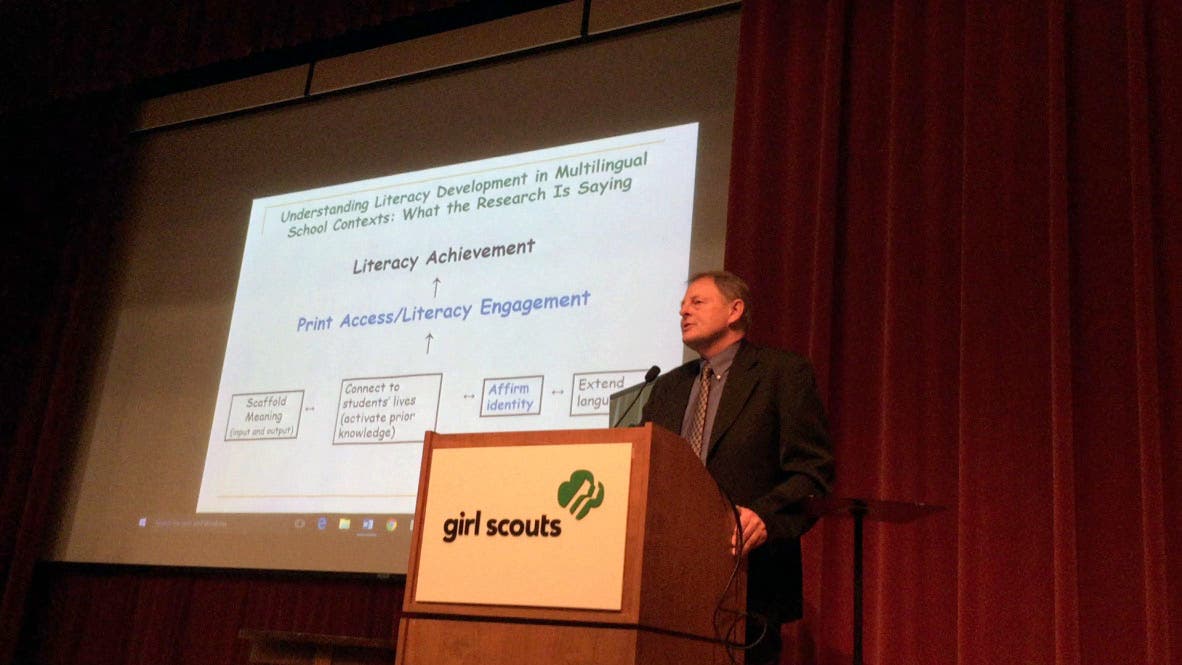
Dr. Jim Cummins, a professor in the department of Curriculum, Teaching and Learning at the University of Toronto, speaks before educators at the Edith Macy Conference Center in Briarcliff Manor.
In an April 1 conference co-sponsored by Pearson Education and the Lower Hudson Regional Information Center, local educators came away with new ways to help English Language Learners succeed in school.
The daylong event included informational sessions on some of Pearson’s innovative literacy software, including its iLit and ReadyGEN digital programs.
Find out what's happening in Harrisonfor free with the latest updates from Patch.
It also included two keynote presentations, one from Dr. Ernest Morrell, director of the Institute for Urban and Minority Education at Teachers College, Columbia University, on ways to get students excited about literacy and how to connect it to their lives, from a social, cultural and digital perspective.
The other keynote was from Dr. Jim Cummins, a professor in the department of Curriculum, Teaching and Learning at the University of Toronto, and one of the world’s leading authorities on bilingual education and second language acquisition.
Find out what's happening in Harrisonfor free with the latest updates from Patch.
In his talk titled, “Reversing Underachievement: Evidence-Based Literacy Instruction for ENLs,” Dr. Cummins said educators must pay attention to literacy research.
“There are huge gaps between what the research is saying and the way it is being interpreted,” he noted.
Dr. Cummins said the majority of ELL instruction is based on education policies that are “problematic” and that are not addressing the real needs of ELL students.
In addition to education policies that have largely ignored literacy research, Dr. Cummins said other factors have contributed to underachievement among the ELL population.
They include the attitudes and beliefs of some teachers and administrators toward immigrant children, their low expectations of such students, a lack of understanding of different cultures, and a curriculum that does not take into account the experiences and contributions of a predominantly minority group.
What Dr. Cummins has found is that literacy engagement is key to helping ELL students succeed and develop the appropriate reading comprehension skills. Unfortunately, policymakers have largely ignored such evidence, he said.
“Sticking one’s head in the ground and ignoring the research is why we haven’t made more progress,” he added.
Expecting ELL students to be proficient in a new language after a year or two and then take a standardized test is unrealistic, he said. Most of the research suggests that it takes at least five years of instruction before a student becomes a proficient speaker of any new language, he noted.
Dr. Cummins said that teachers need to focus first on conversational fluency, which is the student’s ability to carry on a conversation in familiar face-to-face situations, and then introduce more complex academic language through the reading of either print or digital books.
The current crop of academic texts that non-English speaking students are expected to grasp is too difficult for them, Dr. Cummins said, which often leaves them frustrated and disinterested.
“If academic language is found primarily in books, then extensive reading is important for those students to catch up,” he noted.
Dr. Cummins suggested that teachers use a scaffold reading approach, using material that will connect to students’ lives and value the experiences they bring into the classroom.
Reading can make a huge difference to an ELL student’s life, he said. A study conducted by the Organization for Economic Cooperation Development found that the best indicator of a student’s literacy performance was reflected not in his or her socioeconomic background, but in that student’s interest in reading.
Dr. Cummins shared several examples of innovative literacy instruction in the Toronto Public Schools that could be duplicated in any other school district.
One social studies project on immigration gave three seventh-grade students from Pakistan the opportunity to create a 20-page bilingual book in both English and Urdu, while a similar project from a sixth-grade Israeli student helped to educate teachers and other students on the differences in Israeli society.
“Linking literacy with identity is crucial,” said Dr. Cummins. “We haven’t done that in the past. Instead, we have gone off on an evidence-free trajectory. If we bring it back, however, I think we will see massive results in terms of students being able to showcase their talents.”