Schools
SWBOCES Nursing Students Learn from Domestic Violence Workshop
Valuable Workshop Teaches SWBOCES Students How to Spot the Signs of Domestic Violence

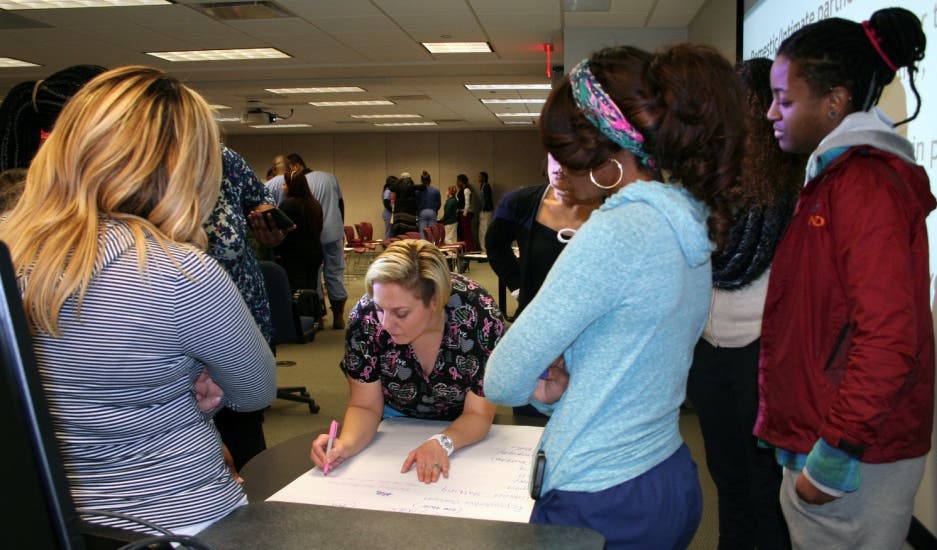
Learning how to spot the signs of domestic abuse in a hospital setting, provide the appropriate medical care and then accurately document the evidence were some of the important lessons that nursing students from the SWBOCES Licensed Practical Nursing Program learned at a special presentation Feb. 3.
The interactive two-hour presentation, which was held at the BOCES offices in Harrison, was given by Kymberly McNair, a training coordinator for My Sister’s Place.
The agency provides confidential emergency shelter and transition-to-permanent housing for abused men, women and children.
Find out what's happening in Harrisonfor free with the latest updates from Patch.
“Healthcare providers are often the first and/or the only ones to have contact with victims and as such they have the unique opportunity to help break the cycle of violence in our communities,” said Ms. McNair, who provides training on the subject of domestic violence to healthcare providers, law enforcement agencies, colleges and religious communities.
The presentation was intended to make the students aware of the role that nurses can play in the crucial care of such patients.
Find out what's happening in Harrisonfor free with the latest updates from Patch.
Prevalent in communities of all races and income levels, Ms. McNair said domestic violence is a problem that is largely misunderstood. While many people have difficulty understanding why a victim would stay with his or her abuser, Ms. McNair reminded the students of the financial difficulty alone that many face when trying to escape such abuse.
Ms. McNair said that most women who are abused will try at least seven to 14 times before eventually leaving an abusive partner. While a lot of abuse is physical, Ms. McNair said many victims are also subject to psychological and emotional abuse.
A half hour into the presentation, she asked students to break up into groups and to rotate through several stations that were set up around the room. On large white poster boards, students were expected to come up with words to describe the different types of emotional, financial, physical, sexual, spiritual and verbal abuse that both men and women can be subjected to.
She discouraged them from writing obvious words like spitting, hitting, kicking and punching. “Those are the things you might hear about on an episode of “Law and Order,” said Ms. McNair. Other physical abuse tactics that are not so typical include malnutrition, isolation and exposure to cold, she added.
Statistics say that one in four women will find themselves in an abusive relationship, which is why proper screening is so important, she noted.
Obstacles to a successful screening include a patient’s reluctance to talk about the abuse, fear of reprisal from a partner, the lack of privacy in an emergency room setting and the degree to which the patients feels comfortable with a nurse.
“Be ethically and professionally nosy,” said Ms. McNair, adding that it’s important that the nurse learn and follow a hospital’s policy in such matters. “Don’t ever say, ‘I know how you feel’ to a patient, because each victim’s experience is unique, nor should you call the police thinking you are helping unless it is required by hospital policy,” she added.
The BOCES LPN Program offers classes in nursing theory, anatomy, medical/surgical nursing, pediatrics, obstetrics and the administration of medication, as well as clinical experience in hospitals, schools and skilled nursing facilities.
A full-time, 10-month accelerated day program is offered, in addition to a part-time 20-month day and evening program. Students who complete the program earn a practical nursing license by passing the National Council Licensing Practical Nursing exam (NCLEX).