Health & Fitness
Huntington Hospital Performs First Spinal Surgery on Long Island with New Imaging System
The hospital is the first to use this technology that helps improve accuracy and reduce radiation exposure.

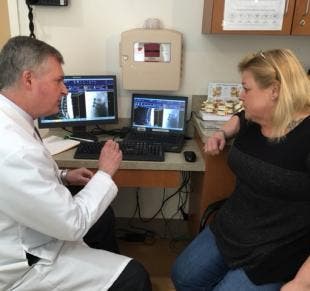
Evelyn Pretty, 48, a retail assistant store manager from Northport is the first patient on Long Island to benefit from Medtronic’s O-arm intraoperative surgical imaging system to treat her prolonged lower back pain and lumbar sciatica, which she suffered from for the past thirteen years.
Huntington Hospital is the first center on Long Island to use the O-arm technology. The procedure on Ms. Pretty was recently performed by Robert Kerr, MD, PhD., the hospital’s chief of neurosurgery.
“Ms. Pretty suffered from severe lower back pain and sciatica for many years and all range of motion activities was very limited,” said Dr. Kerr. “This made it difficult in her work environment where she had to be on her feet most of the day. Since conservative pain management treatment and epidural steroid injections were not successful, surgery was a viable option. Upon reviewing her magnetic resonance imaging (MRI) scans, it was determined that Ms. Pretty suffered from severe degenerative disc disease and spondylosis, a spinal degeneration accompanied by pain. She required decompression and spinal fusion surgery, utilizing the O-arm intraoperative surgical imaging system, in conjunction with the latest StealthStation surgical navigation system.”
Find out what's happening in Huntingtonfor free with the latest updates from Patch.
“The day after surgery, I was up and walking,” said Ms. Pretty. “For the first time in years, I did not have the usual back pain anymore. I received excellent care from the entire staff at Huntington Hospital. After a full recovery, I am so looking forward to being able to wake up in the morning and not be in constant pain!”
The O-arm performs a 15-20 second scan sequence that generates a 3-dimensional (3D) computer model of the spine. During the operation, the neurosurgeon refers to the monitors which provides real-time verification of the location of surgical tools and implants with sub-millimeter accuracy.
Find out what's happening in Huntingtonfor free with the latest updates from Patch.
“When you have to place a stabilizing screw into the spine and it passes within millimeters of the spinal cord, nerve root, or vital arteries, there is no substitute for the kind of accuracy the O-arm provides to a neurosurgeon,” said Dr. Kerr.
In addition to increased surgical accuracy, there are several other advantages of the O-arm intraoperative surgical imaging system:
· Virtually eliminates radiation exposure with a single scan as opposed to traditional spinal surgery, which exposes significant amounts of radiation to the patient and surgical team during fluoroscopic x-ray imaging.
·Allows for the neurosurgeon to take advantage of the 3D modeling to place a virtual screw or other implant and determine the ideal size and trajectory before anything is placed in the patient.
·Provides increased efficiency resulting in shorter anesthetics.
·Reduces risk of needing revision or second surgery.
Patients who can benefit from the O-arm technology include those suffering from spinal trauma, degenerative spondylosis, complex scoliosis, or tumors of the spine.