

I had my first full meal since arriving in India, having dined on Air France meals up until now. Say what you want about airline food but as in all things cuisine, the French know how to do it even when it’s served in plastic dishes with tin foil wrappers.
For my first day of site seeing, my first destination was the hotel’s Sunday brunch. Now, you might be saying this is hardly eating local but I at least elected to dine in the Indian restaurant. And as the rest of the day went, I was about the only Westerner to be seen even in this posh dining room with piped in jazz and pop. I think that the all-Indian staff appreciated my interest in its cuisine and my eagerness to taste new things. A few special dishes were brought out to me by the chef and maître de patiently who patiently explained to me in their heavily-accented English not only what I was eating but how to eat it in order to maximize its savory taste. It seemed to work since I practically had to be rolled out in a wheel barrel, not due to indigestion but to gluttony!
Speaking of wheel barrels, I am determined to travel through India to have as much contact with the locals as possible and so I took my second auto rickshaw ride. Imagine mounting a passenger seat to the wheel barrel’s handles. Now partially encapsulate the wheel barrel with a roof that cascades to the backside and either side of the backseat of the rickshaw providing a minimal amount of protection from the elements, other motorists and the occasional panhandler. Add to the “wheel barrel” a powerful motor, a few safety lights, brakes that have to respond on a dime, and a horizontal metal rod that doubles as a separator between the passenger and the always barefoot driver and a safety grip for what is usually a white-knuckling ride. Forget about shock absorbers. Now head off on the first cobblestone road that you can find and you’ll get a sense of what it’s like to ride in these amazingly efficient little tin cans.
Find out what's happening in Larchmont-Mamaroneckfor free with the latest updates from Patch.
My first site-seeing destinations were Haji Ali, a mosque that “floats” on an island in the Arabian Sea, and Mahalaxmi Temple, dedicated to the Hindu goddess of wealth and where I was anointed by a holy man who also wrapped a red and yellow prayer ribbon around my wrist, called a “mauli” which, among other explanations, is to bring me good fortune.
En route, I was able to take several photographs while still being sensitive not to overtly intrude the privacy of the throngs of people surrounding me. For example, it amazed me to see entire families riding upon a single motor scooter. A toddler is often sandwiched between the father, almost always the driver and the only one usually wearing a helmet as required by law, and the sari-clad mother riding side-saddle. Sometimes slightly older children will be wedged between the father and the windshield, about the only protection these scooters offer. I have also seen families of four with more grown children bunched together on a single scooter. Who needs an SUV?
Find out what's happening in Larchmont-Mamaroneckfor free with the latest updates from Patch.
At some point auto rickshaws are not allowed to venture into parts of Mumbai on account of even greater traffic and pedestrian congestion, I assume, and so I had to transfer to a cab for the final leg of my journey. Mumbai cabs are not New York cabs. If you’re old enough to remember the Checker cab, imagine a much smaller version of it painted black and oftentimes decorated with various religious or cultural symbols. The interiors are sometimes upholstered in brightly-patterned fabric and the roofs are lined in a bold flower pattern with the look and feel of oil cloth. My Hindi-speaking driver pointed me to what I THOUGHT was the cue for Haji Ali. This was my primary destination since I had just about an hour or so to visit the island mosque before high tide would come in and lap over the causeway that connects it to the mainland. It is named in honor of the Muslim saint Pir Haji Ali Shah Bukhari. According to the lonely planet guide book, “legend has it that Haji Ali died while on pilgrimage to Mecca and his casket miraculously floated back to this spot.”
I was the ONLY westerner, alas, the only white or even light-skinned person and probably the only Hindi-illiterate speaking person out of the hundreds of worshipers lined up for what ultimately would be a fleeting glimpse of the shrine. Each day in India I am further reminded what it must be like to me a minority.
Being “Mr. GPS-not”, it was only after that I made it to the shrine that I realized I was in a queue for what was to be my second destination and not the island mosque! How could I have made such a mistake? How you expect me to pick up even a few words in Hindi when I barely made it through high school French and adult ed Spanish?
The slow procession to the shrine of Mahalaxmi queues up on the sidewalk and is orderly and civilized, women in one line and men in another. Upon entering a crowded courtyard, in rapid Hindi and universal arm gestures, I was told to put away my camera and take off my shoes. I suggested that I might just put my shoes in my backpack but it was abundantly clear that this was not an option. I turned over my brand new $90 (on sale) sneakers to one of the many “shoe check” people sitting alongside the line of the faithful. He tied then together with an old rag and I tried to shed my concern that I might be shoeless afterwards. It was only after I advanced a bit in the line that I realized I also need to get a receipt for my shoes if I wanted to reclaim them on my way out!
Although everyone around me was either barefoot or in sandals, apparently the only allowable foot ware, I was allowed to keep on my gold-toe socks. Ya think this might have added to my standing out in the crowd? Having a bit of a hang-up about my own not-so-pretty toenails, I observed a lot of different size, shaped and “compromised” feet with cracked and crusty toe nails. I admired the fact that no one else apparently shared my westerner’s hang up about the appearance of my feet.
But my focus was not just on feet! I tried to absorb as much of my surrounding environment, as possible, from the harmony of color and crystals of the saree-clad women to the various religious trinkets, flowers and street food available for purchase from the jam of vendor stalls lining the courtyard. Up to this point I have resisted buying anything that will add weight to my already bulging and minimal luggage of just one modest-size suitcase and a backpack.
Imagine being sandwiched into a crowded New York City subway with other riders primarily interested in getting to work or school or to the theatre before curtain. Most Westerners try to respect another person’s “space”, avoiding bodily contact and apologizing when we brush up against someone more intimately than either one of us might want or care to be. Now transfer this scene to the long wait for a fleeting glimpse of the shrine to Mahalaxmi (previewed, by the way, on a flat-screen monitor). Unexpectedly I would feel a hand against my shoulder or back that had no intention of moving away. Although my instinct was to recoil, I perhaps naively assumed that my fellow faithful making uninvited body contact with me was here for spiritual reasons, not to pickpocket, and that this close encounter amounted to nothing more than a pent-up desire to pay homage to Mahalaxmi.
As we approached a ramp that ultimately lead to the alter, I spotted two long troughs labeled in Hindi and English as being “drinking water”, admonishing the thirsty not to use them as spittoons. This seemed to be respected. Less obeyed were the “silence” signs, also both in Hindi and English. None of the faithful heeded this command! There was too much excitement to remain silent as we neared the end of our pilgrimage. Occasionally the bare-chested men in saffron robes accepting the pilgrim’s offerings would let out a chant to which the crowd would respond. There was also a loudly-clanging bell, similar to what you might find as a quaint touch aboard a luxury yacht or sail boat anchored in the Mamaroneck harbor, that people would reach out to give a good yank, perhaps to alert Mahalaxmi that we had arrived. Crowd-control security guards (they were allowed to keep on their shoes, I noticed), barked orders which either advanced the crowd, redirected the men to the women’s line as there were more of us than them, or ordered us to stop to allow the throng of people in front us to thin out.
I don’t know how long I stood in line to get a glimpse of the shrine but the real experience for me as a non-Hindu was everything that lead up to this moment. I tried to imagine transporting all of these people to St. Patrick’s Cathedral or St. John the Divine in New York. Besides being houses of worship, both are also major destinations for tourists from all over the world. Most probably don’t come to worship and are oblivious to any on-going service. Instead, they’re snapping away their cameras and all have kept on their shoes! Having finally reached our destination, the crowd almost immediately dissipates although some continue to pray on the sidelines. I noticed a mountain of plastic bags filled with what I assumed were offerings of the pilgrims that surpassed what the altar could hold. One woman kissed her fingertips and touched one of the plastic bags and its mystery-to-me contents.
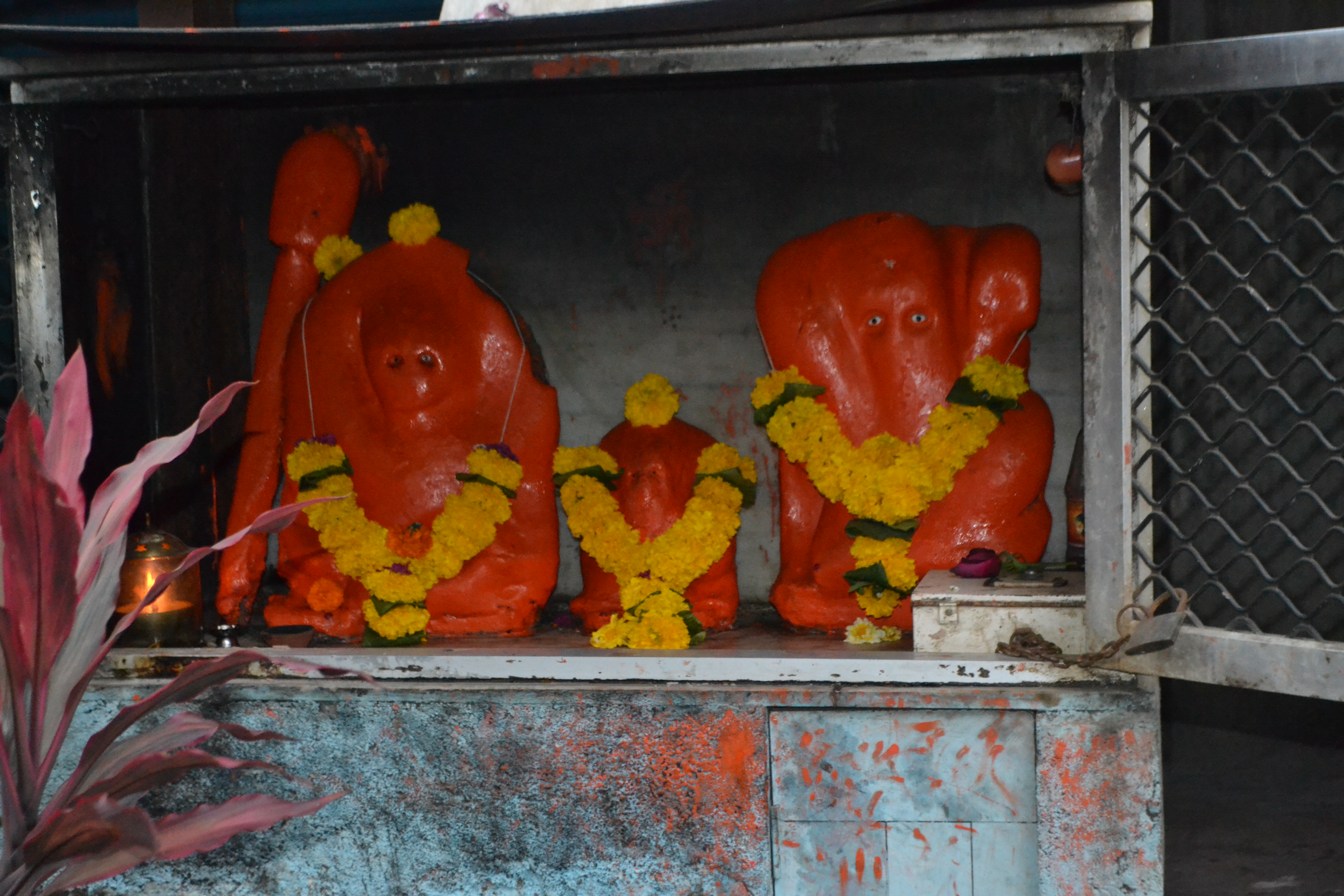
I lingered a bit on my way out, stopping for my prayer band and anointment. I looked at some garlands of various religious symbols (I assume) but took a pass, choosing not to haggle on the price – an Indian art form at which I have started to become quite adept. I also noticed several “Nazi” swastikas, including a blinking neon light config. I know enough about Hitler-era Germany to know that this icon attributed to the 20-century’s original evil empire actually had its roots in Eastern religion. For Hindis, the swastika is most commonly used as a charm to bring good luck and fortune. Exiting the shrine I came upon my first holy cow – literally. It stood patiently alongside a vendor who was maybe a human relative. Who knows? I say this in all due respect as Western religions have a lot of their own comparatively strange beliefs and practices. Believers stopped reverently to touch the animal or give it fingertip kisses. Probably inappropriately, I chose to just snap a photo.
Speaking of taking pictures, just prior to my arrival in India the country’s parliament voted to designate homosexuality as illegal. Therefore I was surprised to see two young men openly walking hand-in-hand along the promenade embracing the Adrian Sea. Again, I discretely snapped a photo from behind of just their clasped hands. My apologies but I wanted to record their bravery. But were they Gay and brave or just two male friends in a society where the human touch between the same sexes amounts to nothing more than a platonic form of affection and friendship?
I was so delighted to receive a response to my first posting from a former student of mine, Zankhana, who is Indian and for whom I have fond memories. She wrote in acceptable facebook shorthand: "I wish u get to see all the better part of the country along with the sad!!!! That's the beauty of India."
Zankhana, I think I am seeing the true beauty of India by freely and willingly mingling with ordinary people, no different or less than I, who define both old and modern-day India. It was moments like the ones that I experienced during my first day as a tourist that I hope to retain the rest of my life and to share with my American friends through these postings. Anyone can get a photo