Crime & Safety
Hold On To Your Bag, Purse Patrol Is On the Prowl
People's United Bank had their Purse Patrol at the A&P in Mamaroneck yesterday.


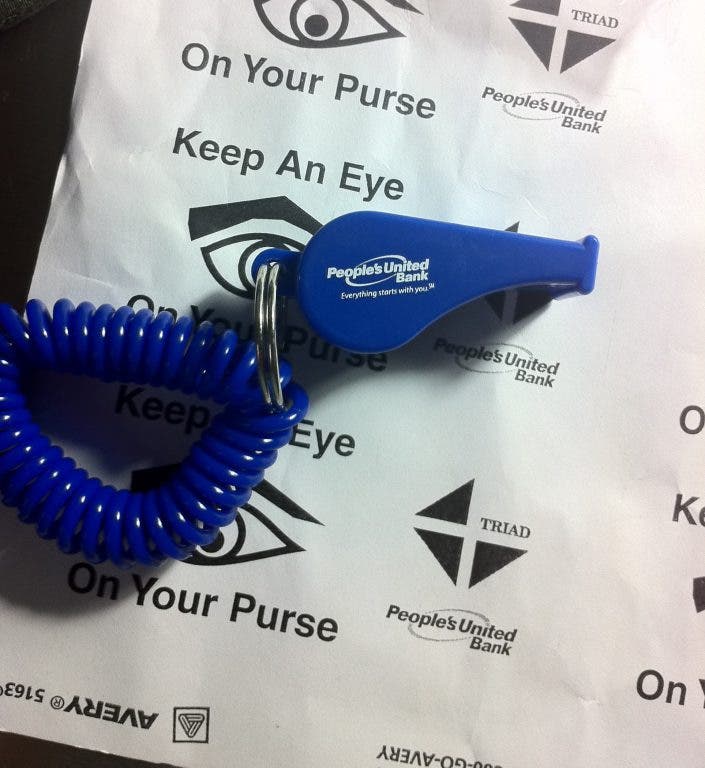


Unsuspecting shoppers were the targets of Sergeant Regan Kelly of the Village of Mamaroneck Police Department yesterday afternoon as they browsed the aisles of A&P in Mamaroneck. As people turned to pick up produce or glance at the ingredients of a box on a shelf, Kelly placed a “Keep an eye on your purse” sticker on the unattended bag, to remind patrons that it only takes a second for your purse and identity to be stolen.
The “Purse Patrol” is part of the Masters Program at People’s United Bank; a program started in 1996 that’s dedicated to helping protect seniors from financial harm and was one of the first of its kind. The program provides educational programs, seminars, events and training about safety issues in the communities the bank serves.
Masters Program Coordinator and 2010 winner of the FBI Director’s Community Leadership Award Angela DeLeon, trains staff to see signs of financial fraud.
Find out what's happening in Larchmont-Mamaroneckfor free with the latest updates from Patch.
Seniors, a particularly vulnerable population, can be victim to e-mail and phone scams that target the elderly. Recently, a patron of the United Bank in Mamaroneck sent $20,000 in checks to an unknown recipient in the hope of redeeming money for a “lottery” he won. Bank personnel were able to recognize the account activity as abnormal, and put stop payments on all the checks, resulting in no loss to the patron, said Branch Manager Paula Saraiva.
Sylvia Martin, a Mamaroneck resident who had her purse “swiped” by Kelly, said that she didn’t notice the sticker until it was too late.
Find out what's happening in Larchmont-Mamaroneckfor free with the latest updates from Patch.
“I didn’t see him—I was looking at the bananas,” she said, continuing, “Usually, I’m vigilant.”
DeLeon stresses the importance of being aware of your surroundings at all times.
“Criminals pick their prey,” she said, continuing, “They will watch someone in the parking lot that is not paying attention,” the profile of a typical crime victim.
And, perhaps more frightening than simply having your purse stolen, is the far more ominous and ambiguous threat of having your identity taken.
“Someone can assume your identity,” cautions DeLeon, who also warns that thieves can let themselves into your home as well.
According to the U.S. Department of Justice Community Oriented Policing Services (COPS) site, between 20-60 percent of adult Americans report being a victim of fraud. Additionally, in 2000 the U.S. Senate Special Committee on Aging reported $40 billion in losses to telemarketing fraud.
The FBI has tips on how to avoid telemarketing fraud, one of the more common crimes perpetuated on the elderly:
- Don't buy from an unfamiliar company. Legitimate businesses understand that you want more information about their company and are happy to comply.
- Always ask for and wait until you receive written material about any offer or charity. If you get brochures about costly investments, ask someone whose financial advice you trust to review them. But, unfortunately, beware—not everything written down is true.
- Always check out unfamiliar companies with your local consumer protection agency, Better Business Bureau, state attorney general, the National Fraud Information Center, or other watchdog groups. Unfortunately, not all bad businesses can be identified through these organizations.
- Obtain a salesperson's name, business identity, telephone number, street address, mailing address, and business license number before you transact business. Some con artists give out false names, telephone numbers, addresses, and business license numbers. Verify the accuracy of these items.
- Before you give money to a charity or make an investment, find out what percentage of the money is paid in commissions and what percentage actually goes to the charity or investment.
- Before you send money, ask yourself a simple question. "What guarantee do I really have that this solicitor will use my money in the manner we agreed upon?"
- Don’t pay in advance for services. Pay services only after they are delivered.
- Be wary of companies that want to send a messenger to your home to pick up money, claiming it is part of their service to you. In reality, they are taking your money without leaving any trace of who they are or where they can be reached.
- Always take your time making a decision. Legitimate companies won't pressure you to make a snap decision.
- Don't pay for a "free prize." If a caller tells you the payment is for taxes, he or she is violating federal law.
- Before you receive your next sales pitch, decide what your limits are—the kinds of financialinformation you will and won't give out on the telephone.
- Be sure to talk over big investments offered by telephone salespeople with a trusted friend, family member, or financial advisor. It's never rude to wait and think about an offer.
- Never respond to an offer you don't understand thoroughly.
- Never send money or give out personal information such as credit card numbers and expiration dates, bank account numbers, dates of birth, or social security numbers to unfamiliar companies or unknown persons.
- Be aware that your personal information is often brokered to telemarketers through third parties.
- If you have been victimized once, be wary of persons who call offering to help you recover your losses for a fee paid in advance.
- If you have information about a fraud, report it to state, local, or federal law enforcement agencies.
Get more local news delivered straight to your inbox. Sign up for free Patch newsletters and alerts.