Crime & Safety
In Rain or Snow, Avoid the Slippery Road; Take US 1
When driving past Exit 18 A on I-95, both on the southbound and northbound sides of the highway, heed these warnings.
Driver beware. If it is raining or snowing, driving to or from Mamaroneck on I-95 can be hazardous to your health.
Of course, anywhere you drive in inclement weather can increase your chances of getting into a car accident. Such conditions require a driver to operate with caution and reduce speed. But heeding these warnings is of particular importance at Exit 18 A on I-95, both on the southbound and northbound sides of the highway.
At issue is the surface of the curved roadway, according to Village of Mamaroneck Fire Chief Dean DeLitta. He explained that when the New York State Thruway Authority (NYSTA) resurfaced the highway some years ago, concrete was used instead of blacktop. "When they put down the concrete, the road got noisier and the community complained," DeLitta said. "But instead of putting down blacktop again, they did diamond grinding, which cut grooves into the road and that was supposed to quiet things down.
Find out what's happening in Larchmont-Mamaroneckfor free with the latest updates from Patch.
"Eventually, the diamond grinding wore down, creating a smooth surface," DeLitta continued. "Every time it rained, the stone would become shiny and slick and we started getting all the accidents."
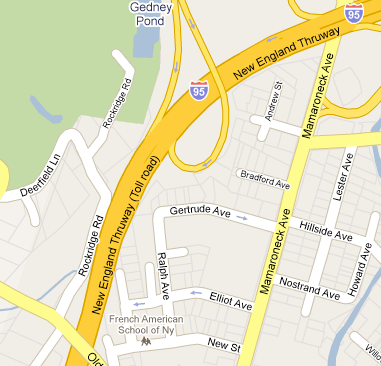
The area at issue is from mile marker 9.5 to mile marker 10.0, a stretch of curving roadway from Mamaroneck Avenue down to Old White Plains Road. Mile marker 9.8, in the middle of the curve, has been particularly dangerous. There is an identical curve on the northbound side of I-95.
Find out what's happening in Larchmont-Mamaroneckfor free with the latest updates from Patch.
According to statistics obtained through the New York State Freedom of Information Law (FOIL) from the Thruway Authority, 12 accidents took place at mile marker 9.8 on both the southbound and northbound sides of I-95 in 2008; that number nearly doubled (22) in 2009. In 2008, 75 percent of those accidents took place on the southbound side, and the vast majority (10 out of 12) happened when the road was wet. In 2009, 19 out of 22 accidents at mile marker 9.8 also took place southbound; 14 of those occurred when the road was wet. The accidents at this one spot were a direct result of the more severe deterioration of the road surface on the southbound side that was worn smooth, combined with the road's curve.
But those accidents were just a fraction of what has been happening on the highway, from mile marker 9.5 to 10 and south toward the New Rochelle toll booths. "In the month of October last year, the VMFD was called to the scene of an accident in that area 19 times," DeLitta said. "And we only get called if there is an accident with injuries or if there are fluids leaking onto the roadway. It got to the point that every time it rained, we knew we were heading up there."
According to DeLitta, the VMFD, as well as state police, put pressure on the NYSTA to fix the problem. The NYSTA responded that they would do a long term study to determine what course of action to take. But with so many accidents taking place, DeLitta felt that wasn't good enough.
On one day in October, there were two separate accidents that took place at mile marker 9.8 within an hour of each other. On another day, two tractor trailers collided, spilling diesel fuel on the roadway.
"[We] told them they don't need to do a study, they just needed to come out here with their boots on and try to walk on this," DeLitta stated.
As a result of the "feet on" experience, the NYSTA laid down a coating of pavement at the 9.8 mile marker trouble spot, just before Thanksgiving. "The accidents dropped dramatically, [seemingly] overnight," DeLitta noted.
While happy with that outcome, DeLitta said there are other issues with which to contend. "They didn't do the northbound side, and there are still problems there because of the way the road is pitched," he said. "We still go to a lot of calls up on the thruway. We worry about the rest of the road where the concrete will continue to wear out." The VMFD covers accidents up to the New Rochelle toll barrier.
According to Dan Sarnoff, Mamaroneck's assistant village manager, "It is our understanding that the Thruway Authority is going to repair the northbound side of I-95," but he did not expect much to happen until the warmer months.
He noted that because the roadway is owned by the NYSTA, the VOM is not in a position to demand a time line for repair projects. No formal requests have been submitted, he believes, but multiple conversations have taken place. "That's how it usually works," he explained. "We've had verbal assurances that the repairs will be made, hopefully in the coming spring and summer. The State has already made positive steps fixing one side of the road, and we fully expect them to carry through on the other side in short order."
The NYSTA did not respond to a request to be interviewed for this story.
"The Thruway Authority is looking proactively at the rest of the road, but they need to be on top of it quicker" Chief DeLitta said. "We shouldn't have to have months of multiple accidents before something is done about it."