Health & Fitness
Summit Panel Discusses Health Care Issues of Larchmont-Mamaroneck
Three local health care experts speak about the best ways to keep the entire community healthy.
By Nina Recio Cuddy
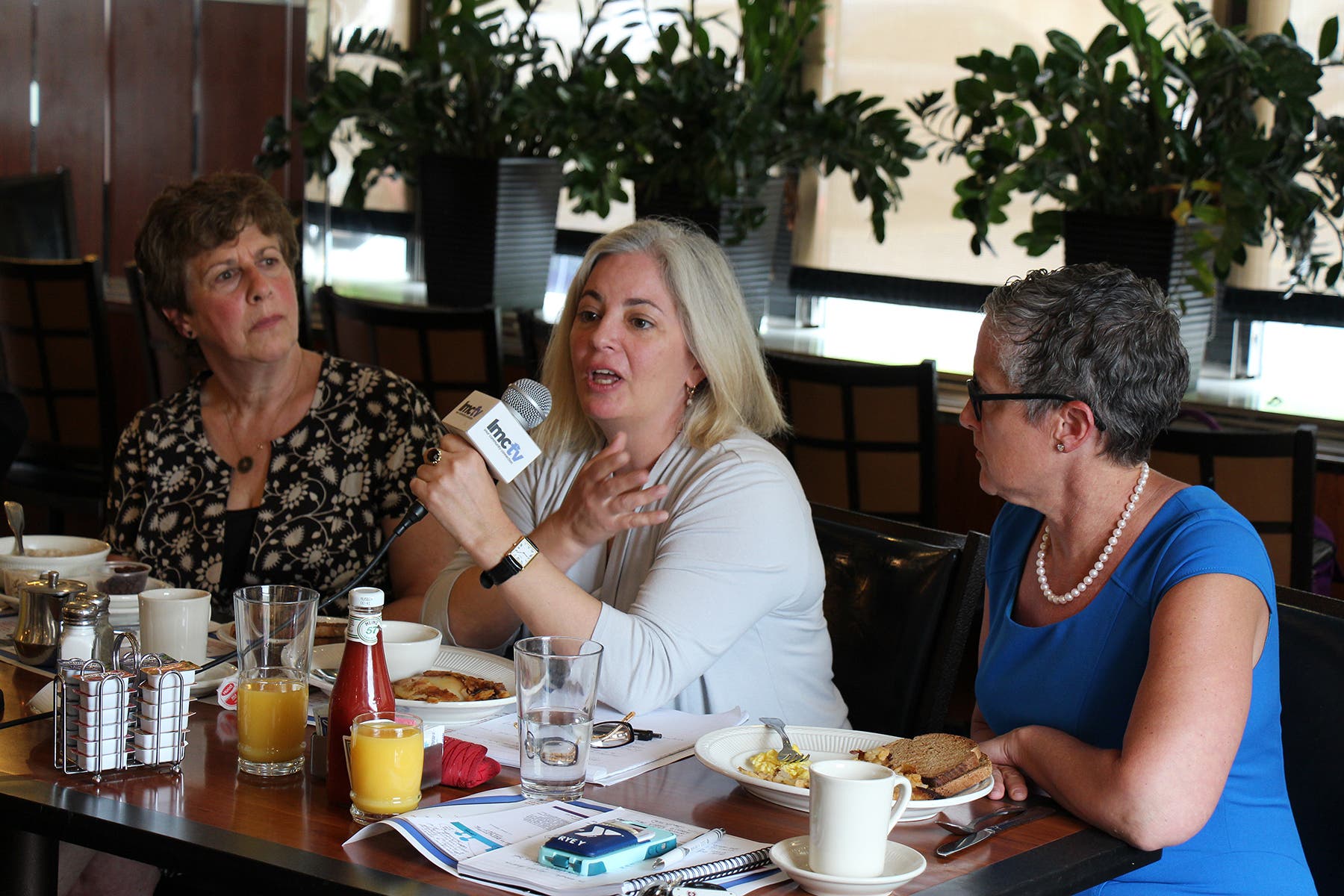
At its monthly breakfast program held on May 12 at the Nautilus Diner, the Local Summit focused on the general health concerns and challenges of the Larchmont-Mamaroneck community by presenting a panel of three local health care experts to speak about the best ways to keep the entire community healthy.
The three panelists were Lisa Perry, Larchmont resident and Senior Vice President, Quality and Technology Initiatives for the Community Health Care Association of New York State, Laura Rossi, Senior Program Officer for the Westchester Community Foundation, and Laura Tiedge, Senior Director of Healthy Living at the Rye YMCA.
Find out what's happening in Larchmont-Mamaroneckfor free with the latest updates from Patch.
“Our district enjoys relatively high health status,” stated panelist Lisa Perry, but she added, “there are differences in the health data within the two ZIPs.”
The “two ZIPs” she referenced represent the two ZIP codes for the communities of Larchmont (10538) and Mamaroneck (10543). Perry stated that, while there are many health and wellness issues shared by residents of the two ZIP codes, the local demographic differences and social disparities between the two, as documented in the 2010 census data and recent New York State health data, create different health concerns that may require different solutions.
Find out what's happening in Larchmont-Mamaroneckfor free with the latest updates from Patch.
Elaborating further on the disparity between the ZIP codes, Perry explained that, as compared to 10538, “the residents of 10543 are three times as likely to be uninsured, twice as likely to have limited English proficiency, four times as likely to lack a high school diploma, and twice as likely to live in a household with under $15,000 in annual income.”
There are other health-related disparities as well, including the limited access to prenatal care within 10543 and the significantly higher pregnancy rates among teens living in that ZIP code. Perry reported that women in ZIP code 10543 are twice as likely to get late or no pre-natal care. Residents of ZIP code 10543 are also more likely to be on Medicaid or have no insurance. Also of concern is how children in that same ZIP code are three times as likely to visit an emergency room for asthma-related issues, although, panelist Laura Rossi from the Westchester Community Foundation, pointed out that asthma is the most frequent cause of pediatric ER visits within the County.
Given the social disparities between the two ZIP codes and in health care access for some residents, the panel’s discussion turned towards the question confronting the Larchmont-Mamaroneck community of whether to open a community health center in Mamaroneck Village and, or, a school-based health center within the Mamaroneck Avenue School.
Perry described the work of community health centers, particularly federally-qualified community health centers, noting that such centers were established in 1965 as part of President Lyndon Johnson’s War on Poverty. Perry explained that a community health center, whether federally qualified or not, is intended to provide an array of primary care services to residents within a community. If the center is federally-qualified, then it must also provide enabling services, such as transportation, translation and education, so that care can be readily accessed, and is required to be governed by a community board. In addition, 51% of its community board members must be patients. There are 1,300 federally-qualified community health centers nationwide, with 63 based in New York State at 600 sites that serve two million patients. Half the centers are in New York City. Generally, a community health center is open six or seven days a week, 12 months a year, and, often, 12 or more hours a day.
School-based health centers are housed in a local school and are staffed by either a Physician’s Assistant or Nurse Practitioner. Usually, there is only one clinical professional on the staff. The purpose of a school-based health center is to provide the same care a child would receive in a pediatrician’s office, including well-child examinations, exams for illness with related tests (such as strep tests), and health education. The services are exclusively for the children in the school. Generally, the school district determines the scope of services. According to Perry, by having medical services available in the school, student attendance improves. She said that the availability of this service is critical for student retention. She added, “The health of the school in general is improved when the service is embedded.”
There was discussion that the demographic disparities existing between the two ZIP codes may require different approaches to remediation and different programs. But the panelists were in agreement that outreach, education, and prevention are important components to achieving a healthy population in both ZIP codes, without regard to the demographic differences, and emphasized that there are shared concerns.
In her role as Senior Director of Healthy Living at the Rye YMCA, panelist Laura Tiedge described how each year the YMCA convenes a committee to evaluate the health issues for the community. In addition to the concerns of achieving greater and improved access to health care providers, Tiedge listed chronic disease control, substance abuse, and care for seniors, including their ability to age at home, as important contemporary community health issues.
Tiedge described the YMCA’s goal for the last ten years as promoting “overall well-being within the community” by reducing the risk to residents of developing a chronic condition, such as diabetes, and by helping those with chronic conditions to reclaim their health by effectively managing the chronic condition. Tiedge explained that the YMCA believes in a “boots-on-the-ground” approach to improving the health of the community at large.
Towards this goal, Tiedge and the YMCA have been involved in helping set up community health fairs, and she also cited the organization’s work with “Healthier Port Chester” and “Healthy Mamaroneck” as examples of its efforts to assist local communities become healthier. “A community can come together to make decisions that alter situations,” stated Tiedge. Another example of the YMCA’s early successful work with the community is “The Boston Post Road Diet”. This infrastructure improvement plan resulted in shrinking the Boston Post Road down to only two lanes between Mamaroneck and Rye in order to encourage more and safer pedestrian and bicycle use, particularly near schools.
The YMCA also works with the local school districts by supporting school recess programs, assisting school wellness committees, and supporting school gardens. She noted that the Mamaroneck School District has very active wellness committees that are supported by the YMCA. The YMCA also supports “The Tiger’s Den”, a designated alternative learning space for students and faculty at Mamaroneck High School.
For more expansive outreach, the YMCA has been working with community faith-based organizations, allowing the organization to reach community members by providing services or working at a church. When working with individual households, Tiedge would encourage reducing screen time (TVs, computers, tablets, smartphones) and “engaging in more physical activity, and better diet.” Presently, the YMCA is seeking grant money to set up a large community garden in Port Chester in order to provide access to fresh and healthy food choices. “The healthy choice should be the easy choice,” declared Tiedge.
Funding for community health concerns falls squarely within panelist Laura Rossi’s wheelhouse. Her organization provides funding through strategic grants to assist in securing access for children to health care and health education, among other things. In addition to chronic disease prevention and management, her organization is also concerned with children’s behavioral health issues and with health and wellness concerns of the aging population. She stated that there is a large reform initiative underway in New York State to improve the integration of behavioral health with primary care.
Seniors’ behavioral issues are also of concern. Rossi reported that residents of age 85+ constitute one of the larger growing populations in the County. Inter-generational programs have been developed that help everyone, such as “My Second Home” and “Reach Out and Read.”
This breakfast forum was hosted by The Larchmont-Mamaroneck Local Summit, an informal community council that seeks to make life better for all in the tri-municipal area. Its monthly public meetings are held at the Nautilus Diner in Mamaroneck at 7:45 a.m., usually on the third Tuesday of the month. The next breakfast meeting will take place on June 16, and the topic will be “Healthy Lawns, Healthy Children.” Prior programs can be accessed for viewing by using the link on the Larchmont/Mamaroneck Local Summit website.
0NB