The unprecedented and celebrated organizational genius with which Levitt & Sons meticulously planned the thousands of details that went into creating Levittown oftentimes obscures the fact that many features were impromptu or, of necessity, executed on-the-fly.
It also obscures the fact that Levitt & Sons faced what would to lesser developers prove insurmountable in its endeavor to create the unprecedented. The first three years were as much about crisis management as about designing and building - a situation wrought by the reality that even visionary William J. Levitt could not, at the beginning of 1947, have foreseen the truly massive scale at which the development would evolve.
Find out what's happening in Levittownfor free with the latest updates from Patch.
By December of 1951, Levitt & Sons had built almost 90% more houses than they had originally anticipated and the endeavor to provide the residents thereof with community services and amenities was a daunting task, indeed.
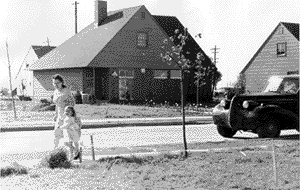
On October 1, 1947, when the first 300 families moved into their brand-new Levitt & Sons Cape Cods, only the "tree section" between Bellmore Road and Division Avenue had been developed and, according to Lynne Matarrese in The History of Levittown, New York (1997), "stores and services were virtually non-existent in the area although salesmen descended upon the store-less residents selling everything from baby food to storm windows. Lawns weren't seeded yet and there was mud everywhere. Street lights, telephones, schools, mail delivery, and bus service were months away, some services a year or more in the future for these first residents".
Find out what's happening in Levittownfor free with the latest updates from Patch.
The matter was further exacerbated by the fact that in their rush to build residences for homecoming GI's and their families, they were slower in responding to educational facility requirements and Levitt & Sons thus frequently found themselves in the middle of heated internal conflicts within the Jerusalem and Island Trees school districts and their respective boards of education. The Jerusalem School District (now called the Levittown School District), for instance, mushroomed from 38 students in September of 1947 to 700 by September of 1948 and would, by the autumn of the following year, have some 11,170 students.
The decision to switch from rentals to sales owing to more profitable opportunities to attract potential home buyers generated by the Housing and Rent Act of 1949 which insured loans up to 95% the value of the house, and the difficulties of collecting thousands and thousands of rents was also highly controversial because - and this is ironic in a community whose ideology became single-family middle class home ownership - many people, rendered ill-at-ease by the uncertainties of the post-WWII economy, preferred to rent.
And when a letter-to-the-editor that appeared in the December 11, 1947 issue of The Island Trees Eagle suggested naming the community "Levittown" and groundswell of support seemed to emerge, it inspired William Levitt to announce, 20 days later, that the new name would be adopted effective January 1, 1948. But many vehemently opposed, including the newly-formed Island Trees Community Association even though on May of 1948 The Levittown Eagle (which obviously supported the change) conducted a poll which showed that 98.5% of the sample of residents questioned were in favor.
Conflicts over community services, schools, rental issues, and the name of the suburban community became so intense that in April of 1948, Levitt & Sons purchased The Levittown Tribune ostensively to keep new residents abreast of company policies (for this was still a "company town") but as much as a publicity organ to propagate their point-of-view. Some accused Levitt & Sons of thus having a "Party Line" and some wag with a sense of irony who remains unknown to this day, distributed leaflets about town voicing strong opposition to the company. The leaflets were signed "The Island Trees Communist Party" and were a rapier jab at William Levitt given our Founder's reputation as an outspoken anti-communist.
If these are the birth pangs of suburban Levittown, it must be said that the ingenuity and fortitude of community residents and the patience of William Levitt was such that the community prospered. It was clear, these problems notwithstanding, that Levitt & Sons were creating an entirely new way of life and people wanted to be a part of it. These crisis years, chaotic as they seemed, also witnessed the rise of Levittowners coming together to form civic organizations: Levittown Chamber of Commerce (1948), Levittown Property Owner's Association (1949), as well as athletic teams, church congregations, and political clubs.
If there's a symbolic light-at-the-end-of-the-tunnel it would probably be on July 14, 1951 when a grand gala celebration on Hempstead Turnpike occasioned the opening of 15 new businesses. Levittown was attracting investors and jobs - and public confidence. Levitt's genius, doubted by some, paid off in the end. William Levitt and Levittown emerged as the harbinger of a new era.
Want to learn more about the history of Levittown and the surrounding communities? Visit levittownhistoricalsociety.org.