Community Corner
Levittown's Victorian Roots
The 1950s suburb draws inspiration from the 1800s era, writes Paul Manton.

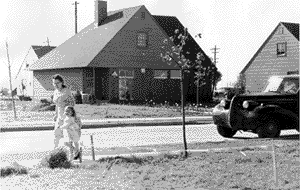
In an odd way, Levittown's iconic status as the embodiment of the 1950s American Dream has its roots in the 1850s, and those roots will have some bearing on its ability to sustain that paradigm in the 2050s.
Since the mid-Victorian era, our society has evolved, begrudgingly, from an authoritarian, social class-structured, sectarian, traditionalist culture to a democratic, egalitarian, secular, corporate media-generated culture. This Damoclesian process facilitated the emergence of consumerism and popular culture, the rise of the middle class to become the socioeconomic norm, and suburban one-family homeownership as the principal settlement pattern.
Levittown is the culmination of this process and epitomized its cultural tableau in the 1950s, sixties and seventies. Indeed, the attractiveness of this lifestyle is evident when we consider that even people who have been ideologically predisposed towards critique of bourgeois culture - Marxist intellectuals and avant garde artists, for example - have always been typically middle class. (Hence the sophistry of the wits, wags, and snobs who have been intransigent in their anti-Levittown bias).
Find out what's happening in Levittownfor free with the latest updates from Patch.
What we've been witnessing since 1980 is a protracted deconstruction of the process. The liberalization of society that once seemed to offer limitless possibilities in an age of greater social conformity, the free enterprise system and social welfare state that once seemed to offer a bulwark against poverty and social upheaval in an era of expanding industrial growth, has unraveled. The philosophy of social progress no longer embraces the noblesse oblige, Puritan work ethic, and civilizing mission that animated the Victorian social reformers. The bourgeois has abandoned the values that, in the 19th and 20th centuries, created the stable and growing middle class society in the first place.
If that abandonment is to be a temporary estrangement and Levittown and the American Dream are to mean something to our grandchildren in the 2050s the way they meant something to our grandparents in the 1950s, we will have to rediscover the historical roots of our former success. Learning about the history of the suburbs and the middle class, from the days of Queen Victoria to the days of the King of Rock & Roll, might be a good start.
Find out what's happening in Levittownfor free with the latest updates from Patch.
Want to learn more about the history of Levittown and the surrounding communities? Visit www.levittownhistoricalsociety.org.