Community Corner
Wantagh: The Story of Long Island
A look at the history of Levittown from historian Paul Manton.

British historian Michael Wood's mini series "The Story of England" tells the history of the sceptered isle through its geographic dead-center: the town of Kibworth in the Midlands. Intended as a microcosm of English history, it falls short the mark only because, as Newsday TV critic Verne Gay recently put it, it's like "telling the story of Long Island based on Hauppauge and Hauppauge alone." But one community does represent the summation of our local history and that community is Wantagh.
It's easy to forget that Wantagh is larger than Levittown and Hicksville combined because much of it is in the Great South Bay as it extends all the way to Jones Beach. Northern Wantagh encompasses the fringe of the old Hempstead Plains that's now the heart of suburbia. Consequently, somebody in colonial times, were he to follow the route of the Wantagh Parkway south of Southern State Parkway, would begin his journey in the open, horizon-to-horizon windswept meadows, venture ever southwards through swampy woodlands, before arriving at the extensive salt flats by an Indian trail that became Merrick Road. Beyond that, the dunes and scrubby swales of the barrier island that faces the restless Atlantic. The suburban development of the area and the ease of transport upon modern roads and bridges allows us to forget that in the days of yore, one traversed a diverse landscape on moccasin feet and, later, horseback, on a difficult trek. It was this diversity that makes Wantagh such an historical microcosm.
Find out what's happening in Levittownfor free with the latest updates from Patch.
Capt. John Seaman's famous Jerusalem Purchase of 1664 was a narrow band of some thousand acres that included portions of today's Wantagh, Seaford, and Levittown; the start of a settlement of Quakers who grazed their sheep and cattle in the north, worked the waters as barmen and fishermen to the south, and operated farms and artisan's shops betwixt. Wantagh was a land of Indians, Quaker yeoman, Negro slaves and freedmen, baymen, herdsmen, and rebels for religious and political liberties throughout the colonial period and notwithstanding the Quaker shunning of military service, Benjamin Birdsall served in the Continental Army at the Battle of Long Island.
The arrival of the Long Island Rail Road to Hicksville in 1837 and Island Trees (via the now-defunct Stewart Line) in 1871, brought the Industrial Revolution to town and with it, droves of German immigrants. Wantagh got its own station in 1867.
Find out what's happening in Levittownfor free with the latest updates from Patch.
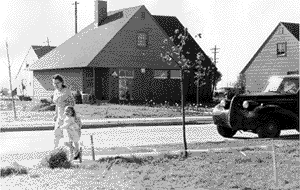
The automobile age came of its own with the creation of Jones Beach State Park and the Wantagh and Southern State parkways in the 1920's and 30's and after World War Two, the Levitt Development spilled southwards and, indeed, in 1951 Levitt & Sons erected the last - No. 17,447 - of their massive project at what's now 161 Tardy Lane in Wantagh.
From the religious and political upheavals of the colonial period to the growth of an agrarian society as the age of steam, rail, and iron clad made its presence felt, to the rise of suburbia as the dominant socioeconomic paradigm, Wantagh's chronicle has been an abbreviation for Long Island's history in a way Kibworth isn't for England.
Want to learn more about the history of Levittown and the surrounding communities? Visit www.levittownhistoricalsociety.org