Neighbor News
LNG Averts 'Panic Premium' in Winter Prices
New Yorkers pay double the price of natural gas than New England consumers. Reuters reports LNG imports played crucial role in lower prices


A recent Reuters article outlines the critical role liquefied natural gas (LNG) imports played in helping New England avert “panic premium” prices similar to what consumers experienced during last year’s polar vortex. The fall in oil prices also provided much needed relief, allowing dual fuel units to switch to oil to keep the grid reliable.
Reuters reported that ISO New England said, “79 oil and dual-fuel units able to burn both gas and oil bought about 4.5 million barrels of oil. In addition, six gas units bought fuel from LNG terminals that bring gas in from overseas as part of the current winter reliability program.”
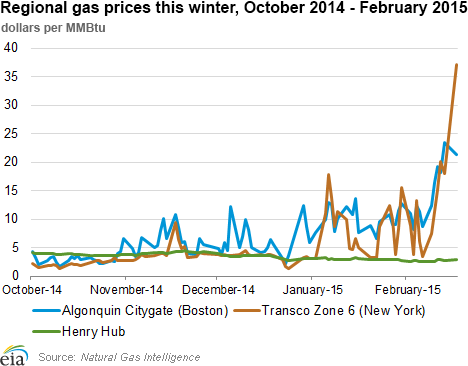
Thomson Reuters Analytics found that LNG Imports into the Algonquin-hub quadrupled, bringing the price of natural gas down to an average of $17.73 per million British thermal units (MMBtu) from $22.50 MMBtu last February, a 21 percent decrease. The savings are welcome news to ratepayers who are buried in mountains of snow during one of the coldest winters on record.
Find out what's happening in Long Beachfor free with the latest updates from Patch.
Ignoring the benefits of LNG would be a major economic and environmental mistake for New York. The natural gas price difference between New York and New England this winter offers a striking contrast. For example, the Boston region has access to LNG, and Long Island/New York City does not. According to the U.S. Energy Information Administration (EIA), the price of natural gas on Transco-6 hub serving New York spiked to $38.15 MMBtu on Wednesday, February 18, 2015, which is double New England’s average of $17.73 MMBtu. (See above EIA images on natural gas prices across regions.) This translates into New Yorkers paying more for a product that is essentially cheaper in a similar region.
Opponents to projects like Port Ambrose, a deep-water natural gas import terminal 18.5 miles off the coast of Long Beach, offer no credible alternative to powering or heating our homes during harsh winter weather. The silent majority of ratepayers cannot afford to continue paying double the price for natural gas because a vocal minority is holding progress hostage. The fact is Port Ambrose will reduce the price of natural gas in downstate New York by tapping into existing pipelines on the seafloor, creating over $300 million in annual savings for consumers, hundreds of jobs for the local economy, and a resilient energy infrastructure.
Find out what's happening in Long Beachfor free with the latest updates from Patch.
In terms of the environment, though natural gas is a fossil fuel, it is the cleanest between oil and coal. Given pipeline constraints headed into the northeast, the New York Independent System Operator recently ordered power plants on Long Island and New York City to prepare to switch to oil when electric prices eclipsed $1,000 per megawatt hour on February 19, 2015.
These issues should not be overlooked or underestimated as hundreds of thousands of New Yorkers struggle with respiratory challenges daily. And our modern/mobile lives depend upon the reliable flow of electricity. The bottom line is New York needs to address its energy challenges to benefit all consumers. Moving forward with Port Ambrose is among the right choices for New York’s economy and environment.
Editor’s Note: Richard Thomas is Executive Director with the New York Affordable Reliable Electricity Alliance. Founded in November 2003, New York AREA is a diverse group of more than 150 business, labor, and community groups, individuals and energy companies including Liberty Natural Gas (developer of the Port Ambrose project). New York AREA’s mission and purpose is to ensure that New York has an ample and reliable electricity supply and economic prosperity for years to come by engaging policy makers, businesses, and the general public regarding the necessity and importance of safe, low-cost, reliable, clean electricity. For more, visitwww.area-alliance.org.