Neighbor News
Future Doctors Face Active Shooter, Bus Bomb, Train Crash Simulations On Long Island
Future doctors tested their EMT skills amid smoke, screaming victims and fast-moving disaster scenarios in Old Bethpage.


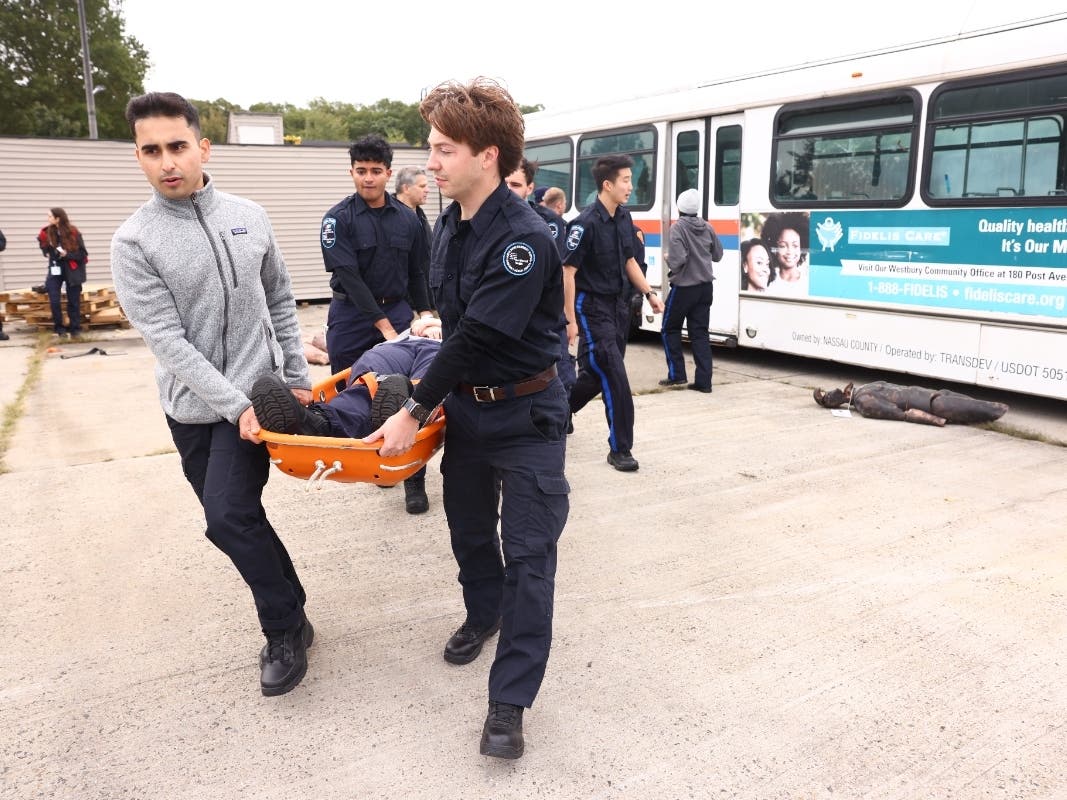


OLD BETHPAGE, NY — First-year medical students at the Donald and Barbara Zucker School of Medicine at Hofstra/Northwell were confronted with screaming victims, smoke-filled scenes, simulated explosions, an active shooter, a train derailment and other mass-casualty emergencies Friday as they put weeks of emergency medical technician training to the test at the Nassau County Fire Service Academy.
The Sept. 25 exercise, known as Mass Casualty Incident Day, was the culmination of the students’ EMT training and was designed to place them in fast-moving situations where the controlled conditions of a classroom or hospital could quickly disappear.
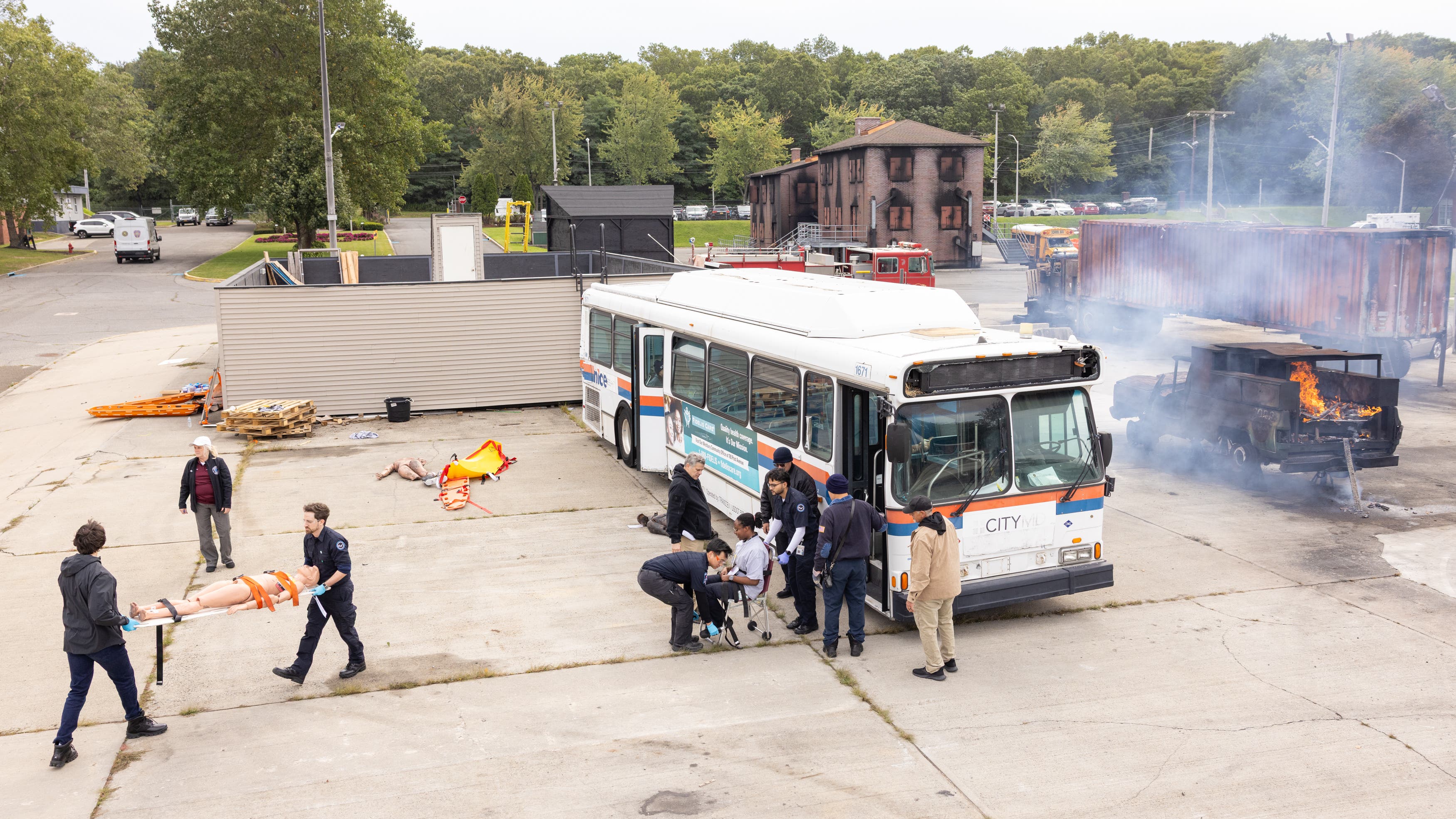
Students moved between scenarios involving a terrorist bomb explosion on a bus, an active-shooter response, a Long Island Rail Road derailment, a hazardous-materials incident and a vehicle crash requiring an extraction with the Jaws of Life.
Find out what's happening in Long Islandfor free with the latest updates from Patch.
Officials said the exercises are developed from real-world case studies, allowing students to practice responding to situations modeled on emergencies that have actually occurred.
Paul Wilders, chief instructor at the Nassau County Fire Service Academy, said instructors were evaluating whether students could handle pressure, communicate, work in teams and apply skills they had spent weeks developing.
Find out what's happening in Long Islandfor free with the latest updates from Patch.
“We want to make sure teamwork is happening," Wilders said. "We want to make sure that they’re not stressed. They’re evaluating their patients and they’re making sure that at the end of the day, the patients get treated.”
Sirens sounded, smoke drifted through training areas and simulated patients cried out for help as students assessed injuries, assigned triage priorities, coordinated with one another and determined who needed treatment or evacuation first.
"This is real-world stuff, and this is exactly what’s going to happen in the street," Wilders said. "Fire service is going to pull up, Police departments, Emergency medical services. We’re all going to have to work together at some point.”
That coordination, he said, should be learned before the emergency occurs rather than during it.
“Better to do it on blue-sky days, in the training environment first,” Wilders said.
First-year medical student Maddie Monness of Irvington said the scenarios allowed students to apply what they had been learning to emergencies that felt much less theoretical.
“They definitely kept it very high intensity,” Monness said. “There was screaming, yelling and I was trying to stay grounded and stay focused on the goal. Coming to Bethpage and experiencing things like a car bomb or a train accident— is very eye-opening. They do a really good job of training us and making it fun while doing things that you would think would be super scary.”
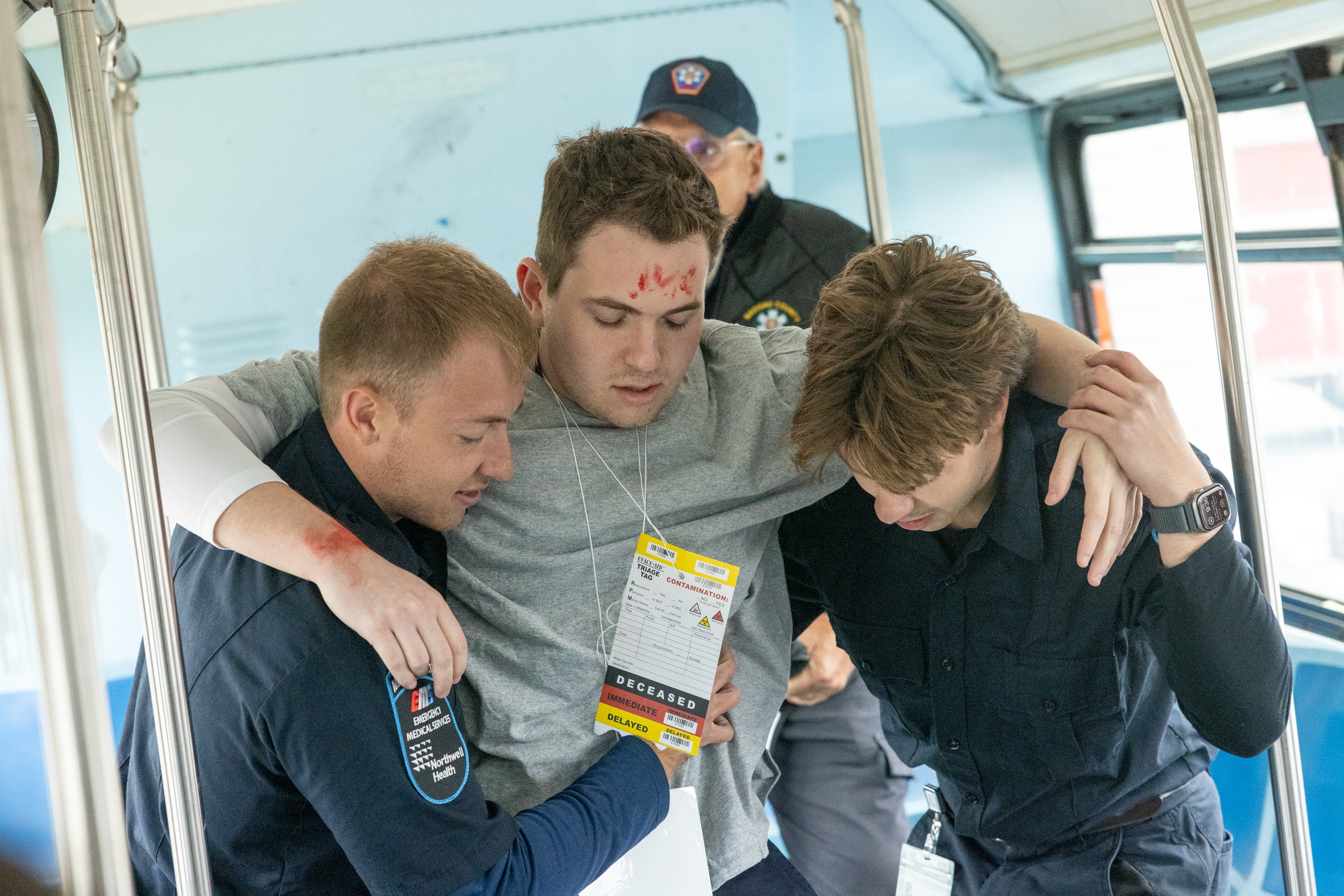
Wilders said the partnership with the Zucker School of Medicine allows students studying in Nassau County to have access to a high level of emergency training locally rather than traveling elsewhere.
The Zucker School of Medicine incorporates EMT training early in its curriculum to emphasize communication and teamwork, school officials said. The school was among the first medical schools in the country to make EMT training part of its program and has continued the model for about 15 years.
Dr. David Battinelli, Deborah and Lawrence Smith Dean of the Zucker School of Medicine and physician-in-chief at Northwell Health, said the program reflects the school’s effort to expose medical students to clinical work immediately rather than waiting until later in their education.
“We do clinical training from day one,” Battinelli said. “Because of all the resources at Northwell, we got the idea 15 years ago — let’s give them EMT training — but redesign for physicians.”
Todd Atkin of the Nassau County Police Department’s Office of Homeland Security said the exercise uses the same basic triage concepts responders may employ during an actual mass-casualty incident.
.jpg)
“Having them communicate with each other and work with us, it makes an amazing scenario because now they have to operate at a very high level of stress,” Atkin said. “We get muscle memory from that stress, and now they’re able to function better in stressful situations for the rest of their careers.”
Officials said the training can also give future emergency-room physicians a clearer understanding of what happened to a patient before that patient arrived at the hospital.
“Having that background information to help them figure out the course of action to treat the patient is tremendous,” Atkin said.
The experience left an impression on Hewlett resident Ryan Kenny, a 2023 graduate of the Zucker School of Medicine, who participated in Mass Casualty Incident Day as a first-year student in 2019.
He later remained with Northwell for emergency-medicine training and said he is now completing a Northwell/FDNY EMS fellowship while working clinically as an emergency physician at LIJ.
Kenny said he can still remember going through the bus-explosion scenario during his first month of medical school.
“It really is a great program because by going through the EMT curriculum and culminating in this capstone day, it takes people and kind of evens out the playing field a little bit,” Kenny said. “It gives them a strong exposure and teaches them strong skills in teamwork and leadership that they’re going to take forward for their whole careers.”
The experience helped point Kenny toward a career that continues to straddle emergency medicine and EMS. In addition to his medical work, Kenny said he volunteers as a firefighter and EMT in his local community.
His advice to the students following the same path he began seven years earlier was not to assume they already know what kind of physician they will become.
“Just have an open mind,” Kenny said. “There are so many different things in medicine that you could do with your career. The great thing about that is there’s so much good that you could do for humanity, and it starts today — that exploration.”
Battinelli said the long-term benefits are part of the purpose of the training. Most students will not become working EMTs, even though they earn the certification, but the lessons can emerge later in less obvious ways.
“It’s like everything in school,” Battinelli said. “You look back and you’re like, ‘I wonder why they had me do that,’ and then you realize why I function better in teams than other people. This is the beginning of that.”
Get more local news delivered straight to your inbox. Sign up for free Patch newsletters and alerts.