Community Corner
Family history drives woman's efforts to end Alzheimer's
Putnam Walk coming up on Oct. 10 will feature new format

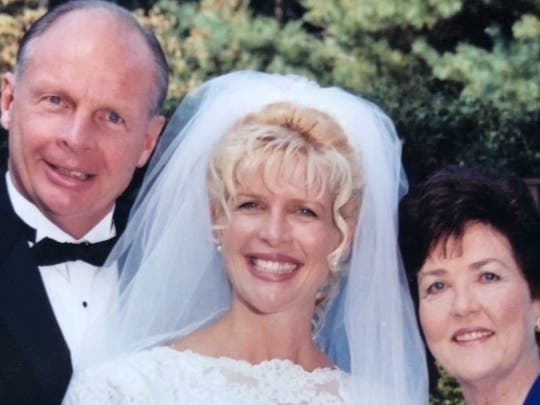
Dementia has touched Eileen Bridgham-Kounios of Carmel’s life twice on her father’s side – both her father and his mother had Alzheimer’s. Now she worries the condition is hereditary and that she may be at risk as well. As Team Retention Chair for the Putnam Walk to End Alzheimer’s, she says she is driven to volunteer out of a hope for a better future.
“I’m so happy to be a part of it and do what I can. I personally believe it’s hereditary. I’m a little worried about myself and what’s going to happen with me. The more I can do to create a better future for myself gives me more motivation to participate and do my part helping the Alzheimer’s Association get to their goal of a world without Alzheimer’s and other dementia,” she said.
Her grandmother, Norma Bridgham, first started showing signs of dementia after her grandfather passed away.
Find out what's happening in Mid Hudson Valleyfor free with the latest updates from Patch.
“My parents downsized her to an apartment, where she lived on her own until they started to be uncomfortable leaving her alone,” she said. “My grandmother lived with our family until my parents couldn’t help her anymore. She lived with Alzheimer’s for almost 20 years, going from a very mild stage until she didn’t remember us,” she said.
Losing a spouse also led to dementia for her father, Rich Bridgham. A former firefighter who had worked as a contractor painting houses and loved to read about science in his spare time, he had for several years centered his life around caregiving for his wife, who was seriously ill with an autoimmune disease and eventually received a liver transplant.
Find out what's happening in Mid Hudson Valleyfor free with the latest updates from Patch.
“He was a friendly, outgoing, bubbly man — always smiling,” Bridgham-Kounios said of her father. “If you needed help with a fence in your yard, he would be there. His main goal was making my mom happy. Every moment he lived and breathed was about making her happy.”
The loss of his wife left him at loose ends, and he had trouble sustaining interest in things.
“She passed away seven years ago, and the dementia started kicking in,” Bridgham-Kounios recalled. “My dad really didn’t know what to do with himself anymore. He tried to keep busy. He would read — then he lost his passion for reading and cancelled all his newspaper and magazine subscriptions. Other than spending time with his grandchildren and family, he didn’t have interest in doing much.”
She said she knew something was seriously wrong when he started labeling everyday objects and leaving instructions for himself on how to do simple things, such as operating the TV remote.
“He couldn’t remember what the microwave was called. I knew my father used a microwave every single day because that’s how he heated his meals, and suddenly he couldn’t remember the name of the microwave,” Bridgham-Kounios said. One day she found a plate broken on a stove burner where he had put his food to cook instead of in the microwave.
Her father lived on his own for about four years, but the time came when her family didn’t want him to be alone, and they moved him into their home. He had been living there for about a year when he slipped and fell down the stairs, breaking his hip. This accident and the resulting surgery provoked a downward spiral.
“He was a completely different man after his surgery. He went from being the nicest, sweetest, most loving man to someone who was angry and withdrawn. He couldn’t understand what happened to him. It just progressively got worse,” she said.
After her father passed away last year, she participated for the first time in the Putnam Walk to End Alzheimer’s. This year, Walk Co-Chair Denise Kuhbier invited her to get involved on the Walk planning committee.
This year’s Putnam Walk to End Alzheimer’s on Oct. 10 will be different than previous years. Instead of a mass gathering at Putnam Veterans Memorial Park, participants will watch a virtual opening ceremony, then set out walking with small groups in their own communities. A Walk app will help walkers track their progress and keep them engaged. Bridgham-Kounios said she thought the new format was well-set up and well-received.
“In speaking to about 150 former teams, I think they were pleased with the fact it will be done on their own terms. And the fact it was still going to take place — people were really happy about that. Of the new walk format, it seems very seamless the way the whole thing was put together. I think it’s wonderful. I’m just thrilled that we are still able to have this walk.”
To register for the Putnam Walk or make a donation, visit PutnamWalk.org
About the Walk to End Alzheimer’s
Held annually in more than 600 communities nationwide, the Alzheimer's Association’s Walk to End Alzheimer’s® is the world’s largest event to raise awareness and funds for Alzheimer’s care, support and research.
About the Hudson Valley Chapter
The Hudson Valley Chapter serves families living with dementia in seven counties in New York, including Duchess, Orange, Putnam, Rockland, Sullivan, Ulster, and Westchester. To learn more about the programs and services offered locally, visit alz.org/hudsonvalley.
About the Alzheimer’s Association
The Alzheimer’s Association leads the way to end Alzheimer’s and all other dementia — by accelerating global research, driving risk reduction and early detection, and maximizing quality care and support. Its vision is a world without Alzheimer’s and all dementia. Visit alz.org.