Crime & Safety
NY Deploys National Guard To 2 Wildfires After Suspected Lightning Strike
The Shawangunk fire complex now consists of three wildfires covering more than 200 acres of the popular preserve 90 minutes north of NYC.


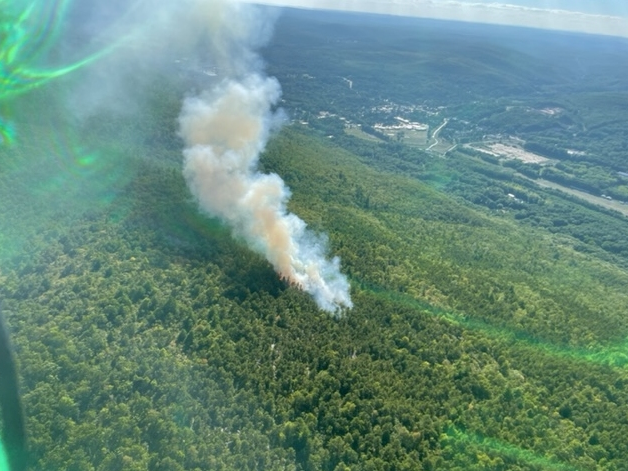
ULSTER COUNTY, NY — State officials have deployed New York's Army and Air National Guards and requested firefighters from Canada to assist fire suppression efforts in Minnewaska State Park Preserve.
The Shawangunk fire complex consists of three fires in the region. The Napanoch Point fire started over the weekend as a result of a suspected lightning strike and had grown to 150 acres by Tuesday. The Wurtsboro fire in the town of Mamakating also started over the weekend and is roughly 70 acres. A smaller fire two miles east of the Napanoch Point fire, named Stony Kill, was detected Monday and is roughly 0.68 acres.
Firefighters are working in difficult terrain under tough weather conditions.
Find out what's happening in Mid Hudson Valleyfor free with the latest updates from Patch.
Minnewaska State Park Preserve contains the dramatic Shawangunk Mountain ridge. The 24,000-acre park features sheer cliffs and ledges opening to beautiful views, waterfalls, lakes, 35 miles of carriage roads and 50 miles of footpaths. It contains dense hardwood forests and a rare community of high altitude pitch pine barrens.
The whole of the popular park, which is just 90 minutes north of New York City, was closed Tuesday until further notice.
Find out what's happening in Mid Hudson Valleyfor free with the latest updates from Patch.
Two Army National Guard UH-60 Black Hawk helicopters with three-person crews, capable of dropping 600 gallons of water at a time, began aerial operations Tuesday, while a contingent of five firefighters from the Air National Guard have been deployed.
State Department of Environmental Conservation Forest Rangers, in cooperation with Ulster County, are serving as Incident Commanders, and more than 200 wildland firefighters and volunteers, including Rangers, local fire response resources, and staff from DEC, Office of Parks, Recreation, and Historic Preservation, Division of Homeland Security and Emergency Services, New York State Police Aviation, and State Fire are fighting the fires, which have grown to 150 acres.
Additionally, 20 Canadian firefighters from Quebec, secured through the Northeastern Forest Fire Protection Compact, are set to arrive on Thursday. The Compact, established in the 1940s, provides the means for its member states and provinces to cope with fires that might be beyond the capabilities of a single member through information, technology and resource sharing (mutual aid) activities.
"As wildfires continue to rage through Minnewaska State Park, I urge every New Yorker to take sensible precautions to keep themselves and their families safe," Gov. Kathy Hochul said. "I thank all of our brave first responders, partner agencies and neighbors who are working around the clock to protect our communities."
No residences are affected at this time. Out of an abundance of caution to protect residences closes to the Napanoch Point fire, DEC Forest Rangers and staff volunteers were assigned to put a contingency fire line in place in the town of Warwarsing near Berme Road.
"Thank you to Governor Hochul, the State agencies, and all the first responders working around the clock to combat the flames on the Shawangunk Ridge," said Wawarsing Town Supervisor Terry Houck said. "Our community is grateful for the work being done to keep our citizens safe."
Since the fires began, a coordinated effort of state and local resources has been on the ground attempting to suppress the fires. Firefighters are working in a joint unified command led by State Forest Rangers. Forest Rangers have significant experience in incident command and fire prevention strategies due to their extensive training and cooperative wildland firefighting missions to other states.
"On the ground and in the air, DEC's Forest Rangers and expert wildland firefighters are putting into practice hours spent battling wildland fires here in New York and in western states," New York State Department of Environmental Conservation Commissioner Basil Seggos said. "These firefighters are focused on protecting the public and working to contain the fire.
Additional multi-agency resources include New York State Police Aviation, which has flown two helicopters since Sunday and dropped approximately 120-180 300-gallon buckets of water per day. Each of the two National Guard Black Hawk helicopters have dumped 12 buckets of water every hour, a total of 24,600 gallon buckets, since being deployed. The State Office of Fire Prevention and Control activated the State's Fire Mobilization and Mutual Aid Plan and Fire Operations Center to ensure the timely coordination of additional resources.
"I want to thank Governor Kathy Hochul and all of the first responders who have worked tirelessly during this wildfire," Ulster County Executive Pat Ryan said. "We will continue to work to limit the spread of the fire and I ask all residents to be mindful of the dry season that we are in and take necessary precautions to reduce the chances of further fires."
New York's Hudson Valley and Catskill regions remain at high fire danger risk, meaning outdoor fires have the potential to spread quickly, especially if the wind picks up. Fires may become serious and difficult to control unless successfully contained while small.
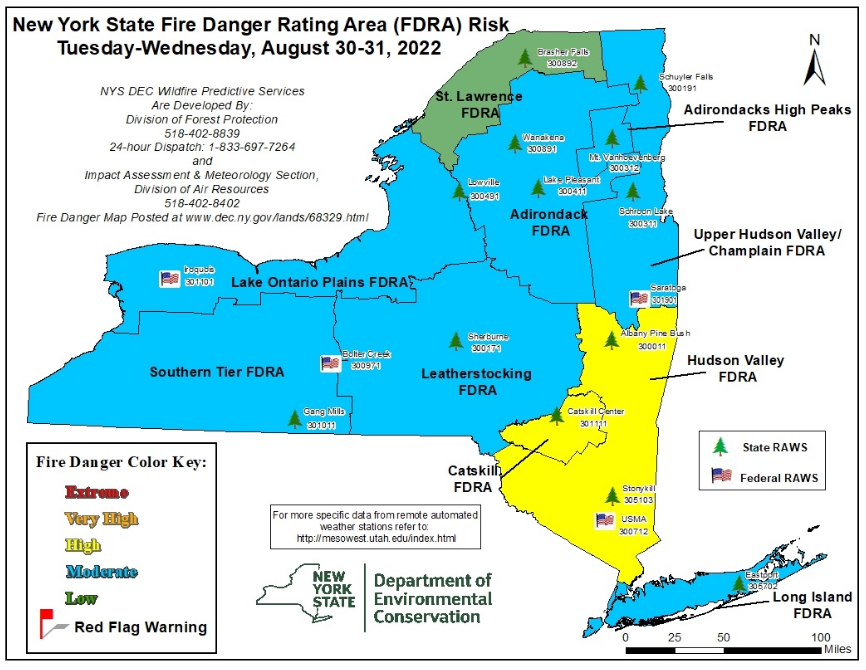
"Until we get significant rainfall, these fires are going to keep burning," Seggos said. "We need everyone to do their part and be careful with fire. While this fire started with a lightning strike, most of the fires we've seen this summer started with an unattended campfire. If you don't need to build a fire, don't. The extremely dry vegetation can ignite almost immediately."
All campfires and open burning are currently banned in Mid-Hudson Region State Parks. Check parks.ny.gov for more information.
DEC continues to encourage New Yorkers and visitors to follow the recommendations below to reduce the risk of wildfires.
While camping in the backcountry, New Yorkers are advised to:
- Use existing campfire rings where possible.
- Build campfires away from overhanging branches, steep slopes, rotten stumps, logs, dry grass, and leaves. Pile extra wood away from the fire.
- Clear the area around the ring of leaves, twigs, and other flammable materials.
- Never leave a campfire unattended. Even a small breeze could cause the fire to spread quickly.
For information on open burning and campfire safety in New York, go to DEC's Open Burning in New York and Fire Safety When Camping webpages. For further questions about wildfires, call 1-833-NYS-RANGERS and call 911 to report a wildfire.
Get more local news delivered straight to your inbox. Sign up for free Patch newsletters and alerts.