Health & Fitness
Long Island in Severe Drought; it Isn’t Just Texas Anymore
Dry conditions and wind cause fires across Long Island. Are we peering into our future?


Multiple fires including the very large one in eastern Suffolk County have devastated our region in the past week (see image #1 ) and conditions are ripe for more fires to occur in the near future. Although not as bad as the fires of 1995, the fires last week burned nearly 2,000 acres and destroyed two homes. Many ecosystems in this region also greatly suffered.
We were not alone. In the past few weeks more than 20 states have experienced large fires due to an extensive nation-wide drought. Image #2 shows that a significant portion of the country is currently experiencing drought conditions ranging from severe to exceptional. Texas has been especially hard hit with drought and fires that have lasted for more than two years. Last year alone, Texas farmers lost $8 billion due to the drought.
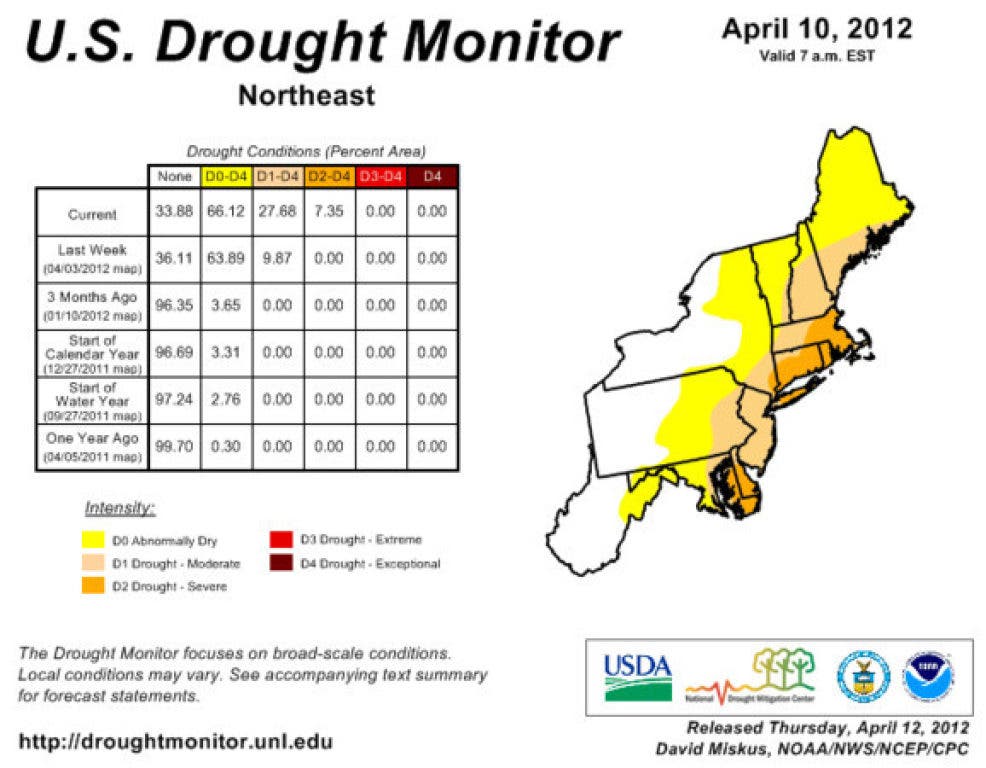
Drought is now affecting us here. Image #3 shows that Long Island and other parts of the northeast are experiencing severe drought conditions. According to the National Weather Service Drought Information Statement, the drought is likely to continue and to worsen. When the wind kicks up like it did last week, fires can spread rapidly. Many locations in our region are six to nine inches below normal precipitation for this time of year and the next few weeks the dry pattern will likely continue. Is this what lies ahead in the future?
Find out what's happening in Miller Place-Rocky Pointfor free with the latest updates from Patch.
As the climate keeps warming from human emissions of heat-trapping carbon dioxide, it is expected that Long Island and the northeastern US will experience longer, hotter summers with morefrequent dangerous heat waves. If the world keeps burning fossil fuels at current accelerating rates, Long Island can expect summers like South Carolina and Georgia toward the end of the century (see image #4). These hot conditions set the table for increased fire risk if there is little rainfall during the hot period. On the other hand, a warming climate will likely increase annual precipitation in much of the northeastern US, although it is expected that more precipitation will fall in the cooler seasons and not during summer when it is most needed. I was unable to locate research about climate change-related fire risks in the northeast so it is not clear whether the expected heat waves or increased precipitation will be a greater factor for determining our future fire risk.
Unfortunately, drought is very likely to increase in a large portion of the US – especially in the breadbasket. Carefully view images #5, #6, and #7 to see how drought is expected to increase in coverage and severity across much of the US as we head toward the year 2100. These images are from a recent study by National Center for Atmospheric Research (NCAR) scientist Aiguo Dai. Human-caused climate change will likely create increasingly dry conditions across much of the globe in the next 30 years, possibly reaching a scale in some regions by the end of the century that has rarely, if ever, been observed in modern times. These images are based on the best current projections of greenhouse gas emissions. (During the height of the Gulf of Mexico oil spill in 2010, about 5,000 metric tons of oil gushed into the water each day. At the same time, human activities were pumping 82 million metric tons of carbon dioxide daily into the atmosphere, a record. For perspective, our emissions from fossil fuels are equivalent to 15,000 Gulf oil spills every single day.) It should be noted that a value of -4 is considered to be “extreme drought” and by the 2060s MOST of the US would be experiencing extreme drought or worse.
Find out what's happening in Miller Place-Rocky Pointfor free with the latest updates from Patch.
Of course, we all pay for drought in the food line, regardless of where we live. The severe heat and fires in Russia in 2010 (influencedby climate change) devastated the grain harvest and caused food prices to soar world-wide. The 2010 Russian heat wave offers us a glimpse of our own future if the major economies of the world do not begin reducing their addiction to fossil fuels. We can make smart choices now for our energy needs by becoming energy efficient and by investing in cleaner, infinite energy sources such as wind and solar power. Gas prices keep rising while the cost of wind and solar keeps falling. It is good business to begin switching over as soon as possible.