Schools
Clearwater Brings Hudson River Education to 10 Special Students
They had the opportunity to touch artifacts and fish, see and smell the river and listen to sea shanties.


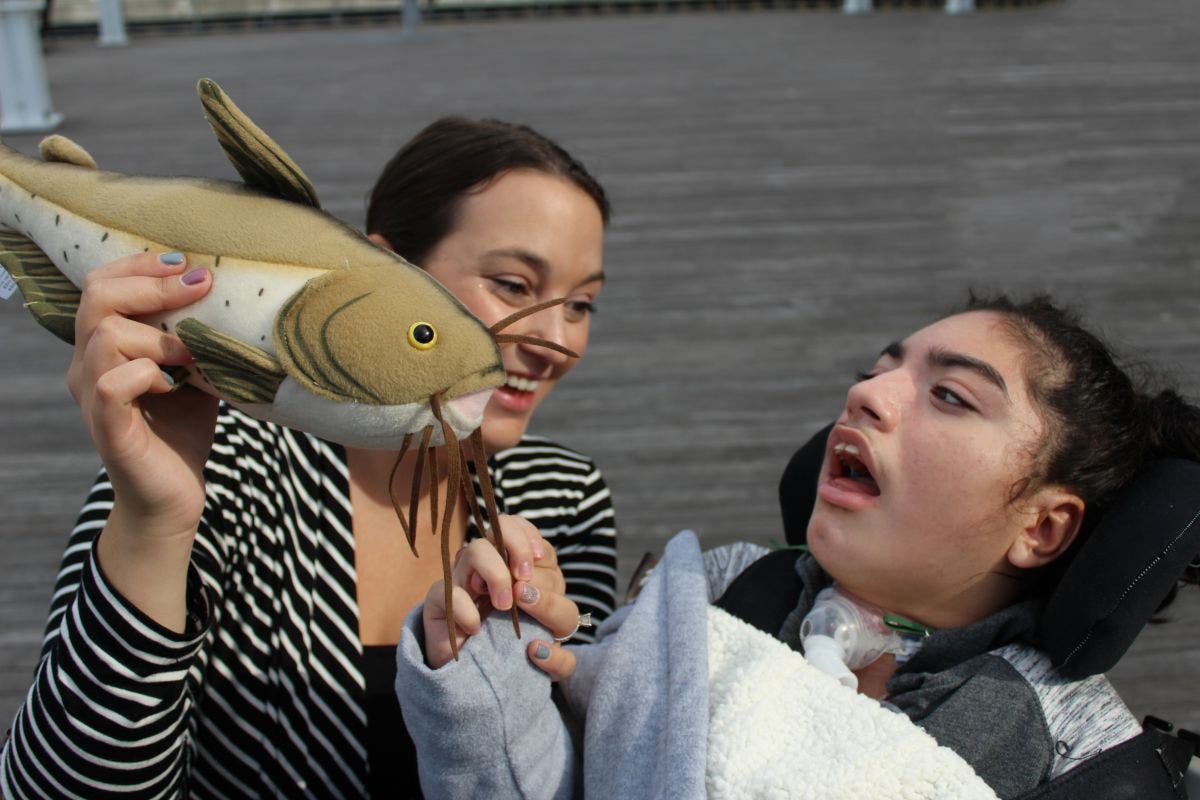
Hudson River Sloop Clearwater’s Tideline Program Director, Eli Schloss met with 10 residents from the Elizabeth Seton Pediatric Center, who are students at the John A. Coleman School, at the Yonkers Pier on Thursday morning for a very special day of Hudson River education.
The students from the school were selected to participate in Clearwater’s onland education program where they were introduced to Hudson River fish, shoreline artifacts, the history of the Hudson River and traditional folk songs.
The Elizabeth Seton Pediatric Center is a pediatric sub-acute specialty care facility, serving the most medically complex children in New York State. The group of students from the Coleman School (and residents at the Elizabeth Seton Pediatric Center) ranged from ages 9 through 15.
Find out what's happening in Mount Vernonfor free with the latest updates from Patch.
The Coleman School heard about Clearwater’s onland education program through a teacher at the school, Allison Klein, who is also a long time volunteer and coordinator of the children’s area at the Clearwater Festival. The Coleman School has been recognized annually as a School of Excellence by the National Association of Special Education Teachers (NASET).
“I was so impressed with how Eli and Maura communicated with our children,” said Klein. “They saw our students’ abilities and engaged them so that they could learn and experience the Hudson fully. The multisensory elements of the program were a perfect fit for our children. They had the opportunity to touch artifacts and fish, see and smell the river and listen to sea shanties. We are grateful for this experience, which was informative, memorable and, of course, fun!”
Find out what's happening in Mount Vernonfor free with the latest updates from Patch.
Clearwater’s Tideline programs reach all learning styles through hands-on experiential learning. Students evaluate the health of the river with first-hand interactions with the living environment as they catch, identify, and classify fish and invertebrates. They can predict the future of the river by looking at the historical uses of the river and its role as the birthplace of the environmental movement. Students connect the ecology, beauty, and environmental challenges of the river to their own lives.
Tideline Program Director Eli Schloss commented, "It was a pleasure to work with the students at the Coleman School, and we were able to show them some amazing aspects of the river. To see live animals from the river is always impressive and these students were fascinated by the American Sole and the eel. We also had some artifacts for them to examine, from a railroad tie, to an oyster shell, to the baleine of a whale. It was an exciting challenge to show the history of the valley through these tangible items. It was a rewarding and valuable experience for all."
PHOTO/ courtesy the John A. Coleman School
Get more local news delivered straight to your inbox. Sign up for free Patch newsletters and alerts.