Politics & Government
Fight over Ramapo Border Developments Leads to Calls for More Cooperation
Clarkstown officials want to tighten the laws governing regional planning.


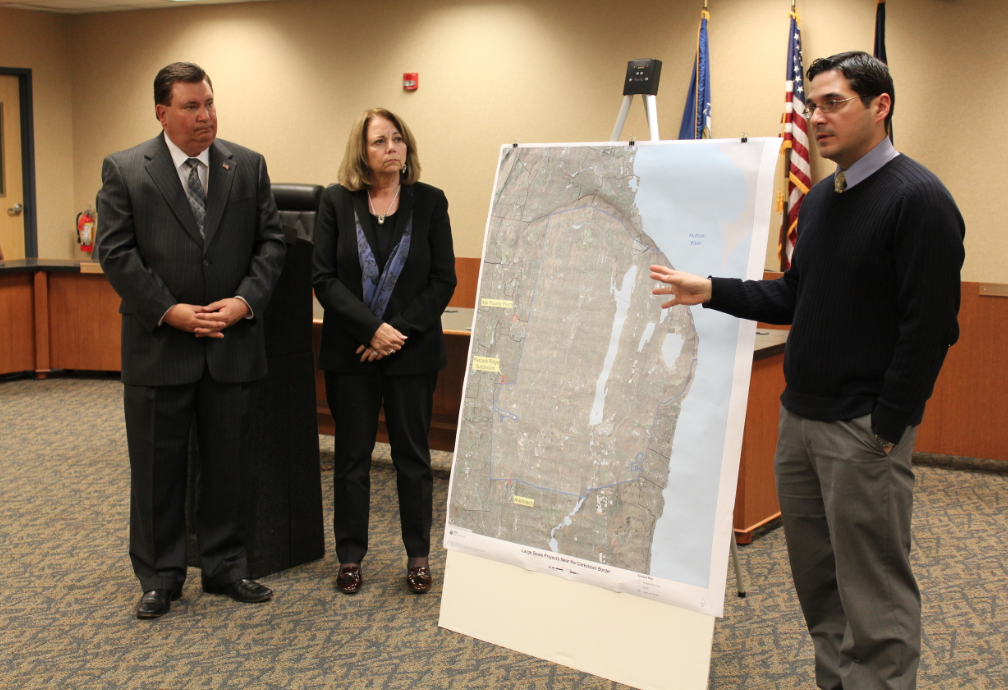
Clarkstown Supervisor Alex Gromack called yesterday on Rockland county and local officials to work together to implement changes to the current system of planning notification and inter-municipal review of planning and zoning matters.
“Clarkstown recognizes the current state law does not meet the challenges facing municipalities in the 21st Century,” he said, “communities have a right to know what is being built in other municipalities just outside their borders.”
Right now, by law applications for special use permits, use variances, site plans and subdivisions on properties within 500 feet of municipal borders require the referral of the application to the County Planning Department; however, only a simple notice of a hearing on these land use actions is required to be sent to an adjacent municipality, he said.
Find out what's happening in Nanuetfor free with the latest updates from Patch.
Gromack believes there is a procedural deficiency in the fact that Clarkstown must go out of its way, often by the use of the Freedom of Information Law, to obtain the same application materials received by the County Planning Department.
Counter to the intent of General Municipal Law, this actually inhibits inter-municipal cooperation and regional planning.
Find out what's happening in Nanuetfor free with the latest updates from Patch.
“Our communities are connected not only by roads and bridges, but also by forests and streams, which do not recognize boundaries between our communities”, he said. “In order to both facilitate orderly and sustainable growth we must improve our methods of communication and municipal cooperation.” Gromack further stated, “What happens in one municipality can have a dramatic effect on its neighboring municipality.”
Gromack will work with State Legislators to amend General Municipal Law 239.
Meanwhile, since state law allows municipalities to enter into inter-municipal cooperation agreements to share resources and accomplish common goals, Clarkstown is calling on the County, Towns and Villages of Rockland to work together to implement these changes to the current system of notification and inter-municipal review:
- In addition to the state law required land use actions, public hearing notices should be sent to adjacent municipalities for zone changes and comprehensive plan amendments. Notification of meetings by other land use boards as well as continuances of any meetings should also be sent. Notification should be sent whether such meetings are public hearings or not. (Currently we only get notifications for site plans, subdivisions, and special permits.)
- The materials required by state law to be sent to the County Planning Department for review should be sent to adjacent municipalities. The adjacent municipality should be afforded the same amount of time to review the materials and provide comment as the County, which is currently 30 days. (The Town does not receive documents such as maps, drainage reports, and traffic reports.)
- While Rockland County supplies municipalities with Geographic Information System (GIS) data for their municipality, the County should also supply parcel and zoning data for adjacent municipalities. This data is essential for locating and reviewing projects in neighboring municipalities. (Towns should have access to all the County GIS data that pertains to all five Town and Villages.)
- The Rockland Municipal Planning Federation provides excellent educational opportunities for Zoning, Planning, Village and Town Board members, but more is needed if true inter-municipal cooperation and regional planning is going to happen in Rockland County. The 24 Towns and Villages that make up the County need better communication with one another. The County Planning Federation should convene planners from every Town and Village on a regular basis to discuss the following issues:
- Major projects with the potential to affect neighboring municipalities or the County as a whole
- Environmental features that cross municipal boundaries such as streams and wetlands, ridges and viewsheds, natural habitats and flood plains.
- Infrastructure issues such as water supply, drainage, sewerage and transportation.
- Funding opportunities for inter-municipal cooperation on planning related projects from trails to transit
- Changes to State Law that affect local and regional planning
“We are a small county and all the towns and villages should be united in their efforts to protect our environment and our natural resources which are limited,“ said Councilwoman Shirley Lasker. “ We must not and we cannot allow any one town or village to adversely affect the entire county.”
Gromack has repeatedly talked to Ramapo town officials about two large developments in the approval process there.
Here’s the text of his remarks in February.
The Town of Clarkstown is concerned about the density of the two developments and their potential impact on the town’s residents, roads and natural resources.
At the last two public hearings, I’ve urged the board to issue a positive declaration under SEQRA, and to prepare a full Environmental Impact Statement so that any adverse environmental impacts can be fully explored and mitigated to the fullest extent possible.
I have reviewed the short form environmental assessment forms – or EAF’s - in connection with these two projects. The board unanimously adopted part two of these forms at its December 18, 2014 meeting. In part two, John Lange of Frederick P. Clarke associates, the town’s planning consultant, recognized that the development would have “a moderate to large” environmental impact in 6 out of the 11 categories listed.
Under part 3 – determination of significance – your planning consultant checked the following
“Check this box if you have determined, based on the information and analysis above, and any supporting documentation, that the proposed action may result in one or more potentially large or significant adverse impacts and an environmental impact statement is required.”
So my question is, why not just commence with the preparation of the Environmental Impact Statement? The process is designed to be an open, interactive process between the town, the applicant, and the residents. The result should be a better project that mitigates, to the fullest extent possible, adverse environmental impacts.
So if the town is inclined to grant the petition, the Town of Clarkstown once again respectfully urges that a full Environmental Impact Statement be prepared.
PHOTO: Clarkstown Supervisor Alex Gromack, Councilwoman Shirley Lasker and Director of Planning Joe Simoes at the press conference/contributed
Get more local news delivered straight to your inbox. Sign up for free Patch newsletters and alerts.