Community Corner
The Bronx Takes Banking Into Their Own Hands
Coalition Launches The Bronx People's Mobile Branch to Address Financial-Access Challenges Heightened by Recent Bank Branch Closures
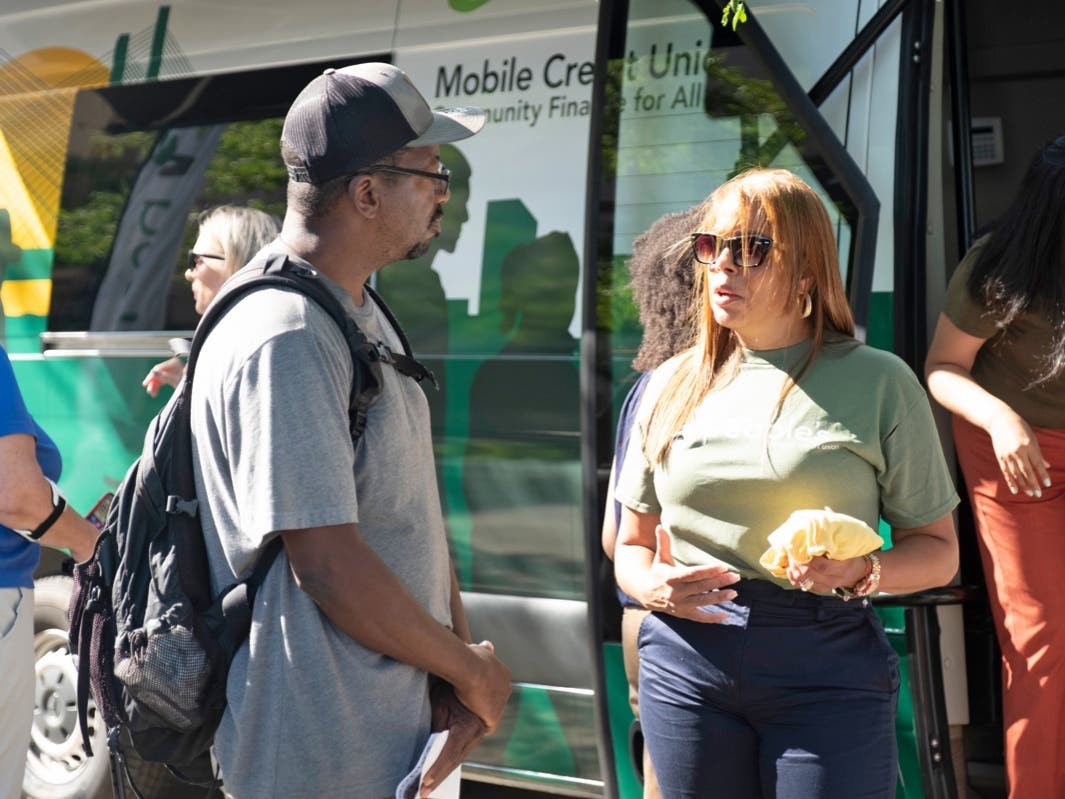
(The Bronx, NY) – Even before the pandemic, the Bronx had the fewest bank branches and the most check cashers and pawnshops per household in the state, and possibly the country. At the height of the pandemic in 2020, a spate of branch closures spurred four longstanding Bronx community groups into collective action, teaming up with a longstanding credit union based on the Lower East Side to change the banking game in the Bronx. At a July 19th press conference, these groups – which now form the new Bronx Financial Access Coalition – celebrated the launch of The Bronx People’s Mobile Branch while advocating for affordable and convenient financial services throughout the borou
The organizations negotiated an agreement with Sterling National Bank (which is now Webster Bank after a recent merger) to fund their efforts to partner with the credit union on the launch of the Bronx People’s Mobile Branch that has begun to serve numerous Bronx neighborhoods. Twelve community organizations serving the Bronx are already participating in the select partner group program which forms the foundation of the outreach efforts along with the mobile branch van. A future permanent branch in the Bronx will be the Lower East Side People’s Federal Credit Union’s fourth location, following branches in the Lower East Side, East Harlem and Staten Island’s North Shore.
“We are excited to expand to the northern borough in partnership with the Bronx Financial Access Coalition. The future Bronx People’s Federal Credit Union branch will be a division of the Lower East Side People’s Federal Credit Union,” said Lower East Side People’s CEO Aissatou Barry-Fall. “These communities don’t just need financial services, they need affordable financial services. Today we proudly announce our goal of establishing a permanent branch in the Bronx by the end of 2023.”
Find out what's happening in New York Cityfor free with the latest updates from Patch.
The credit union offers free checking accounts, credit builder loans, low-cost auto loans, and accounts for members with ITINs who may have trouble opening accounts at a traditional bank. For now, these services will be offered through their mobile branch van which launched in April in a number of Bronx neighborhoods including Melrose, Morris Heights and Longwood. The coalition and credit union’s strategy is to restore and build trust with community residents who have had bad experiences with banks, or are tired of paying high fees to banks or check cashers. With a low deposit of $25 members are able to access credit union products and services including fee-free ATMs at most McDonald’s, 7-11s and Citibank branches, and a 67% discount for CitiBike membership for low-income families.
“Community development financial institutions like Lower East Side People’s Federal Credit Union are designed to meet the needs of historically redlined communities, with affordable and convenient products that build wealth and community ownership,” said Jorge Luis Vasquez, Jr. Board Chair of Lower East Side People’s. “We don’t extract resources or perpetuate poverty.”
Find out what's happening in New York Cityfor free with the latest updates from Patch.
This Bronx credit union effort has been the result of two years of conversations between The Bronx Financial Access Coalition’s member organizations. They began working together even earlier in a citywide coalition advocating for responsible banking in historically redlined communities like the Bronx. Going back to 2019, they had opposed bank branch closures in the face of claims by the banks that they were losing money on local branches. Complaints to banking regulators also proved unfruitful, as both state and federal agencies claimed they lacked the enforcement power to stop branch closures. For example, New York’s state banking regulator released a statement in December of 2020 declaring that the closing of two Popular Bank branches in Hunts Point and Castle Hill “will not result in a significant reduction of banking services in the communities to be affected.”
From the beginning of 2020 to the end of 2021, 19 branches in the Bronx closed while only four opened. The vast majority of those closures (16) were in majority Black and Brown neighborhoods. Another 10 Bronx branches had closed in the prior three years while six had opened, meaning a net loss of 19 branches over five years across the borough.
The breakthrough occurred when Sterling Bank, which announced the closing of its branch on 149th Street in the Hub in August 2020, reached a compromise with the four community groups that now comprise the Bronx Financial Access Coalition. Even though they would not stop the branch closure, officials at Sterling National Bank, which is now Webster Bank after its merger, negotiated an agreement to financially sponsor the groups to bring an established community credit union to the bank-starved neighborhoods of the Bronx.
“We heard from our community partners that bringing a community development credit union to the Bronx would make a big difference and we listened. We are proud to be the premier bank sponsor of the Bronx Financial Access Coalition and their partnership with Lower East Side People’s Federal Credit Union,” said Karina Saltman, a Senior Managing Director within the Office of Corporate Responsibility at Webster Bank.
“We are grateful to the bank for listening to us, and acknowledging the collective expertise in our own neighborhoods. Our conversations have been many, and at times difficult, but they are guided by a mutual commitment and understanding. We negotiated a strong agreement with the bank that seeks to make up for the harm done by the recent branch closing, and we encourage other banks who have closed branches in the Bronx to follow Webster’s responsive and innovative example,” said Jumelia Abrahamson of University Neighborhood Housing Program and a board member of the credit union since 2021. “We believe that their investment in our efforts will impact the banking game in the Bronx by bringing access to affordable and solid banking to neighborhoods beyond the largest commercial districts, and in particular for residents who feel they don't need, trust or could afford mainstream products and lending. By merging literacy and products, the Bronx Financial Access Coalition is making it easier for low-income and immigrant families to avoid check cashing fees, to apply for credit and improve their score no matter their immigration status, and for new entrepreneurs to open business accounts.”
One South Bronx resident described the challenges of accessing financial services in her bank-starved neighborhood, and why she recently joined the credit union. “Before, I would go to the check casher and buy a prepaid card for $10. Then I’d have to pay additional money to load my money onto the card. If I wanted to put $100 on my card, I had to pay $5. When I needed to take money off my card, I had to pay $2.50 to get my money, plus the $1 from the ATM. You end up spending the money you have just to use it,” said Sonya Ferguson, the president of the Banana Kelly Block Association, a Bronx Community Board 2 member and a board member at Banana Kelly Community Improvement Association. “I signed up for the credit union because it’s for the people, and I like the idea of belonging to something. The part about fixing your credit is great, and a free ATM is even better. Now I can say I’m a member of a financial institution!”
The Coalition is actively recruiting other organizations to become select partner groups of the credit union, which then opens up membership benefits to all of its staff, members, clients and affiliates. First, the coalition groups themselves signed up to lead the way.
“I cannot express enough how critical the credit union’s mobile branch is to our community and how grateful I am to the partners of the Bronx Financial Access Coalition. I encourage more organizations to join as Select Partner Groups. This is a great opportunity to talk to your staff, members and clients about building credit, banking services and taking control of your finances,” said Hope Burgess, the President & CEO of Banana Kelly Community Improvement Association, Inc. “After joining as a select partner group, a number of our staff and residents have already joined the credit union. I signed up as a member myself because I have seen firsthand the barriers and struggles our residents face from the lack of access to financial institutions. And besides the financial security this brings, the People’s Credit Union also helps to build credit and improve credit scores for our residents. This is an empowering tool.”
A massive banking desert stretches across a collection of South Bronx neighborhoods including most of Morrisania, Longwood, and Melrose. From Morris Ave in the west to Intervale and Fox Streets in the east, and from Crotona and Claremont Parks in the north to East 150th Street in the south – an area about 1.5 miles wide by 2.5 miles long – you will not find a single full service bank branch. Many stretches of the west Bronx along Jerome Avenue, the Grand Concourse and University Avenue also have few, if any, branches. In some areas the only options are check cashers, pawn shops, or branches of the largest national banks that typically charge high monthly maintenance fees for customers without direct deposit or certain minimum balances.
In a pre-pandemic survey of hundreds of community members, WHEDco found that about one out of every four respondents did not have a U.S. bank account and more than forty percent of respondents said they have zero dollars saved.
"I knew we needed something radically different, innovative and responsive that would build wealth, like a community development credit union,” said Davon Russell, President of WHEDco.
"We’re elated to be a key partner bringing the Bronx People’s Federal Credit Union and better banking services to community members, staff and volunteers. That it is community-owned is a plus I could only imagine.”
Many of those surveyed by WHEDco who are banked said they can’t maintain the minimum balance required and do not have a bank branch in their neighborhood, among other challenges cited.
“You can have a bank account and still be unhappily banked in the Bronx,” added Kerry A. McLean, WHEDco’s Vice President of Community Development. “It’s time the people of the Bronx have more affordable, convenient, wealth-building, tech-forward, financial services, and the Bronx People’s credit union will do just that.”
Branch closures are part of a long history of redlining practices that led to the devastation of places like the South Bronx and the Lower East Side in the 1970s and 80s. Back then, community residents organized to save their neighborhoods, and one of their victories was the passage of the federal Community Reinvestment Act in 1977. The specifics of the regulations under this law are currently being revised by all three federal banking regulators for the first time in over two decades.
“The changes being proposed to the Community Reinvestment Act provide a historic opportunity for the CRA to finally meet its original intent to combat redlining and disinvestment and increase access to banking and capital in communities of color like ours here in the Bronx,” said Jessica Clemente, Executive Director of Nos Quedamos. “We appreciate the regulators working together and proposing several positive changes to the CRA regulations. However, the proposal as written is a missed opportunity that fails to live up to its purpose as an anti-redlining law. The CRA must explicitly include race, downgrade for harm and displacement, strengthen community input, and improve access to branches and banking.”
The Coalition also used the July 19 event to encourage and support local residents, organizations and elected officials in writing letters to the federal banking regulators demanding a stronger Community Reinvestment Act that considers racial equity in the bank examination process. Comments are due on August 5.
Investment from the federal and state government can also spur these initiatives forward. LES People’s FCU was able to access federal dollars from the Department of Treasury’s CDFI fund to aid in their expansion. In 2021, the state’s fund made its first ever allocation to community development financial institutions around New York, including to LES People’s for expanding into the Bronx, though no money was allocated by state officials in 2022.
“Funding the state’s CDFI Fund should be a top priority to boost initiatives like ours,” said Gregory Jost of Banana Kelly Community Improvement Association and a steering committee member of the New York State Community Equity Agenda Coalition which includes more than 40 groups from across the state. “We also believe that legislation like the New York Public Banking Act can make a big difference by paving the way for places like New York City to create public banks to hold municipal deposits. Instead of depositing taxpayer money in big Wall Street banks, local public banks can act in the public interest to expand quality affordable and convenient financial services in partnership with community-based financial institutions like the Lower East Side People’s Federal Credit Union. With initiatives such as these, we can seriously address the longstanding inequalities in our financial system.”
The mobile branch van is able to come to neighborhoods throughout the Bronx for special events by visiting the website, bronxfinancialaccess.nyc. Organizations can become select partner groups and create a regular bi-weekly or monthly schedule for the mobile branch as well. Community residents can sign up to join the credit union online or come visit the mobile branch van. Upcoming dates and locations include (Fridays) July 29 and August 12 on Kelly Street between East 163rd Street and Intervale Ave, (Tuesdays) August 2 and 16 at Boricua College Plaza in Melrose, (Thursday) August 4 at 45 West Tremont Ave between Jerome and University Aves, (Thursday) August 11 on the Grand Concourse at East 196th Street, and (Saturday) August 13 on Murdock Ave between East 233rd Street and Strang Avenue in the Northeast Bronx.