Weather
'Expect The Very, Very Worst': NYC Faces Future Ida-Scale Threats
The storm devastation Wednesday night shows climate change is upon New York City, Gov. Kathy Hochul and other officials said.


NEW YORK CITY — At least 12 dead. The wettest hour in New York City's history. Subways inundated with flood water. Streets and basement apartments swollen with rain.
The devastation from Hurricane Ida's remnants Wednesday night not only shattered records, but likely also offer the city a glimpse of a bleak future in which climate change makes once-unprecedented weather events commonplace, Gov. Kathy Hochul and other elected officials said.
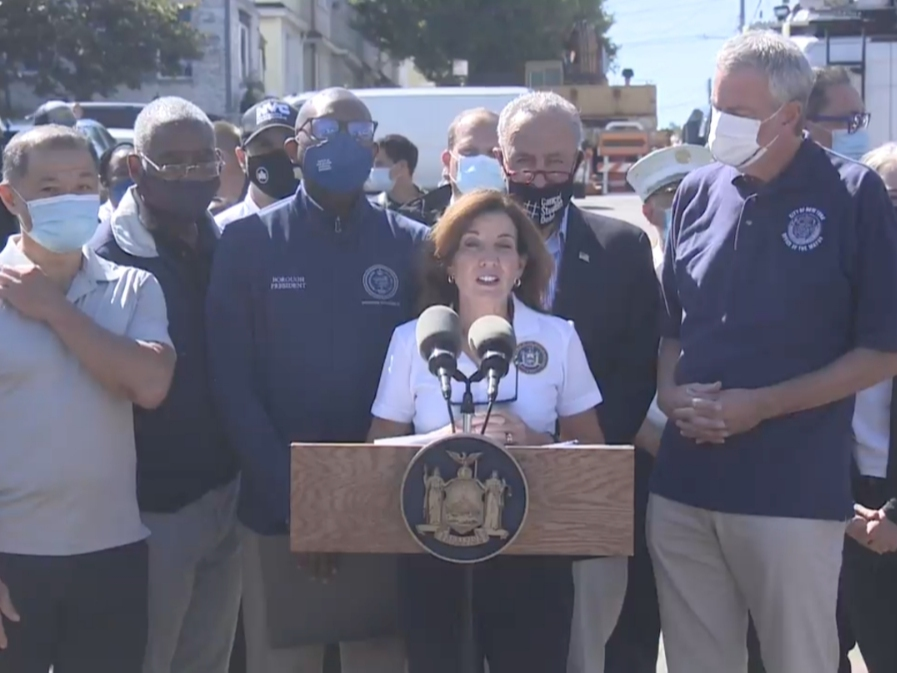
Hochul — flanked by, among others, Mayor Bill de Blasio and Sen. Chuck Schumer — said the city and state are still taking stock of damage from the storm.
Find out what's happening in New York Cityfor free with the latest updates from Patch.
“Even the morning after we’re still uncovering the true depth of the loss, the human loss,” she said.
President Joe Biden promised to approve an emergency declaration soon to get money flowing to the city, state, homeowners and businesses affected by the storm, Hochul said. She already issued a state of emergency for the city following the storm.
Find out what's happening in New York Cityfor free with the latest updates from Patch.
Schumer likewise pledged there will be "no stone unturned" to get federal aid to New Yorkers, as well as declaring a disaster area.
But he also pointed out the storm showed global warming, or climate change, is upon the city — and it must prepare.
“Woe is us if don’t recognize these changes are due to climate change,” he said. “Woe is us if we don’t something about it quickly, both in building resilient infrastructure and going to clean power.”
Experts say climate change is fueling the severity of extreme weather events, from unprecedented heat waves in the West to tropical storms and rising seas flooding cities and coastlines.
Central Park recently experienced its wettest hour on record as Tropical Storm Henri struck the city. The record stood for 10 days until Ida's remnants dumped 3.15 inches on the park.
“When you get two record rainfalls in a week, it’s not a coincidence,” Schumer said.
Ida first struck Louisiana on Sunday as one of the most powerful hurricanes to hit the mainland United States. It weakened to a tropical storm as it traveled up the East Coast.
Even in a diminished state, Ida still prompted a days-long flurry of alerts from the National Weather Service. New York City was, at various times, under a flash flood warning and watch, as well as a tornado watch.
But as the storm approached, the rainfall grew past already-heavy predictions. De Blasio noted between 3 and 6 inches of rain were projected over the course Wednesday — a large but not particularly problematic amount, he said.
“That turned into the biggest single hour of rainfall in New York City history with almost no warning,” he said. “So, now we’ve got to change the ground rules from now on what I think we do is tell New Yorkers to expect the very, very worst. It may sound alarmist at times, but unfortunately it’s proven by nature.”
Midtown saw 7.49 inches of rain while Staten Island recorded 8.92 inches, among other devastating amounts, according to the National Weather Service.
The rainfall prompted the National Weather Service to issue a flash flood emergency — the city's first in its history — that warned of "life threatening" water and urged New Yorkers to immediately seek high ground.
The rainfall caused mass flooding across the city, prompting motorists to abandon cars on the West Side Highway and "unbelievable" water levels across Brooklyn. Subways all but shut down as torrents of water rushed down platforms and through tunnels.
Crown Heights street view pic.twitter.com/WqF61pwOp7
— Zvi Shmuel Naiman (@zvi) September 2, 2021
Meanwhile at 28th Street Station Manhattan pic.twitter.com/TzaXQbyqXh
— Stanley Roberts (@StanleyRoberts) September 2, 2021
Flooding most tragically affected Queens.
Eleven of 12 New Yorkers who died in the storm hailed from the borough. NYPD Commissioner Dermot Shea said most one of the Queens deaths were in basements that flooded, while one was in a car found on Grand Central Parkway.
Hochul said the storm and recent severe weather showed New York needed to prepare for climate change.
"How do we prevent this from happening?" she said. "How do we get money and resources to the places we can build up the resiliency in streets, before we worried about the coastal areas, now it's about what's happening in the streets, the drainage systems that need to be enhanced and all the resiliency we can because of climate change, unfortunately this is something we're going to have to deal with great regularity, and we want to assure all New Yorkers that we're prepared for this, and we'll do everything we can in our power to protect human life and property."
Read More:
Get more local news delivered straight to your inbox. Sign up for free Patch newsletters and alerts.