Politics & Government
Final NYC Mayoral Debate Offers Substance Mixed With Drama
Issues and policies took center stage at the final Democratic mayoral primary debate, although candidates still found time for attacks.


NEW YORK CITY — The last mayoral debate may have unfolded on Saturday Night Live's stage, but the final showdown between Democratic candidates before the June 22 primary wasn't a laughing matter.
Serious talk about pressing New York City issues ranging from public safety, to homelessness, to education dominated Wednesday's debate.
And still the attacks that consumed previous debates between the top-tier Democratic candidates — Eric Adams, Shaun Donovan, Kathryn Garcia, Raymond J. McGuire, Dianne Morales, Scott Stringer, Maya Wiley and Andrew Yang — remained.
Find out what's happening in New York Cityfor free with the latest updates from Patch.
Moderators and candidates did manage to steer discussion toward substantive issues, especially when front-runners sparred. When Adams and Yang bickered over a police union endorsement, Donovan, who is behind in the polls, did just that.
“New Yorkers didn’t tune in tonight to hear us fight with each other,” Donovan said. “This is a moment where we have more than 500,000 New Yorkers still out of work.”
Find out what's happening in New York Cityfor free with the latest updates from Patch.
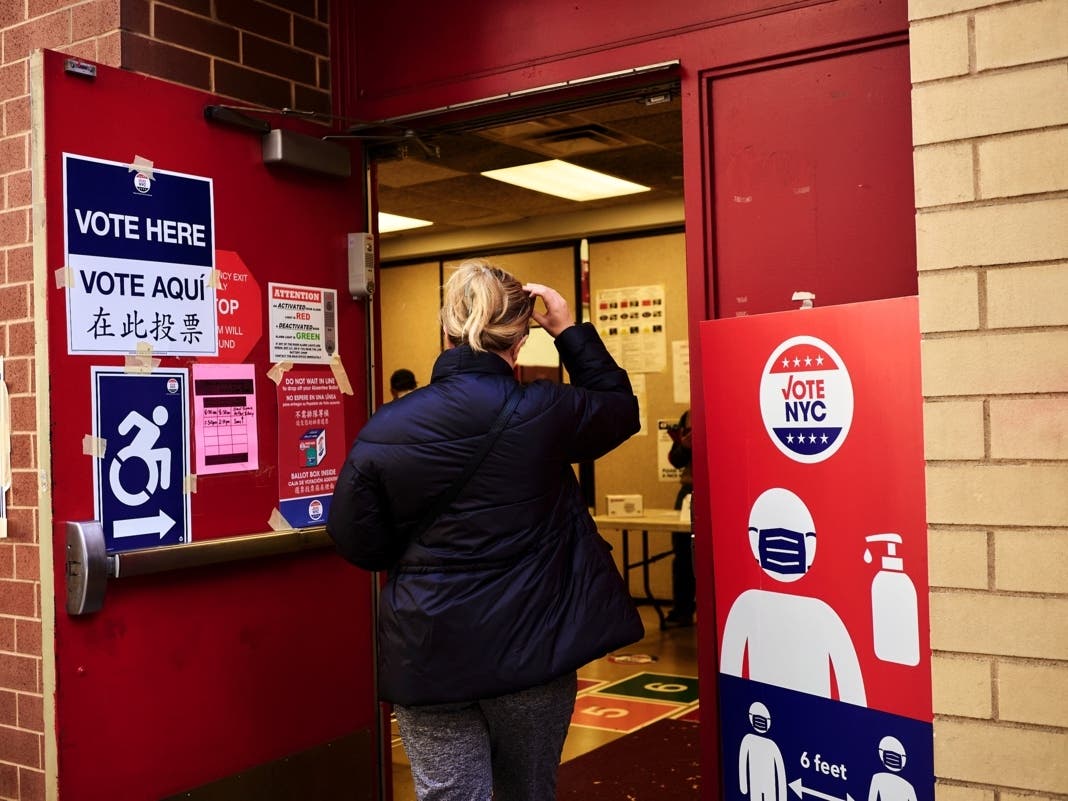
The debate likely could be the last chance candidates have to make an impression on many voters before the June 22 primary.
The third and final official debate unfolded inside Rockefeller Center's Studio 8H, where Saturday Night Live is filmed. And the lead-up to the debate resembled an SNL sketch as candidates turned increasingly competitive, bizarre and acrimonious as the June 22 primary approaches.
Moderators David Ushery and Melissa Russo, both with WNBC, Allan Villafana with Telemundo 47 and Sally Goldenberg with POLITICO kept the debate going at a tight clip with sharp questions crafted to each candidate.
They quickly turned the debate toward public safety.
Garcia, who is polling neck-and-neck with Adams for the lead in recent polls, faced an incisive question about whether her proposal to offer $2,000 gun buybacks actually won't bring more guns to the city. She responded such programs work and she's committed to get 10,000 guns off the streets.
“We have gone from a pandemic to an epidemic of crime,” she said. “I’m going to use every tool in the toolbox, including the gun buyback program, but also an expansion of the gun suppression division of the NYPD, including having neighborhood policing where they actually have the time to engage and build trust.”
Adams, likewise, faced an equally pointed question about his suggestions to bring back some aspects of stop-and-frisk and plainclothes NYPD anti-crime units.
“Let’s be clear I don’t want to return to anything,” he said. “I want to show how to use tools correctly.”
Other candidates, especially Morales and Wiley, put the emphasis on shifting funds and responsibilities from the NYPD and toward community and mental health services.
Morales, when pressed on her call to cut $3 billion from the NYPD, said the city's police department is perhaps the most-funded in the world.
“If there were a correlation between policing and public safety we would be the safest city in the world,” she said.
But Garcia, who mostly stayed above the fray, later said cutting police funds is the "worst idea" her competitors proposed in the campaign.
“These are complicated times and several of my opponents are using hashtags: #DefundThePolice,” she said. “I just don’t think that’s the right approach.”
McGuire, who throughout the debate weaved pointed barbs into his discussions of policy proposals with barbs, agreed.
"Let's be very clear for Black and Brown communities, neither 'defund the police,' nor stop-and-frisk...," he said, before being interrupted by Morales.
"How dare you assume to talk for Black and Brown communities," Morales said.
On homelessness, an issue that is often intertwined with crime, the candidates offered a raft of proposals to shift the city from a shelter system toward housing.
Stringer, for instance, proposed new developments set aside 25 percent of their space for affordable housing.
“We talk a lot about homelessness, but we never talk about providing a home,” he said.
Donovan, who served as President Barack Obama's housing secretary, called himself outraged there are more people sleeping on the city's streets and in the subways than during the Great Depression. He called for more supportive housing at the pace of 2,000 units a year.
“We need to reimagine our right to shelter as a right to housing and put that first,” he said.
Garcia said she's committed to building 50,000 units of affordable housing, as well as 10,000 units of supportive housing. And she called to increase the value of housing vouchers.
Yang listened to the proposals and shifted the conversation. He said mentally ill people who are homeless are changing the character of neighborhoods across the city.
Families concerned about safety are leaving as a result, he said.
“I’m frustrated by the political nature of these responses,” he said, before calling to rebuild “psych beds” for mentally ill people.
Stringer quickly shot back.
“That is the greatest non-answer I’ve heard in all of our debates,” he said, asking Yang to give specifics on cost.
Sharp elbows and responses continued through the night.
Wiley, who has racked up momentum in the campaign's final weeks, gave more succinct answers than in previous debates. But she balanced them with specific policy proposals.
When asked about whether they would integrate schools or improve their quality, Wiley — and other candidates — undercut the question's premise. Brown v. Board of Education shows that's wrong, she said.
"After Brown, we have recognized that a quality education is also an integrated education because we learn from one another, improve our critical thinking skills and we make this society more cohesive," she said. "I am going to end every discriminatory admissions practice in the system, but I'm also going to hire 2,500 more teachers."
Get more local news delivered straight to your inbox. Sign up for free Patch newsletters and alerts.