Health & Fitness
Hard-Hit Neighborhoods Fall Behind On Coronavirus Vaccine: Data
Newly-released data shows significant disparities in which New York City neighborhoods and ZIP codes have so far received the vaccine.


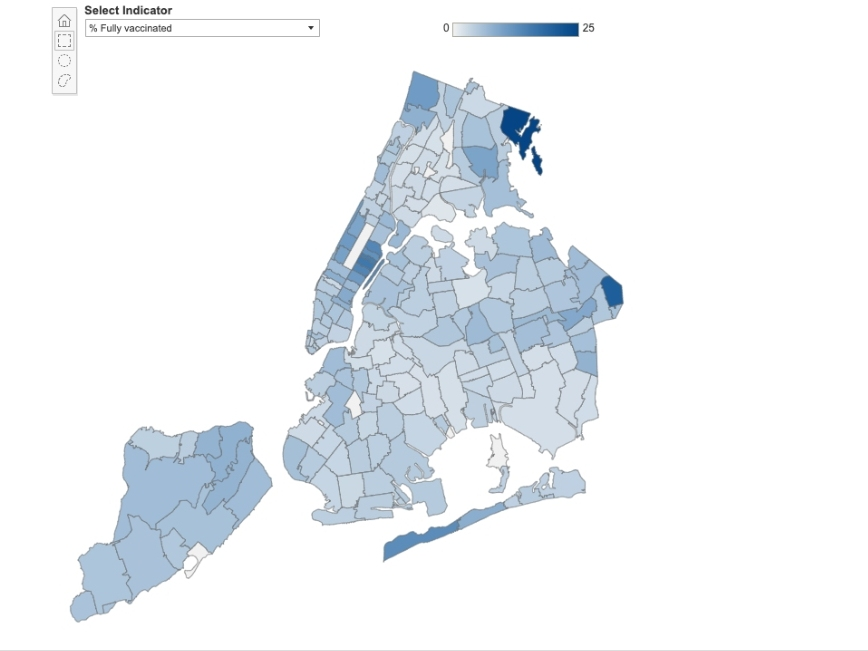
NEW YORK CITY — New York City's coronavirus vaccination effort has so far left behind the neighborhoods hit the hardest by the virus, according to newly-released data.
Large swaths of Brooklyn, Queens and the Bronx have 5 percent or fewer residents who received partial COVID-19 vaccinations, the ZIP code data shows.
That's far below the 10 percent of all New Yorkers who have now received at least one dose of coronavirus vaccine. Meanwhile, wealthy Manhattan ZIP codes and much of largely-white Staten Island hover at or above that average, according to the data.
Find out what's happening in New York Cityfor free with the latest updates from Patch.
Mayor Bill de Blasio acknowledged the disparities outlined in the ZIP code data released Tuesday but denied they showed a failure of his administration to vaccinate people of color and disadvantaged New Yorkers who both bore the pandemic's brunt.
"This is about addressing inequality, doing something very tangible about it," he said. "This effort will not stop. We are going to go deeper and deeper into the communities to ensure there's equity."
Find out what's happening in New York Cityfor free with the latest updates from Patch.
The data released Tuesday shows partial vaccinations — meaning people who received their first of two doses — and full vaccinations for all adults by ZIP code. It doesn't show those recipients' race or ethnicity, age or any other demographic data.
A Patch reporter asked health department officials about releasing that data but was told "what’s on the page is what is being posted."
Today @nycHealthy finally released vaccination data by ZIP code. I asked if they'd divide that further by race/ethnicity, age, etc. and was told "what’s on the page is what is being posted." @ByMattTroutman was going to ask the mayor about this but didn't get called on. https://t.co/57VmMwNFdb
— Maya Kaufman (@mayakauf) February 16, 2021
Three ZIP codes covering City Island in the Bronx, the Queens neighborhoods of Glen Oaks and Bellerose and Breezy Point on the Rockaway Peninsula have the highest percentages of adults who are partially and fully vaccinated.
Within Breezy Point, 27 percent of its adults have received at least one dose of vaccine, the highest percentage of partial vaccinations in the city data.
By contrast, the ZIP code covering Corona, Queens — once the "epicenter of the epicenter" during the coronavirus outbreak's early days — only had 3 percent of its adult residents partially vaccinated.
Corona falls within one of 33 hard hit neighborhoods de Blasio targeted in a push to ensure vaccine "equity." But like Corona, most of those neighborhoods — largely consisting of people of color and low-income New Yorkers — appear to have fallen significantly behind on vaccinations.
Brooklyn as a whole had 3 percent of its adult population fully vaccinated, followed with Queens and the Bronx not much better at 4 percent each.
By contrast, Manhattan and Staten Island had 7 percent and 6 percent of their respective adult populations fully vaccinated, according to data.
A closer look shows that largely white or well-to-do ZIP codes simply gave out more shots. The 10025 ZIP covering parts of Morningside Heights and the Upper West side counted 15,423 people who had at least one dose — the most of any in the data.
Not far behind were Staten Island's 10314 and a slew of ZIP codes covering the Upper East Side, more of the Upper West Side and other affluent Manhattan areas. All had more than 10,000 people each who received at least one dose, the data states.
Not far away, were three Central Harlem ZIP codes that hovered at or just above 1,500 people each who received at least one first dose, according to the data.
Similar disparities were vividly apparent in maps.
Member Mark Levine contrasted that disparity in a tweet comparing maps depicting fatalities from COVID-19 and vaccination rates.
"This is upside down," he wrote. "It can not stand."
BREAKING: NYC releases, for first time, data on vax rates by zip code. In wealthy, whiter areas, 16% of adults have been fully vax'd. In low-income neighbs of color, as low as 2%. Map on left is covid fatality rate. On right is vax rate. This is upside down. It can not stand. pic.twitter.com/Kiw2JrFeMl
— Mark D. Levine (@MarkLevineNYC) February 16, 2021
Torian Easterling, the city's chief equity officer, said the vaccination map will provide a "roadmap" to further vaccination outreach efforts.
He said many people in those neighborhoods harbor doubts about the vaccine's safety.
De Blasio likewise said more needs to be done to boost confidence in the vaccine itself. He said people doing well in society are also those with the most confidence in the vaccine.
"We have a real distrust problem we have to overcome," he said. "The very communities that need the most help ... have the highest distrust."
Take a look at the ZIP code data here:
Get more local news delivered straight to your inbox. Sign up for free Patch newsletters and alerts.