Arts & Entertainment
Hollywood's Secret “Semi-Covid-Safe” Film Sets
How some non union projects quietly got back to work
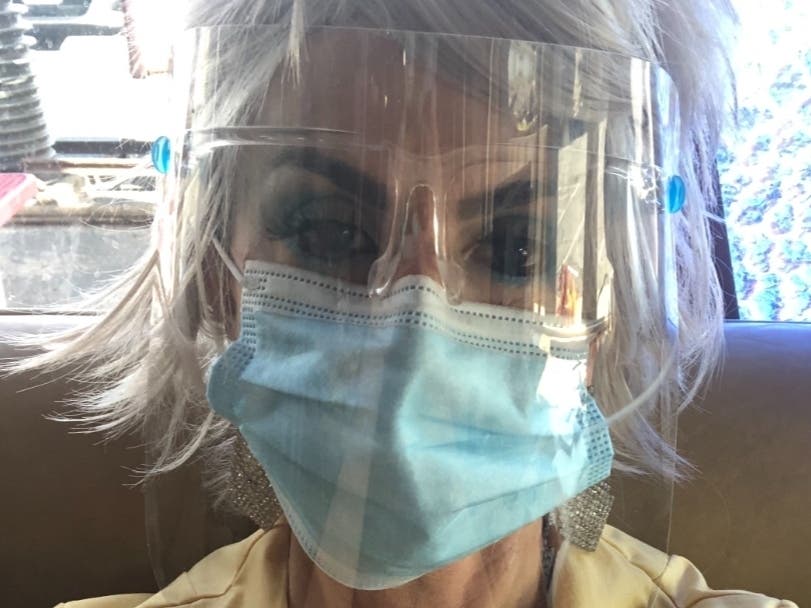

Are you a hermit? Been anchored down inside your domicile the entire pandemic? Never stepped inside a store? A restaurant? Had everything delivered? Then...we are grateful!
Unfortunately, the truth is, most of us are “Semi-Covid-Safe,” (SCS) and sailing uncharted waters. We, the brazen and reckless, venture into grocery, pharmacies and hardware stores. We dine outside; frolic at parks and beaches. Hopefully, we wear masks and cover our mouths and noses. (Apparently, many Homo sapiens are stumped as to where human breath emanates from). Some of us wear gloves. We "social distance," stay inside “bubbles,” and wash hands. But have you ever had a close call? Been crowded in an aisle? Passed by an “unmasked”? Have you ever forgotten your mask? Or to wash your hands before accidentally rubbing your nose? Unless you are a hermit -- or in the NBA -- to be 100% Covid-safe is impossible. “Semi-Covid-Safe” is our new reality.
In the beginning, film industry unions worked swiftly and effectively to protect members and everything was shut down. Earlier this week, an agreement with the major studios was signed by: Directors Guild of America; International Alliance of Theatrical Stage Employees; International Brotherhood of Teamsters; SAG-AFTRA; and Alliance of Motion Picture and Television Producers for new, on-set safety protocols which will hopefully get us back to work. But these standards are costly and labor-intensive. Many Hollywood productions had already abandoned ship and sailed to Covid-safe shores (New Zealand, Australia, Canada). Many switched to non-union. It will take time to learn what impact this had on the future of the industry in the USA.
This is the story of how my colleagues and I worked SCS in the non union world, what I learned, and my own personal How-To Guide for Semi-Covid-Safe non union sets.
Find out what's happening in New York Cityfor free with the latest updates from Patch.
When the pandemic hit, my booked acting projects got postponed and started to backlog. At first, we Zoom-rehearsed. Later, producers would check in with something like, “We don’t know when we are shooting but hope you're still on board.” I responded, “Well, of course I am. I’m battened down in sweatpants, my roots are showing, and I’m drowning in dirty dishes.”
Then, miraculously, four projects were green lit. A few brave (or reckless?) non-union souls ventured forth; pirates of uncharted waters. A loyal sailor, I put on my life vest and climbed aboard, albeit with trepidation. So far, I have acted in two Covid-Safe projects and two Semi-Covid-Safe projects: a Full Length feature; a 30-minute TV series episode; a 30-minute chapter of a Web-based film; and a Podcast. More than a month has passed and no one got infected.
Two projects involved content that required no interaction with others, so were thereby 100% Covid-safe: A podcast where we each recorded separately; and a new media film comprised of vignettes of monologues. The director, cinematographer and crew were live via Zoom while I performed 15 monologues plus the duties of: camera operator; camera assistant; grip; hair; makeup; and costumes. It was a lot of work but got me out of doing laundry.
Find out what's happening in New York Cityfor free with the latest updates from Patch.
Two Semi-Covid-Safe (SCS) projects and how we did it:
The TV Series. Prior to filming, the entire crew got Covid tested. The production team was granted a “Safe Sets International Covid-19 Level A Certificate.” I have no idea of the efficacy of this organization. They did provide a nice 8x10 plaque for display. We were all sent official-looking documentation to sign. Once affirmed Covid-negative, we were all asked to lockdown for a week before filming. I was worried about false negatives which were not addressed on this project. On set I was greeted by a temperature-taker and asked the standard Covid questions. Craft service was all individually wrapped or packaged. We ate meals and snacks outside. There was hand sanitizer and a good supply of soap and water everywhere. A designated person was constantly walking around wiping and cleaning, I called him the “Sanitizer.” As actors, we are the most at risk when filming mask-free. I increased my safety by bringing my own food, isolating myself in a back room, being on set only when absolutely necessary, doing my own hair and makeup. (If hair and makeup are not wearing N-95 masks plus a face shield, I’m not comfortable).
The Full Length Feature. The initial audition was a self-tape. They had a big group callback that sounded unsafe, so I turned it down. Later, they requested I come in privately with just the producer and director masked-up, 6’ away, open doors, in the production office. After the callback, one of the producers said, “I will never make my crew wear masks.” I thought to myself, “Let’s see if he changes his tune by the time we shoot.” If he did not, I decided, I would back out. Sure enough, by the time we shot, he had changed his tune. (By then, the national death count was mounting). We did rehearsals with masks, on an outside deck, but did have to get closer than 6’ during certain blocking. During filming, we had a small crew and shot in an actual unpopulated ghost town. Every morning before I left my motel room, I was greeted by the "Sanitizer." We were given Covid safety reminders under our door every evening and individually wrapped food was brought to everyone. The crew was masked up. Again, I increased my safety by bringing my own food, isolating myself, doing my own hair and makeup. The production team used actors in disguise to double as background.
In these two SCS projects, many safety precautions were taken. But, in hindsight, there was room for improvement. Because of that, I’ve compiled the following How-To Guide. It is not as effective as what union projects are doing, and it is far from perfect, but I believe this is a simple, inexpensive way for non union projects to mitigate risk and get back to work.
My Personal How-To Guide for Semi-Covid-Safe sets:
- Choose locations that take place outdoors and/or with good airflow
- Create content with as few actors and background as possible
- Invest in a strong HEPA filter and fans. Open windows between takes and camera set ups
- Individually wrap all food and drink
- Require the entire cast and crew to take three Covid tests with 3-5 days in between each
- Request that the entire cast and crew lockdown while in this pre-production Covid-testing phase and while in production. (You can’t guarantee compliance, but you mitigate risk because most people will comply)
- Hair, makeup and costume departments need to wear N95 masks and face-shields around the actors
- Hire a dedicated “sanitizer” person to:
1. Enforce proper mask protocols & hand them out (i.e., cloth face masks are not efficacious; masks worn below the nose are useless; hair and makeup people need extra protection). The entire crew needs to be reminded that the actors are the ones most exposed. We have to remove our masks.
2. Collect & keep track of cast and crew Covid test results
3. Issue preproduction lockdown reminders and stay-home agreements before & during filming
4. Give daily Covid safety briefings
5. Take daily temperatures & give the standard AMA Covid health questionnaire
6. Enforce the 6’ rule where ever possible & mark 6’ seating areas for breaks
7. Continually wipe down all surfaces, switches, handles, etc.
8. Open windows and turn on fans and air filters between takes and/or camera set ups
9. Make sure soap and sanitizers are well stocked
10. Give constant reminders to wash hands
Don’t take my word as gospel. Don’t be careless. Don’t take risks. Keep in mind that every time you leave the house, you are putting yourself and potentially others at risk. I am aware that many people would feel unsafe working within the parameters stated above or even with the union protocols. Some may even be appalled by what I have written. However, we are all in unfamiliar waters now and we each have to chart a course that gives us comfort. My philosophy has been to mitigate risk to the best of my ability, stay away from anything that makes me feel uncomfortable, and sail forth to keep working -- because without my work, I feel my soul drowning.
--
Follow on Intagram: @maureenkedes
www.maureenkedes.com