Neighbor News
Inside the Many Worlds of Bill Westmoreland
From NYC portrait studios to pastoral fields, Bill Westmoreland reflects on four decades of image-making across art, fashion, and music.

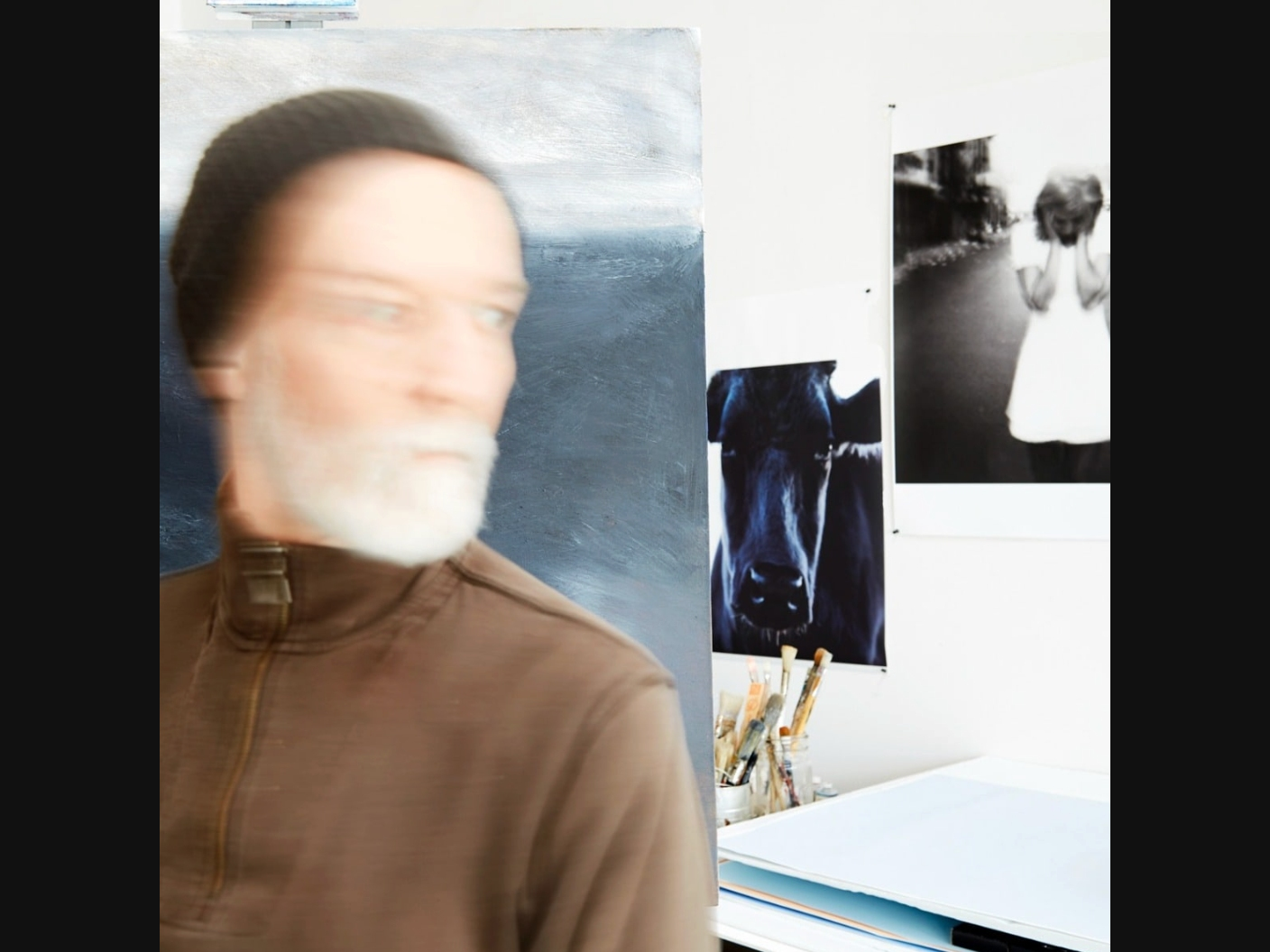
Bill Westmoreland has spent more than four decades moving between worlds that rarely sit still. In New York City, his portraits have quietly defined eras of music, fashion, and performance culture, capturing not just likeness but interiority. In editorial and beauty spaces, his work as a hair and makeup artist sharpened a sensitivity to light, texture, and trust that still anchors his photographic eye today. And beyond the city, in the stillness of upstate Pennsylvania, his camera turns toward something even more unguarded: cows, rendered with the same emotional precision he brings to his human subjects.
A collaborator to some of the most influential image-makers of the last half century, Westmoreland’s career has unfolded in layers rather than lines. From his early years in Paris to his arrival in New York in 1979, he built a practice rooted in intimacy and instinct, working alongside icons while developing a visual language unmistakably his own. Across portraiture, editorial work, album imagery, and exhibition projects, his photographs hold a rare balance of glamour and vulnerability, presence and restraint.
As Visual Director of brutjournal and co-publisher of its Annual, Westmoreland also operates as a curator of contemporary visual culture, shaping how emerging and established artists are seen within a broader creative conversation. His work has become both archive and invitation, documenting the edges of contemporary image-making while expanding what it means to look closely.
Find out what's happening in New York Cityfor free with the latest updates from Patch.
In this conversation, Westmoreland reflects on the overlapping disciplines that have defined his life, the quiet discipline behind his most recognizable images, and why the most enduring work often comes from attention rather than spectacle.
Your work spans photography, hair & makeup, and editorial direction—how do these different disciplines inform each other in your creative process?
Find out what's happening in New York Cityfor free with the latest updates from Patch.
The best part is that I can meet with the photographer/hair and makeup/editor (Me!) before the shoot to create a specific look/lighting/style and direction.
You’ve photographed both iconic musicians and everyday subjects like cows. What draws you to a subject, and how do you approach capturing their essence?
Capturing their essence is important to me so I try to photograph subjects in an environment that is familiar to them. For singers/musicians I try to do a “performance” shot by creating “stage lighting” and backgrounds….. For cows its very simple—I photograph them standing alone in a field—where they spend a majority of their time. I like to take “portraits” of cows.
Looking back on your early career in Paris and then New York, what experiences shaped your visual style most profoundly?
I’ve always loved watching people on the street and I think both in Paris and New York that was very influential for me. Photographing these people on the street and keeping those images for inspiration. I was booked to photograph an event at the American Embassy in Paris and there was one other photographer there also, Bill Cunningham. What an evening, what an inspiration, watching him work.
You’ve collaborated with legendary photographers like Annie Leibovitz and Robert Mapplethorpe. What lessons or insights from those experiences continue to influence your work today?
What I liked about working with them is they both maintain their vision regardless of art directors or creative directors who were on the set. On one job with Robert we were shooting for a jewelry designer. The client wanted a typical beauty shot that would emphasize the bracelets and earrings. Robert positioned the model with her hands cupping her jawline, her elbows touching-- in a very symmetrical position…..it was really rather obvious but also magical……
Your portraits are often described as intimate and emotionally resonant. How do you create that trust and connection with your subjects in front of the camera?
I like to keep my set, kind of low-key, not a lot of loud music and people running around so that the subject feels comfortable and can hear me giving directions. Ha ha.!
BRUT Journal and the Annual showcase innovative contemporary work. How do you select artists and projects to feature, and what do you look for in a visual story?
For brutjournal we focus mainly on outsider artists, avant-garde artists and unclassifiable artists. We try to find work that is very singular and inspired by their own life.
Photography, fashion, and music scenes in NYC have evolved tremendously over the decades. How have you adapted to these shifts while maintaining your artistic voice?
I think as a photographer in these scenes, we have to lead a parallel life so that we capture those shifts as they happen.. Sometimes it’s more journalistic than artistic.
Many people are surprised by your celebrated cow photography. How did this project begin, and what does it teach you about beauty and attention to detail in unexpected places?
One day, I looked out of the window of my studio at my house in Pennsylvania and there were four cows about 5 feet away. I also noticed on the other side of the house that there were 17 cows in my yard. So I called the owners of the land and told him that the cows have gotten out of the fenced-in area. This was my introduction to cows so then instead of the cows coming to me I went over through the fence and stood with the cows and started photographing them. It’s quite amazing. Some of them were very inquisitive and gentle others were aggressive, so I had to be very aware. It’s when I started photographing the single cows that it became more interesting to me because I was on a one-on-one, shooting their portrait, as opposed to shooting a herd of cows in a big field.
For emerging photographers or creatives hoping to work across multiple mediums, what advice would you give about building a sustainable, cross-disciplinary career?
I think one of the most important things to think about is you need to be an expert in each medium. So as you step from one position to another, you maintain the confidence to complete the project.
Looking ahead, are there new projects or mediums you’re excited to explore that your audience might not expect from you?
My undergraduate degree is in painting and drawing. For many years, I painted horizon line landscapes, and I was fortunate to be in a show called Horizon lines at Dorsky Gallery in Soho in the early 2000s. Along with Bryce Mardin and Sugimoto. I incorporated those ideas into my photography and created a “drive-by“series of blurred landscapes that looked a lot like my paintings Lately I’ve been kind of dipping into the old painting ideas. So I’ll see where that takes me.!!!
Discover more of Bill and his work at: billwestmoreland.com/