Politics & Government
Rent Guidelines Board Sued by Landlords for Rent Freeze
The Rent Stabilization Association has filed a suit against the Rent Guidelines Board for passing another rent freeze for the upcoming year.


New York City, NY — A group representing landlords of rent-stabilized buildings filed a lawsuit Thursday against the Rent Guidelines Board for approving a rent freeze in June.
The Rent Stabilization Association, which represents 25,000 landlords, filed its suit in Manhattan State Supreme Court in an attempt to "put the rent freeze on ice," according to a press release sent to Patch. The RSA press release said the rent freeze was passed "on criteria outside the scope of the Rent Stabilization Law and to accommodate Mayor Bill de Blasio's political agenda."
Want more New York City news? Sign up for Patch’s free daily newsletter and breaking news alerts
If the RSA gets its way a rent freeze passed by the RGB during its June meeting could get thrown out by a judge. In that case, the RGB would be forced to pass new rates for rent-stabilized apartments, which could result in a rent increase.
Find out what's happening in New York Cityfor free with the latest updates from Patch.
In June, the RGB voted to freeze rents on one-year leases and raise rents by 2 percent on two-year leases for rent-stabilized apartments and lofts. Seven members of the board voted in favor of the proposal and two abstained. The two abstaining votes came from the two board members representing landlords. The new rent rates will apply for all leases signed starting Oct. 1, 2016 and ending Sept. 31, 2017.
The RSA argues that instead of taking into account data and studies, the RGB's decision to freeze rents was politically motivated.
Find out what's happening in New York Cityfor free with the latest updates from Patch.
“The RGB, through the rent freeze, is inappropriately and unlawfully providing a rent subsidy to all tenants regardless of need," said Joseph Strasburg, president of the Rent Stabilization Association. "The rent freeze is not based on need, but rather on the perceived inability of tenants to pay, and to accommodate de Blasio’s political agenda of gaining favor with a large segment of the city’s voting block."
The lawsuit also argues that the RGB improperly factored in tenant affordability when deciding to freeze rents. The lawsuit argues that the board violated the Rent Stabilization Law and the Fifth and 14th Amendments to the U.S. Constitution by considering tenant affordability as a factor in determining rent rates.
In its lawsuit, the Rent Stabilization Association requested the following from the Court:
- To annul the rent freeze passed by the RGB in June as arbitrary and capricious.
- To declare the rent freeze unconstitutional on the ground that RGB's determination to take into account tenant affordability violates the separation of powers doctrine.
- To declare the rent freeze unconstitutional on the ground that once RGB has established a level of reasonable rents, reducing such rents based on the perceived inability of tenants to pay reasonable rents enacts a taking of property without just compensation.
- To order the RGB to come up with new rent guidelines for Oct. 1, 2016 to Sept. 30, 2017 in accordance with applicable law.
Andrew McLaughlin, executive director of the Rent Guidelines Board, told Patch that the board has not yet been served with the lawsuit and has no comment.
The RGB used statistics from reports commissioned by the board to draw up its final resolution during its June 27 meeting.
One study, titled "2016 Price Index Of Operating Costs," used several different factors such as real estate taxes and insurance costs to determine a Price Index of Operating Costs. According to the study, the cost of operating rent-stabilized apartments has decreased 1.2 percent in 2016. The overall cost of operating these properties has gone down despite a rent freeze and rising real estate taxes and insurance costs. What could explain the decrease is the nearly 40 percent drop in the cost of fuel.
The same study calculated that the price of operating rent-stabilized buildings will increase a projected 5.5 percent next year.
There were approximately 840,000 rent-stabilized apartments in New York as of 2014, according to a March study from ProPublica. But there may be even fewer now. A study conducted by the Rent Guidelines Board showed an estimated net loss of 8,009 rent stabilized units in 2015. The Rent Stabilization Association claims the real number is closer to a million.
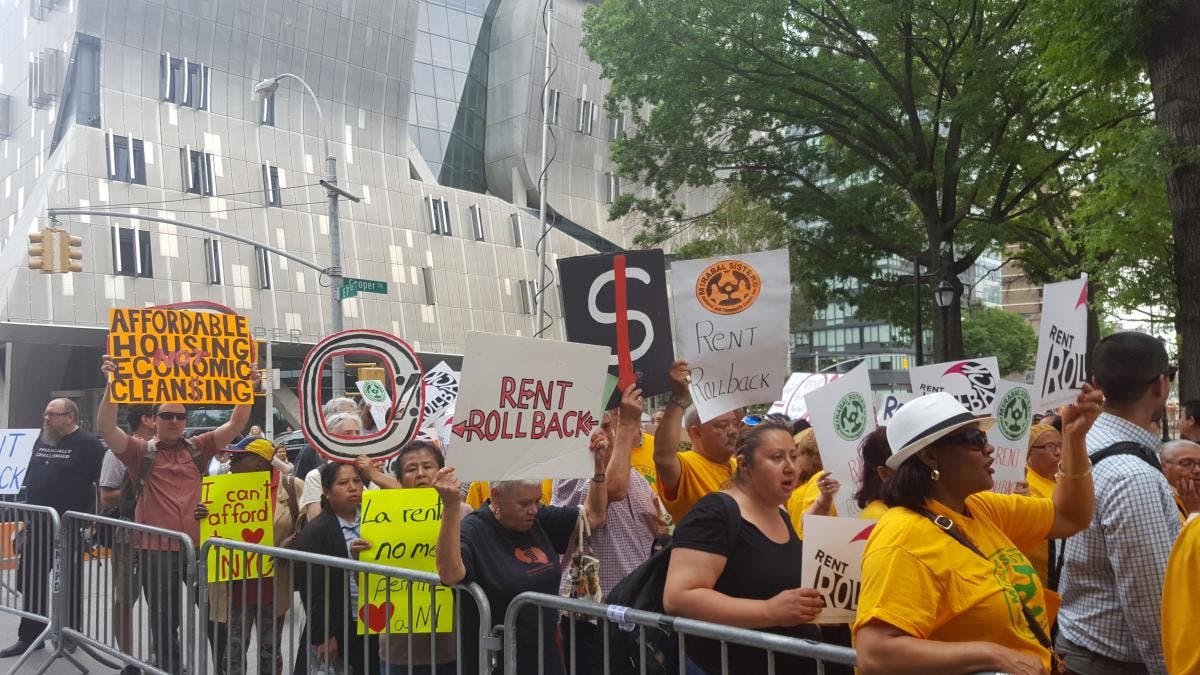
Photo: Picketers outside the Cooper Union Great Hall during the Rent Guidelines Board's June 27 vote. Credit — Brendan Krisel.
Get more local news delivered straight to your inbox. Sign up for free Patch newsletters and alerts.