Politics & Government
This Rustic Ferry Is Getting Dismantled In Queens To Become An Artificial Reef
The Prudence Ferry has been abandoned for years, but will get a second life in the waters off Fire Island this summer.

April 20, 2026, 5:00 a.m.
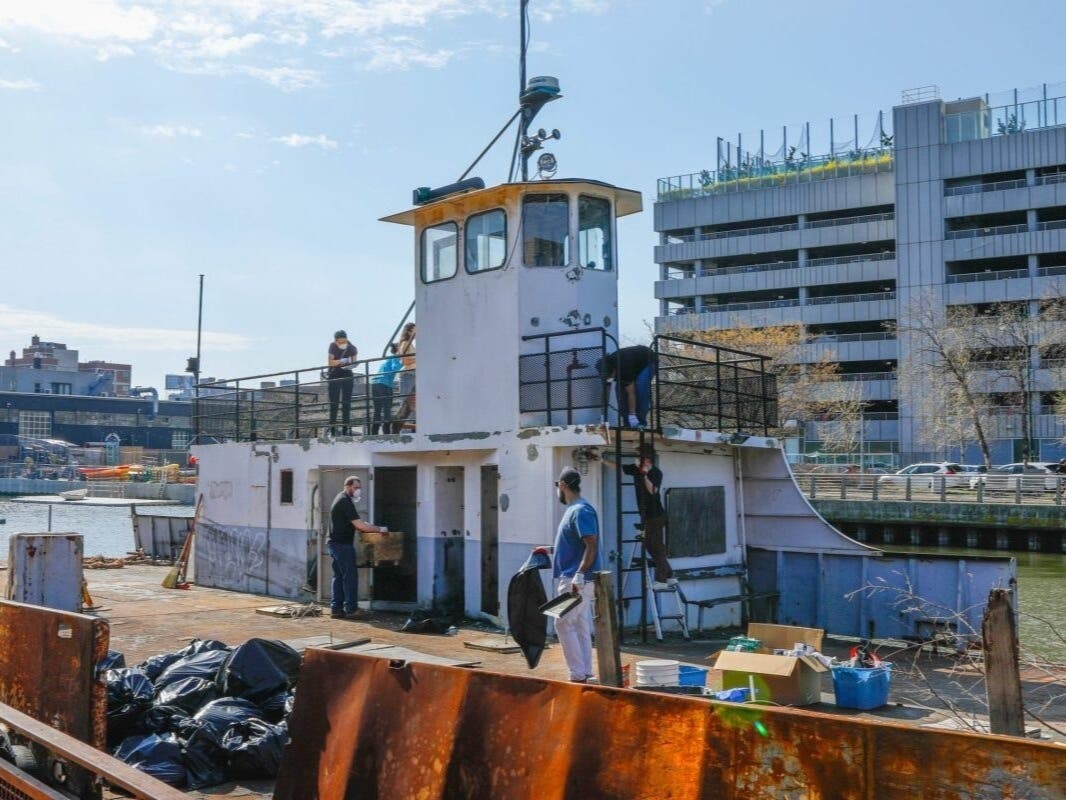
Behind the gate of a waterfront restaurant, a rusted ferry wobbles on the waves of the East River. It’s become a familiar eyesore for residents of Long Island City, Queens since it was first moored to the Anable Basin in 2012 and has floated there since, a forgotten lump of metal — until now.
Find out what's happening in New York Cityfor free with the latest updates from Patch.
The abandoned ferry, named Prudence, is getting a second life as an artificial reef. Each Saturday morning this spring, residents in masks and safety goggles leap from stable ground onto the ferry to remove any hazardous materials and make it fit for sea creatures to move in.
“This whole thing is going to just be covered in sea anemones and sponges and mussels and there’ll be fish everywhere,” said Harris Moore, 36, the local scuba diver behind the mission to sink the Prudence Ferry.
Find out what's happening in New York Cityfor free with the latest updates from Patch.
“Boats — they don’t last forever,” he said. “Better to sink it properly in a place where it’ll do good than have it just go down with toxic craziness.”
A Second Life
Volunteers have joined Moore since February to peel off old paint, cut wires and remove residual oils to prepare the ferry for its second life as a refuge for underwater critters. It will build upon the 16th artificial reef site, “Sixteen Fathom Reef,” part of New York’s fleet of reefs already sunk offshore, from Rockaway Beach to Mattituck.
“It’s a lot of paint chipping,” said Long Island City resident Formosa Huang, 25, who brought several friends to volunteer with her on a recent Saturday.
“A lot of sea animals like anemones are going to attach themselves to the boat,” she said. “If there’s paint that is going to come off easily, they might attach, fly off and then just drift.”
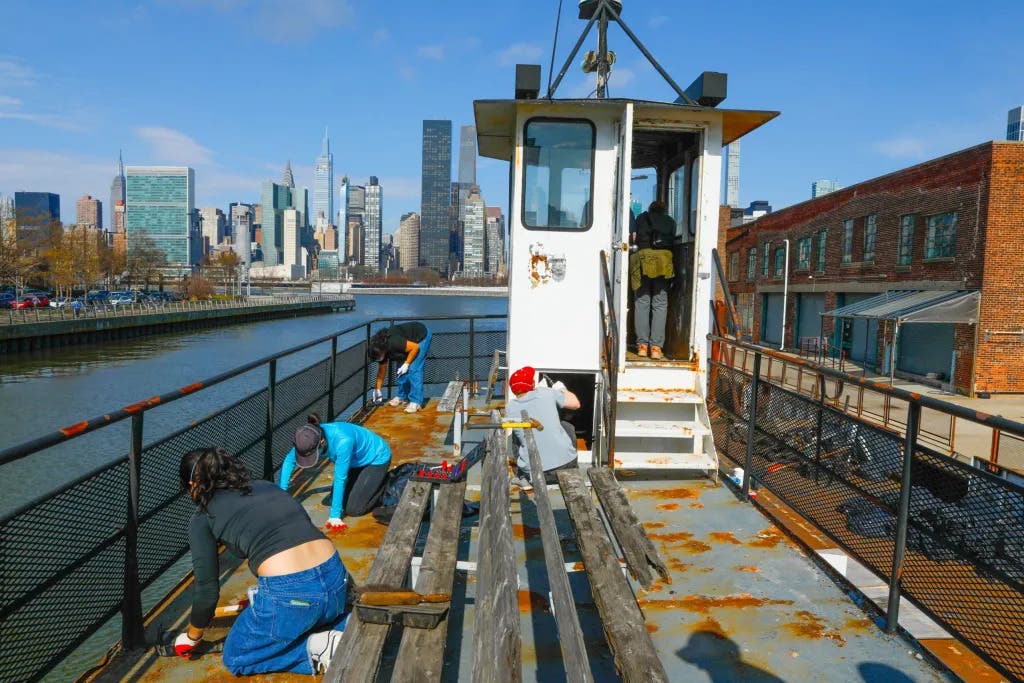
Paint and electronics are removed from the Prudence Ferry before it can become a reef, April 4, 2026. Credit: Alex Krales/THE CITY
Years ago, the Long Island City-based company Plaxall purchased the ferry to turn it into a floating beer garden that never materialized. After noticing the ferry languishing in the basin, Moore, a Long Island City resident, reached out to Bill Cadden, the retired marine engineer who founded Long Island Artificial Reef Society, a nonprofit that creates artificial reefs out of mostly boat vessels.
“They just wanted to get it off their hands,” Cadden said about Plaxall. “Companies do not want to incur the expenses of prepping the boats for artificial reefs.”
He plans to sink the ferry in June by strategically cutting holes at the sinking site. The ferry will then flood with water and go under, Moore explained.
Cadden’s past projects include sinking materials from the Tappan Zee Bridge and creating a reef as a memorial, he told THE CITY. He visited the ferry with Chris LaPorta, the reef coordinator from the state Department of Conservation.
The department runs New York’s artificial reef program, which considers whether plain concrete, rock or steel objects could be artificial reefs.
According to LaPorta, New Yorkers have been making artificial reefs for about a century, when fishermen in the 1920s began dumping butter tubs half-filled with concrete to enhance the ocean floor’s scarce marine habitat. The state’s official program began in 1962 and expanded under former Gov. Andrew Cuomo in 2018, himself a fisherman who doubled the artificial reef sites to approximately 6,800 acres.
Volunteer labor makes sinking the Prudence possible. As part of his nonprofit, Cadden frees companies like Plaxall from the responsibility of the vessel and provides for the state program.
“We don’t really have the funding to go out and buy material,” LaPorta said.
Many of the volunteers THE CITY spoke to said they did not know much about what it takes to prepare a vessel for reefing, but they were drawn to a project with a quirky nature.
“I like the idea of creating habitat when it’s declining,” said Long Island City resident Tina He, 33. “I read that the average American spends something like five hours on their phone every day, and I think people can find a lot more joy helping each other and working on shared projects together.”
It can be dirty work. On a sunny Saturday in April, volunteers crawled into the ferry’s tight spaces, disassembling its mucky toilet, sawing through thick wires and slowly picking at paint-covered surfaces as the boat rocked on the water.
Kyle O’ Connor, 28, who works as a video producer, told THE CITY he enjoyed the work’s “teamwork aspect.”
“It’s just such a cool setting, being able to be out on the water and see the city,” he said. “I feel like a lot of my job is sitting at a desk. I think it would be nice if everyone had a few more hours a week doing some kind of community-oriented manual labor.”
Creating Complex Habitat
For nearly a decade, the MTA prepped and sunk more than 2,500 rail cars in the Atlantic Ocean as part of a subway reefing program that ended in 2010. But not just any old piece of equipment can become a reef, according to Cadden.
“For a vessel to be donated and reefed, it needs to be made out of steel,” which is durable and unlikely to break into pieces that will resurface on the beach or become tangled in fishermen’s nets, Cadden said.
And he cannot just sink the vessels anywhere, which would be considered ocean dumping. Instead, state and federal agencies like the U.S. Army Corps of Engineers delineate reef sites that require permits.

Local volunteers clean the Prudence Ferry in Anable Basin, April 6, 2026. Credit: Alex Krales/THE CITY
These permits must be renewed to sink additional reefs and monitored to “show it’s not just a lump of concrete, or a chunk of steel sitting down there doing nothing, but producing the results that we said it was going to produce,” Cadden told THE CITY. (Divers and anglers can also sign up as volunteers who observe and document the reefs’ marine life.)
“After the materials are prepared and deployed, it doesn’t take very long,” LaPorta said. “As soon as fish find it — literally, they could be on it within a day — the growth begins.”
“What used to be an old vessel, in a matter of up to a year and then beyond, becomes completely colonized by anything from sponges, barnacles, hydroids and anemones,” he told THE CITY.
While the ferry may have little monetary value for humans, sea creatures can now benefit.
The Prudence’s current condition hits the sweet spot: useless to humans since it no longer runs, but with a structure stable enough for towing and sinking at the reef site.
“It’s basically only worth is what you could get for the scrap metal,” Moore said.
“It’s coming back in leaps and bounds,” Cadden, who is also a diver, said about marine life served by artificial reefs. “The last one I’ve been around, back rays are coming back into the area because the water is that much cleaner.”
“We have schools of menhaden and bluefish that we haven’t had in decades. You have whales right off the beach,” he told THE CITY.
“It’s not going to look like a Caribbean reef, but it’s prettier than you would imagine,” Moore added.
This press release was produced by The City. The views expressed here are the author’s own.