Home & Garden
Hudson Valley Quarantined for Dangerous Bug: MAP
State officials are trying to prevent a large-scale local infestation of the forest-killing Emerald Ash Borer, and you can help.


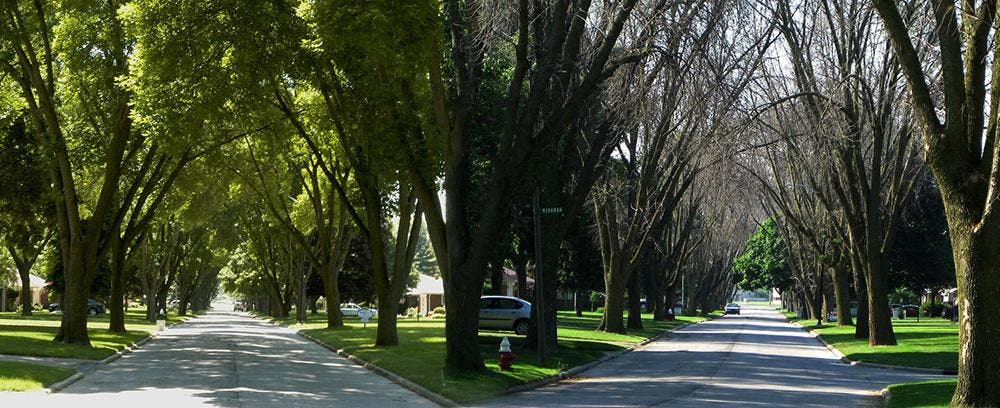
A dangerous insect, the emerald ash borer, has been found in Rockland County, and much of the Hudson River Valley corridor has been placed under quarantine to try to limit the infestation.
According to the New York State Department of Environmental Protection, EABs could kill all species of ash trees in the region, devastating neighborhoods, parks and forests.
The quarantine prevents movement of all species of ash trees out of the affected area. What does that mean for regular folks? John Wickes of Wickes/arborists in Spring Valley has the definitive answer:
Find out what's happening in New Cityfor free with the latest updates from Patch.
Don't transport firewood out of this area, whether you're going camping, planning a beach cookout, heading to a cabin in the Adirondacks, or whatever.
Seems simple, but in fact it has been proven to be the primary way the infestation has spread, Wickes said. "Dozens, dozens of people have been found driving on the Thruway with firewood, taking ash logs from quarantined areas into new regions."
Find out what's happening in New Cityfor free with the latest updates from Patch.
And if you're a property owner, keep an eye out. Warning signs of EAB infestation can include yellowing, canopy dieback and browning of leaves outside of normal foliage changes. Infected trees are considered high-risk and need to be removed as quickly as possible in the proper manner.
The emerald ash borer, native to Asia, is already responsible for destroying hundreds of millions of trees in the U.S.
"The baseball bat industry is freaking out," Wickes said.
The beetles were first discovered in Michigan in 2002. Since then they've been spotted in more than 20 states and several Canadian provinces, including areas in and around Rockland County. In New York, while they are concentrated in the northwest, officials from the Department of Agriculture warn that further spread is inevitable.
They are metallic green beetles less than an inch long, and they're highly invasive. While the adult will feed mostly off leaves, the larvae will feed off the inner bark of the tree, disrupting the tree's ability to transport water and nutrients. The emerald ash borers are recognizable by the D-shaped holes they leave in trees. Once infected, the host tree will typically die within two to four years.
The beetle devastates whole areas, like the neighborhood shown below.
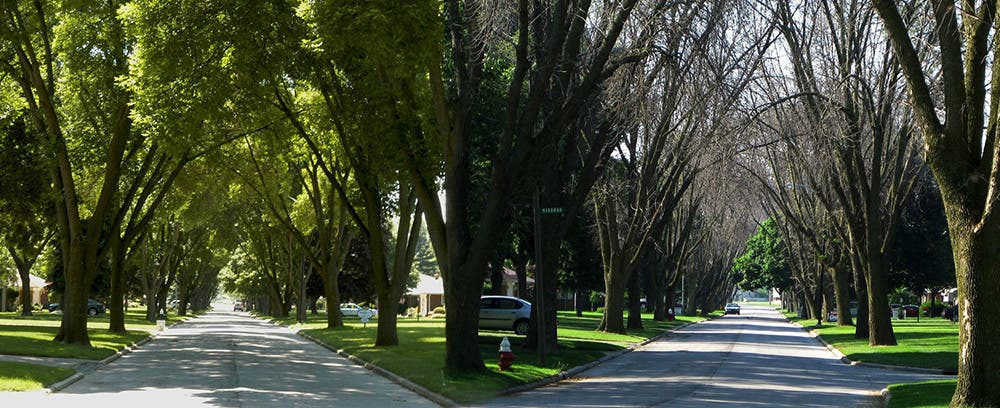
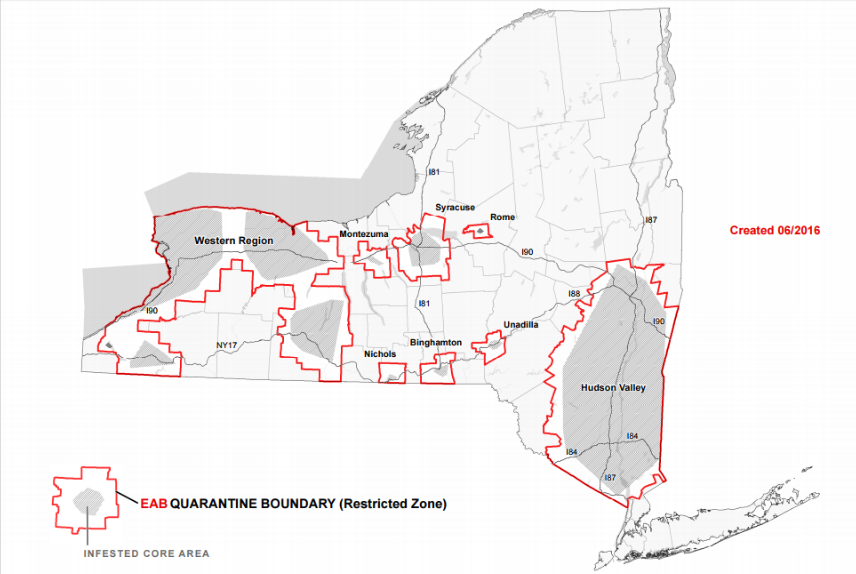
In order to limit a local infestation, the state Animal and Plant Health Inspection Service has put most of the Hudson Valley area under quarantine. The quarantine prevents movement of all species of ash trees out of the affected area.
Experts warn that without immediate action, severe tree loss could create a huge financial burden for the local economy. Prevention of tree loss is possible but requires proactive treatment before the infestation of EABs takes place.
In New York, quarantined areas are Binghamton, the Hudson Valley, Montezuma, Nichols, Rome, Syracuse, Unadilla and the Western Region, according to the DEC.
The DEC is asking residents to send digital photos of any suspect beetle such as an emerald ash borer (see what it looks like on DEC's EAB web page), as an expansion of its current swimming pool Citizen Scientist project.
Those that don't have a pool can still help. DEC expanded its photo collection to include anyone who spots a suspect beetle, whether or not it is found in their pool. Photos can be submitted to the forest health program email address listed below.
Step 1: Contact the Forest Health Program for a sheet to help identify insects collected. NYSDEC Forest Health Program, Attn: Jessica Cancelliere. E-mail: foresthealth@dec.ny.gov. Phone: 518.478.7813
Step 2: Take a picture of any insect you think might be an EAB.
Step 3: Send the photos of the insects that look like EAB to foresthealth@dec.ny.gov.
Step 4: Freeze the insect in a plastic container until DEC staff respond (typically that will take about a week). Staff will either instruct the participant to discard the insect or give instructions on mailing it, delivering it, or arranging for pickup.
Get more local news delivered straight to your inbox. Sign up for free Patch newsletters and alerts.