Schools
Summer Lab Teaches Teachers as Well as Students
Clarkstown school district math and science learning lab showing students and teachers innovative ways to tackle curriculum.


While the original version of "$10,000 Pyramid" debuted in 1976, decades before any of them were born, a group of students used the game's structure Tuesday to learn about simple machines.
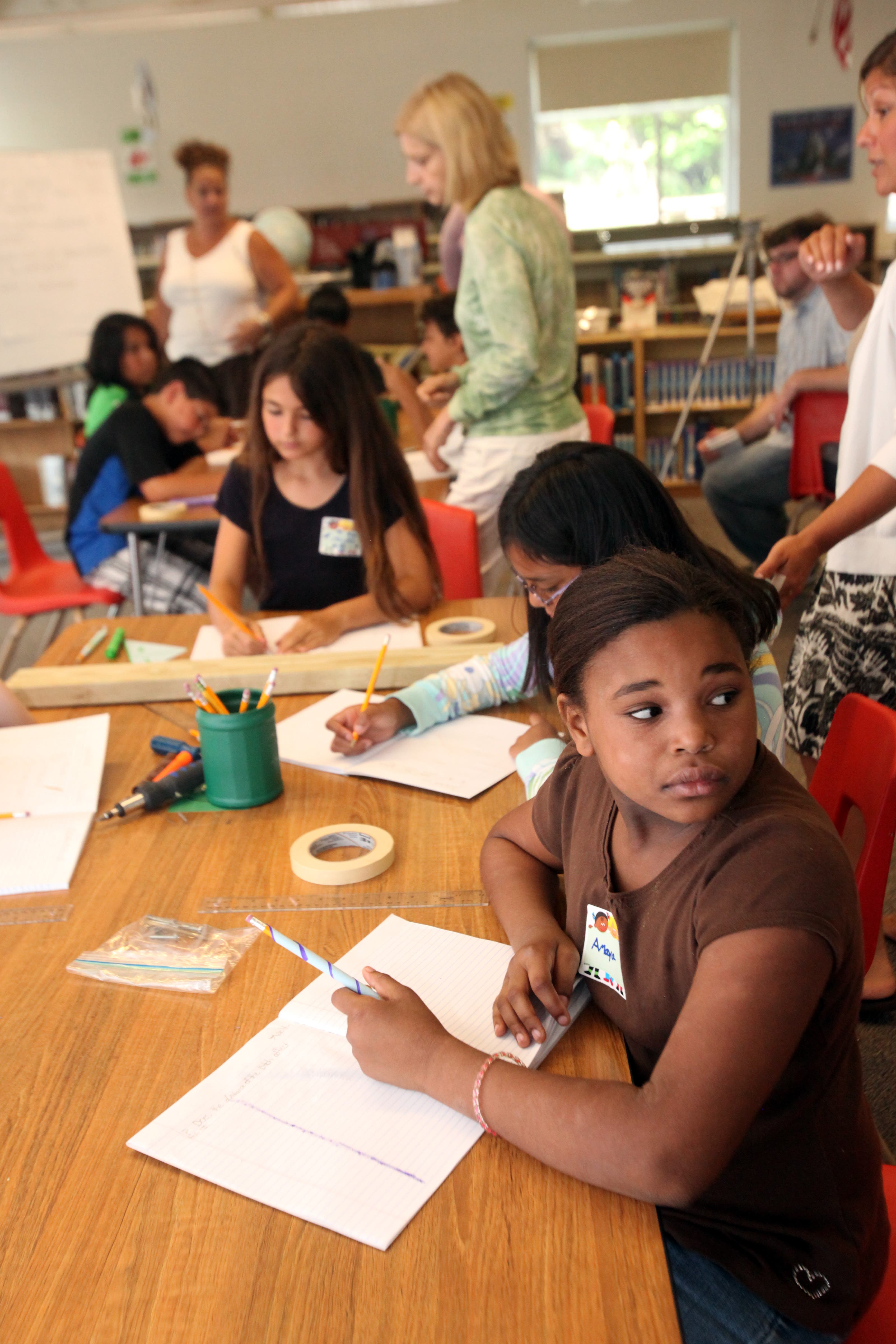
With the sun beating down on the grassy fields and blue jungle gym outside, the eight students who will all enter fifth grade in the fall met in the West Nyack Elementary School library. The students were participating in a math and science learning lab led by John Calvert and Kelly Dowd, both learning facilitators for Clarkstown Central School District.
This is the first summer for the labs, according to Dr. Valerie Henning-Piedmonte, the assistant superintendent of instruction and professional development.
Find out what's happening in New Cityfor free with the latest updates from Patch.
For roughly three and a half years, the labs were being done during school, but Henning-Piedmonte said to stop taking children out of the class, they started doing them after school last year and added two summer sessions this year. The other was last week for students going into fourth grade. Henning-Piedmonte said she thinks the labs will return to after school next year, with different subjects being spread throughout different elementary schools, and they will continue to be free.
The students, who came from various elementary schools in the district, were hand-picked by their teachers and principals to participate in the free four-day lab.
Find out what's happening in New Cityfor free with the latest updates from Patch.
"The students picked were ones that might've struggled a little bit last year, but showed they had an interest in learning," Henning-Pedmonte said. "Here they'll get more attention and they'll learn in fun ways. Plus, it's a way to stay connected to match and science while not in school."
But it's not just the students there to learn. Teachers from some of the elementary schools also sit in, observe how the lab is run and help the students with their projects as well.
"It's as valuable to the teachers as to the students," Henning-Pedmonte said. "They came to us and said, 'Just don't tell us how to do these things, show us.'"
The four-day lab's topic is simple machines (levers, wheels and axles, pulleys, inclined planes, wedges and screws). The lab uses technology and heavily hands-on techniques to teach the students, and show the teachers how to run labs in those more interactive ways.
On Tuesday's unit about screws, the students started their morning at 8:30 a.m. with a game of Pyramid. The group was split into two teams, and each team had to pick from one of the six categories, which were the six different kinds of simple machines. Each category then had four or five examples of that kind of simple machine.
When one team was going, one student had to sit in the "hot seat," a chair facing out at the students and away from the SMART Board, which displayed the words the children had to clue their teammate into guessing and the time remaining in the round. After each word was guessed, Calvert would drag a check mark down from the top of the board and put it next to that word, and click on the next number to then reveal what the next word was.
The SMART Board figured prominently into the lab. Not only did it let kids pretend to be in a room with Dick Clark, but right after Pyramid, they watched a short animated film on the screen that showed them how screws are just twisted inclined planes.
"In the new curriculum, technology plays a huge part in that," Dowd said. "We want to show the students, and the teachers, how the curriculum and technology can support each other, and how naturally they infuse with one another."
After the video, Calvert used a SMART Document Camera, a video camera that hangs aerially and projects onto the SMART Board, kind of like the more high tech, less clunky offspring of an overhead projector and a web cam. Using this, Calvert showed the students how to make their own screws using a pencil, paper triangle and tape. He also called up one of the students, Little Tor Elementary School's Amaya Kirkland, to demonstrate how she made her screw.
"It captures the visual element," Calvert said. "The technology is great, but we have to put it in the hands of the kids."
After that, the children go with a teacher's assistant to eat snack for a half hour while the teachers debrief with Calvert and Dowd about the morning's work so far. There, they talked about how they can use the Pyramid game, or others like Family Feud, to get multiple children involved with the lesson, and also do something that can incorporate multiple subjects at once. They also spoke about allowing the children to redo things if they get them wrong.
"Many time as teachers, we have a tendency to do a Mother Hen thing, and just tell the students what to do or fix things they get wrong," Dowd said. "And during the year, when you have 20-plus kids, that's easier to do just because there are so many of them. But it's better to let them figure out what they did wrong. They have to understand what they just did. The students' tendency is to just mimic whatever their teacher does, but don't really get what's going on."
Another way to combat that the teachers talked about was making them give short presentations on what they learned, or how they did the activity. Allowing the students to work past their mistakes and present their findings played a big portion in the second half of the lab.
The afternoon activity was twisting a screw into a block of wood and figuring out why different screws acted differently when being screwed into the same block. Before doing it, the teachers asked the students what questions they wanted to look into when doing the experiment.
Mimi Rogers, from West Nyack Elementary, asked "Does the distance of the pitch (the area between threads) affect the number of turns?" Nelvin Thomas, from Woodglen," asked "Does the pitch matter?"
And so the children went to work, under supervision of course. They twisted and turned their screwdrivers around until the head of the screw finally reached the block of wood, and then many did various types of arm dances to shake out the pain of getting the screw into the wood. After most of the screws were into the block, neither group could see a pattern in their findings, so they took them out and rethought their processes.
The teachers helped the students with the tools, but allowed them to come up with their own hypotheses and decided where to take the experiment after the first go-around didn't work so well.
"Those were happy accidents," Calvert said. "Recipes don't always go as planned. So by us having to redo some stuff, it's teaching the kids inquiry and to think through problems. I was really excited that things took a turn this time."
One group found that the smaller the pitch, the greater number of turns it took to get the screw down into the wood, and the other found that the Flat Head screws needed more force and energy to screw in.
After that, the children go with the TA once again, this time to relax for about a half hour before they get picked up at noon. While they are doing that, the teachers once again meet to debrief.
"There was a huge improvement today from yesterday in how into the activities the kids seemed, and that's what you want," Calvert said. "The girls seemed really excited to use the screwdriver. Mimi and told me she's watched her dad do it, so she wanted to."
This time, the teachers talked a lot about letting the students use trial and error in experiments, and how by integrating fractions into the experiment, it helped show the students that subjects can overlap. They also planned on switching up the groups later in the week to see how the students act when in mixed gender groups for their experiments.
All while discussing this, as well as during the lab, the teachers are taking notes and filling out sheets of paper focusing on what they see in the classroom environment and the instruction. During the debriefing sessions, Dowd, much like she would when teaching the students, goes around the room and makes sure everyone gets a chance to share.
"You want the teachers to walk our learning something," she said. "You want to pick a subject they think can't be taught in a more interesting way, and show them how much more it can be."