Business & Tech
Comforting Families in New Hyde Park For 55 Years
The New Hyde Park Funeral Home strives to make their guests feel at home.


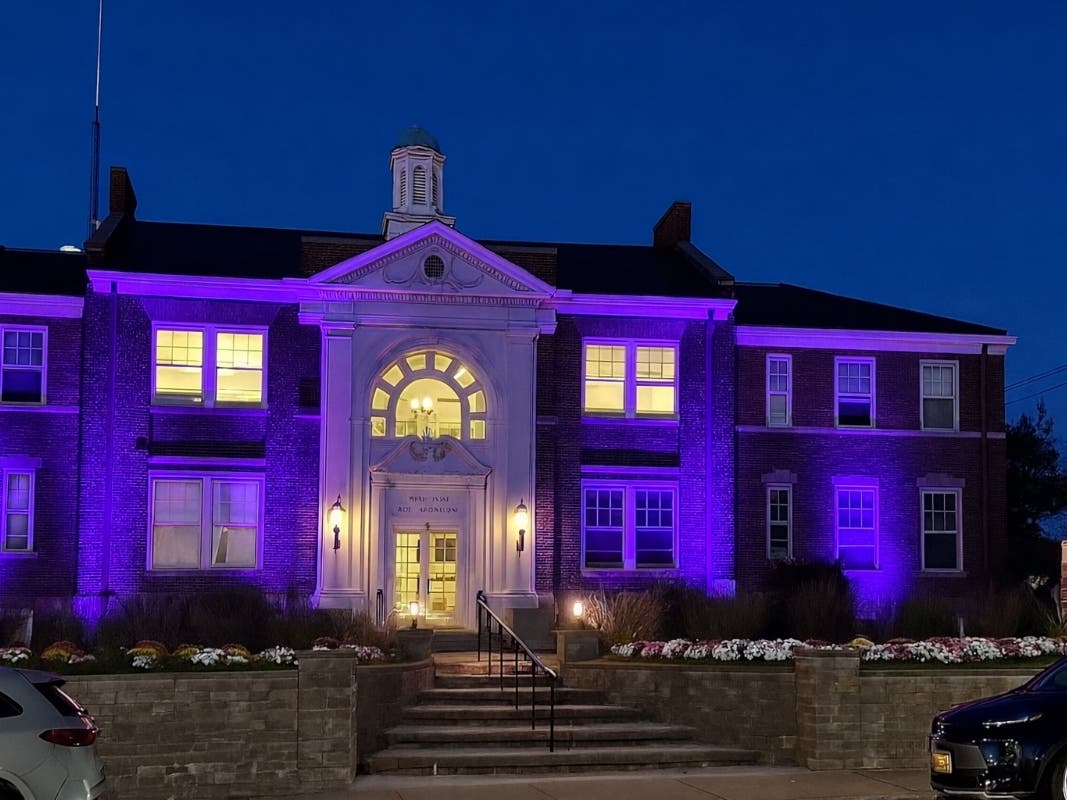
Joe Smolenski Jr. literally grew up in the funeral home business, living in the house at 506 Lakeville Road that now occupies the . The original home was expanded in 1956 into a spacious property that now encompasses more than half an acre, including the parking lot.
What strikes people about the New Hyde Park Funeral Home is the large living room with couches and chairs surrounding a fireplace. Nearby is a smaller living room with the focal point being a 300-gallon saltwater fish tank teeming with exotic fish. There is also a downstairs multipurpose room where kids and adults can watch TV, play games and admire the sports memorabilia and artifacts displayed on the walls.
If it were not for the parlor rooms, where the viewings are, you could mistake this place for your home. And that is the point.
Find out what's happening in New Hyde Parkfor free with the latest updates from Patch.
“We want the comforts of home here,” Smolenski said.
Purchasing a 300-gallon saltwater tank and keeping it filled with tropical fish is a large expense. And yet, it adds a comfort factor to the surroundings that cannot be measured in dollars.
Find out what's happening in New Hyde Parkfor free with the latest updates from Patch.
“People just sit there mesmerized by the beautiful colors and the fish,” Smolenski said. “People find it very soothing. I want to make them feel like guests in our home.”
What it takes to be a funeral director
Last year, the New York Daily News ranked funeral directors/morticians as one of the top 10 most stable jobs. Most people have no idea what the job entails, but if you think the only requisites are compassion for the bereaved family members and arranging, you would be mistaken.
Getting the accreditation to become a funeral director is akin to going to medical school, Smolenski said. College programs in mortuary science usually last from two to four years.
All states require funeral directors to be licensed. Licensing laws vary by state, but most require applicants to be 21-years-old, have two years of formal education that includes studies in mortuary science, serve a one-year apprenticeship and pass a qualifying examination.
In New York State, only a licensed and registered funeral director may make funeral arrangements for the care, moving, preparation and burial or cremation of a deceased person. At a minimum, the funeral director will file the death certificate, transfer the body, coordinate with cemetery or crematory representatives, make the necessary preparations, and move the body to the cemetery or crematory.
Smolenski said the curriculum is so rigorous that many would-be candidates do not complete school.
“You do nothing but go to school and learn the anatomy – every bone, every muscle. Everything associated with things people die from you have to learn," Smolenski said.
It is required that Smolenski complete six hours of continuing education each year.
“There’s a lot more to this profession than people think,” he said.
He said on average a funeral home handles 112 “calls” a year or two funerals a week. Each funeral requires approximately 32 man-hours, he said. There is no “average” week at a funeral home, no indication that business will be slow or busy.
“We’re on God’s schedule,” he said.
About eight years ago, there was a five-day stretch from the Wednesday before Thanksgiving to that Sunday when the New Hyde Park Funeral Home did 17 funerals. They worked through the holiday to accommodate the families. That is the unpredictability of this business.
The New Hyde Park Funeral Home employs five full-time workers but could hire dozens more on a temporary basis for a funeral. That could include everything from limousine drivers to pallbearers to greeters and other temporary employees.
Care and compassion are part-and-parcel of the service that funeral homes provide families and Smolenski said his staff is the best there is at helping families during the grieving process.
Still a family business
On Long Island, most funeral homes are family-run businesses. For Smolenski, the family tree is large and growing. His great uncle started a funeral home around 1917, primarily to serve new Polish immigrants to the country. The tradition passed down to his grandfather, father, himself and now his son, who runs a funeral home in Raleigh, N.C.
“We’re a business no one wants to use,” Smolenski said.
However, when you have to use it, he wants to make sure New Hyde Park Funeral Home provides the greatest comfort possible for the family.