Meet Kimrita Hill of Choice of New York. She was raped and abused as a child by her father and brothers, followed by a life of drug use, prostitution, violence to herself and others, incarcerations, psychosis, and hospitalizations throughout her ongoing mental health journey. She also lost custody of her children due to her drug use and became homeless. Throughout it all, always, she heard voices, twelve of them she counts, beginning when she was five years old. They remain with her today. She considers herself the 13th voice.
One day, 18 years ago, tired of jail, she decided to get sober and manage her illness. A few years later, while participating in a peer group program as part of her treatment, she met an executive from Choice who recognized that she had much to offer others with mental illness. Now, trained as a peer, with advanced education learned on the streets of Yonkers and Mount Vernon, mental hospitals, jail cells, and suicide attempts, she is likely the foremost professional peer advocate in the Westchester mental health system, if not in the country at large.
If you have ever wondered whether someone could be totally transparent and genuine with no walls, prevarications, or gilded lily spin, it is she. If you ever wondered if someone could openly confess and discuss the details of their transgressions with no reservations, including what she was thinking and experiencing in her mind, including the frequent participation of the “voices,” it is she. And if you wonder whether her emergence and commitment to helping others means she is free from managing her condition, the self-doubt, guilt, and stability part of her illness, she is not.
Find out what's happening in New Rochellefor free with the latest updates from Patch.
She is a peer advocate in the truest sense of the word and so much more. She is a therapist, educator, comedian, and storyteller. Her personal gravitas, realness, and brilliance could hold the attention of a concert hall as easily as a classroom or group discussion. This writer has seen it first-hand.
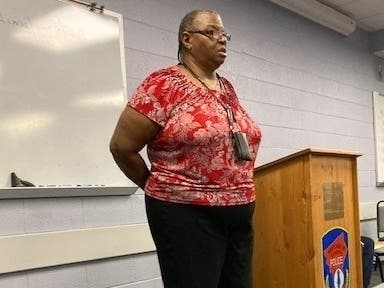
I was privileged to attend a presentation she gave recently to veteran police officers at the Westchester Police Academy about what it is like to have mental illness and what a police officer or other first responder is dealing with upon engaging with someone in crisis. She explained how what you see is not what you get. It is probable, she explained, that the mentally ill person does not see a uniformed first responder, as such. More likely, they see an animal or attacker of another sort, or they are screaming at one of their own voices. And if there is a true “psychotic break,” they will need professional intervention and may not even remember the interaction.
Find out what's happening in New Rochellefor free with the latest updates from Patch.
This audience was filled with experienced law enforcement professionals trained to look for deception or a motive of ill intent and not brought easily to a vulnerable emotional state. I watched these men and women react with laughter, introspection, sadness, and animated interest, transfixed not only by the stories that Kimrita told but by the woman herself. I will never forget the audible gasp of these seasoned professionals when she told of the time she cut her wrists in a suicide attempt, only to be admonished by an EMS technician who angrily told her, “Next time, cut down and not across, get it right” explaining that he was tired of responding to her. When asked by an officer if the police had done anything she felt was wrong, she said, “I really can’t say anything wrong about them except that I was a prostitute, and they utilized my services which is a violation of their code of ethics to serve and protect instead of helping.” The room was alive, and she was the life force, as she continued.
Kimrita gave us great insight into living with her voices. Kimrita made clear that she has come to terms with them, even the “bad’ ones, and that together, they manifest a whole self. As she puts it, “We are not ill, I am not sick, we are only different. I am normal.” She has developed ways to manage their input. For example, she learned to rip up paper and cardboard to deal with violent voices and brought down the house explaining how she takes great advantage of all the Amazon boxes arriving at her door, which she uses for that purpose. She emphasized, as she got rolling, that she liked her voices referring to them as alter egos.
What we learned and would learn still more, as the presentation continued, is that she will never be “normal” in the sense that most of us think of the word. She still has suicidal thoughts and powerful guilt at times and noted that the voices are always there, stressing that she was hearing them even as she was talking with us. Her strength is that it is she who CHOOSES what she will do and what she will act upon. “My voice,” she said, “is the 13th and final voice.”
More than 50% of the attendees had questions, many of them more than one.
In response to one inquiry, Kimrita replied that she isn’t even sure if she is ever happy, as she coexists with her voices and manages her medication. She asked the audience if they could define happiness. Their answers and her retorts held the group spellbound. Her sense of humor during the talk was exquisite and intelligent, if not a downright gift of genius. She gets it. But from it, one hopes that she does find joy in it. I could not help but wonder if this great gift developed as a coping mechanism from a life of pain. I also wondered, call it what you will, whether it be satisfaction, which she also challenged us to define, or just innate goodness, if she was fulfilled by what she is doing and has done for 10 years.
Towards the end, she moved about the room as she answered questions and even provoked some with her own directed at individuals. Into the aisles, across the front and back, and into the corner she roamed, like a minister to their flock. The more she went on, the more a larger sense took over the room. Kimrita Hill is a force of nature. And whether she knows it or not, more importantly, she is a force for love and understanding. All of us realized that we were in the presence of someone so rare, that we were rarely likely to come across someone like her again. It was, it is, as if the ongoing debates within herself fuel the love and passion that helps others as she helps herself, and by doing so, live a life of great meaning.
I for one will never be the same, nor will the police officers and other first responders who scrummed to get their picture taken with her and who gave her a robust ovation. At the meeting’s close, there was a common sentiment: All hoped that Kimrita will find the happiness that a life such as hers deserves.