Politics & Government
Metro North, LIRR Met New Federal Safety Guideline Early
The MTA installed auto controls after the fatal derailment in 2013.


Written by LANNING TALIAFERRO (Patch Staff)
Work done by Metro North because of the 2013 fatal derailment on the Hudson Line means that the MTA is already in compliance with a new safety guideline issued by the Federal Railroad Administration.
Metro-North installed an automatic train control system to control speeds at tight curves in Bridgeport, Port Chester, Spuyten Duyvil, White Plains and Yonkers.
Find out what's happening in New Rochellefor free with the latest updates from Patch.
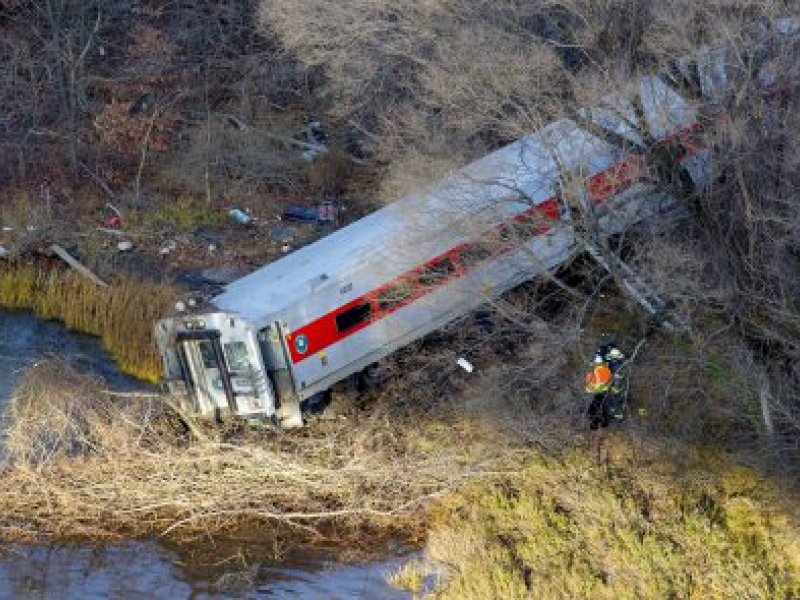
The derailment at 7:30 a.m. Dec. 2, 2013 killed four and injured nearly 60 people. The train was on its way to New York City from Poughkeepsie. The locomotive was on the north end pushing the cars southward. It took the curve—marked for 30 mph— at 80 mph.
Related:
Find out what's happening in New Rochellefor free with the latest updates from Patch.
- Deadly Train Crash Puts the Spotlight on Metro-North’s Recent Safety Record Again
- Harlem Line Tragedy: Safety Systems at Crossing Were Working, Investigators Say
- MTA Inspector General Harshly Critical of Metro North Field Communications Department
The “positive train control” is designed for sections of track where the train must reduce speed by more than 20 mph to negotiate a curve.
The FRA had already required the MTA to install the technology on its Metro North lines. On June 8, the federal agency recommended that all U.S. passenger railroads do the same.
The technology would not have affected the February 2015 crash that killed 6 on the Harlem Line—there the train traveling at the proper speed limit collided with a car that had driven onto the tracks despite the crossing signals.
Here’s the MTA’s full statement:
The Metropolitan Transportation Authority (MTA) announced that as a result of work completed in March 2014 in response to the Federal Railroad Administration’s Emergency Order 29, MTA Long Island Rail Road and MTA Metro-North Railroad are already in compliance with the recommendations made to all U.S. passenger railroads by the Federal Railroad Administration in its Safety Advisory 2015-03.
“Safety is the MTA’s top priority,” said MTA Chairman and CEO Thomas F. Prendergast. “We acted quickly and decisively in to shore up a potential safety hazard as soon as it was identified by the Federal Railroad Administration.”
The safety advisory recommends that all United States passenger railroads “identify locations where there is a reduction of more than 20 mph from the approach speed to a curve or bridge and the maximum authorized operating speed for passenger trains at that curve or bridge,” and “[m]odify Automatic Train Control (ATC) systems (if in use) to ensure compliance with speed limits.”
Under the enhancements to signal systems, a train that was traveling too quickly into a curve where a speed reduction of 20 miles per hour or more is required would automatically slow itself to the required speed in the event that the train’s engineer failed to do so.
The federal agency’s recommendation mirrors a requirement it issued in December 2013 to Metro-North Railroad, which the MTA also applied to the Long Island Rail Road. As a result, the LIRR completed modifications to its signal system by March 2014 to create automatic civil speed enforcement at seven locations: Hicksville on the Ronkonkoma Branch; Hicksville on the Port Jefferson Branch; Syosset; three separate locations between Hicksville and Huntington on the Port Jefferson Branch; and the Hall Interlocking east of Jamaica. And Metro-North did the same at Bridgeport, Port Chester, Spuyten Duyvil, White Plains and Yonkers.
Get more local news delivered straight to your inbox. Sign up for free Patch newsletters and alerts.