Neighbor News
Music Does More Than Soothe the Soul; It Keeps Seniors Affected by Dementia Connected to Their World
Music Therapy at United Hebrew of New Rochelle Eases Restlessness, Improves Mood, Creates New Memories for Loved Ones

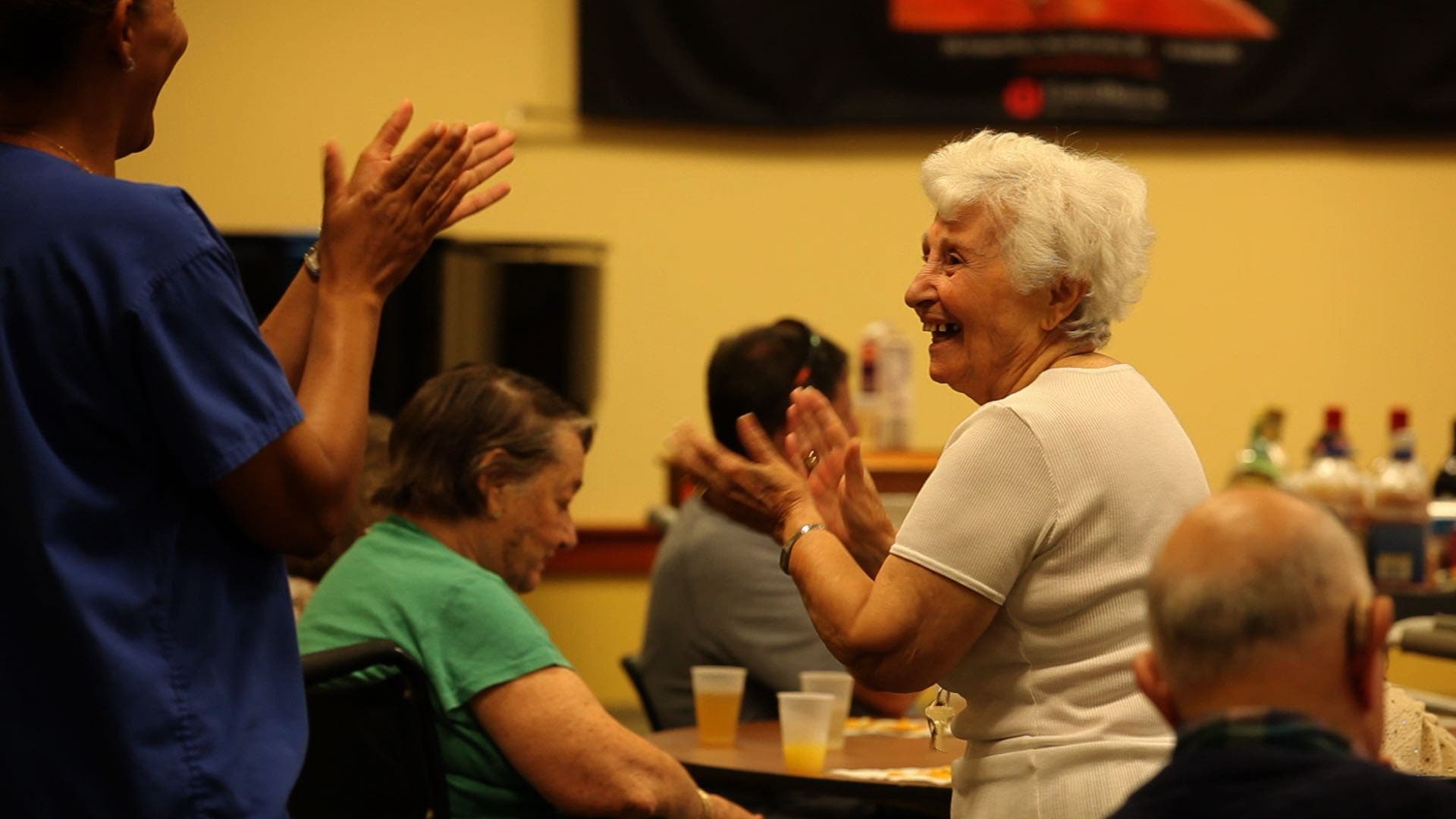
The former jazz singer now living at United Hebrew of New Rochelle doesn’t respond to very much. But when music therapist Michael Lahue sings old songs for her, she lights up.
“I play music and her eyes brighten,” said Lahue, the music therapist at United Hebrew, a non-sectarian, multi-service campus of comprehensive care. “You can tell she’s engaged because she’s hearing something she recognizes.”
Music therapy, a key piece of the dementia care at United Hebrew, is more than just a host of pleasant activities. For many residents affected by Alzheimer’s Disease and other forms of dementia, musical activities – singing, playing chimes or simply listening to Lahue perform music they remember from long ago – can connect them to the world around them, even when nothing else seems to reach them. It also can calm down a resident who has become restless and anxious, as is common among people dealing with dementia.
Find out what's happening in New Rochellefor free with the latest updates from Patch.
“You take someone who may be very restless and put an iPod on and let them go back to their own time and they calm down and really enjoy the music,” says Geri Brooks, Vice President of Geriatrics and Home Care at United Hebrew. “You might have someone who has no movement and does not respond to you, but when you put on those headsets, you see that person’s head move.”
Lahue, who came to United Hebrew in March 2015, uses music therapy several ways: engaging residents in group song, in Music and Movement activities that get them moving to a beat, and in muscle relaxation sessions. In some cases, Lahue sings and performs for residents whose only response is that moment of recognition in their eyes. Over the years, he has studied seven languages in order to sing songs from residents’ childhoods in Italy, Portugal or elsewhere.
Find out what's happening in New Rochellefor free with the latest updates from Patch.
“Music therapy helps patients both cognitively and by regulating their moods,” said Lahue, who was hired almost a year ago, replacing a part-time music therapist. “Even if they have trouble expressing themselves verbally, they can express themselves through music.”
The activities are part of United Hebrew’s approach to memory care, which includes stimulating activities and incomparable care in a secure environment, where adults with memory impairment continue to lead meaningful lives. This approach is used in working with residents diagnosed with mild cognitive impairment and those with Alzheimer’s disease and other related dementias across United Hebrew’s entire campus: In the Nightingale Neighborhood at the skilled nursing facility; the Phoenix Neighborhood and Griffen Program at Willow Towers Assisted Living; and as of March, 2016, at the new Willow Gardens Memory Care facility, Westchester’s only not-for-profit assisted living residence devoted exclusively to those with Alzheimer’s and memory impairment.
Of all the recreational activities at United Hebrew, music therapy is the most effective, says Mila Levine, Director of Therapeutic Recreation/Volunteers at United Hebrew’s skilled nursing and rehabilitation facility.
“Music therapy is really crucial,” said Levine. “Music is universal. It’s something everyone responds to.”
In addition to Lahue, Levine uses a music therapy intern for other programs. And once a month, folk singer and percussionist Alessandra Belloni, an artist in residence at the Cathedral of St. John the Divine in Manhattan, comes in to lead drum circles.
“The drum circle is very beneficial; it’s really amazing,” Levine says. “Somehow, all these people, many of whom have no idea how to create music, are now part of a percussion band. It sounds loud if you’re just listening to it, but if you’re part of the circle, getting into the rhythm, it actually has a very soothing effect. It’s a good way to combat anxiety.”
Lahue works with an art therapist at United Hebrew to sometimes link the approaches. When a resident nearing her 101th birthday began to sing a song she knew as a 14-year-old, Lahue looked it up and identified it as “Honey,” recorded in 1929 by Rudy Vallee. He also shared it with an art therapist, who used the lyrics as a basis for a collage that the residents created as an art project.
It’s not only the residents who benefit from the therapy. Visiting friends and family members can take part in it, too, and may find a new way to connect with a loved one. Even if they are not recognized or get no response to questions, they can sing and make music together.
“It gives them a way to interact with their loved one that they wouldn’t have with a simple visit and gives them a way to connect that they didn’t have before,” Lahue says. “There are these kinds of opportunities to engage where the family member shares a memory that they take away that’s positive.”