Community Corner
Safe and Responsible Seal Watching: DEC Offers Tips |On The Water
New York shares its waters with several species of seals, including Harbor seals, Gray seals and Harp seals.


NEW YORK — Seeing a seal on or along New York's majestic shores can be a transformative experience, but there are a few simple rules to keep in mind to make sure that experience is safe for both seal watchers and the wildlife.
According to the Department of Environmental Conservation (NYSDEC), New York is home to several species of seals. Although it can be tempting to get close when you see one (especially the adorable pups), it is critically important to keep a distance of at least 150 feet, officials warn.
Seals are a federally protected species under the Marine Mammal Protection Act. Keeping this legally mandated distance protects both people and the seal. Seals are wild animals that can injure people and pets, and spread disease — despite their often docile appearance. Likewise, the presence of humans can increase a seal’s stress and alter its behavior.
Find out what's happening in New Rochellefor free with the latest updates from Patch.
Sometimes, it's those with the best of intentions who can cause the most damage. It is normal for seals, even pups, to "haul-out" or rest on a beach. If bystanders take it upon themselves to embark on an unnecessary rescue attempt, they can cause problems for otherwise healthy seals.
If a seal appears sick or injured, officials say calling the New York Stranding Hotline at 631-369-9829 to report the animal is the bast action. Providing the location, details, and your contact information so that the New York Marine Rescue Center's trained biologists and staff may assess the situation as well as the condition of the animal will result in a far better outcome than trying to save an animal that might not need saving.
Find out what's happening in New Rochellefor free with the latest updates from Patch.
According to the National Oceanic and Atmospheric Administration (NOAA), photographing seals can help to raise awareness of the animals we share our coastlines with, but only when taken from a safe distance. Seals are sensitive to being disturbed and approaching more closely can cause them to become stressed or leave the area. If the seals start to vocalize more, start looking at the observers as they approach, move away, wave flippers or increase their yawning, they are telling spectators to back away.
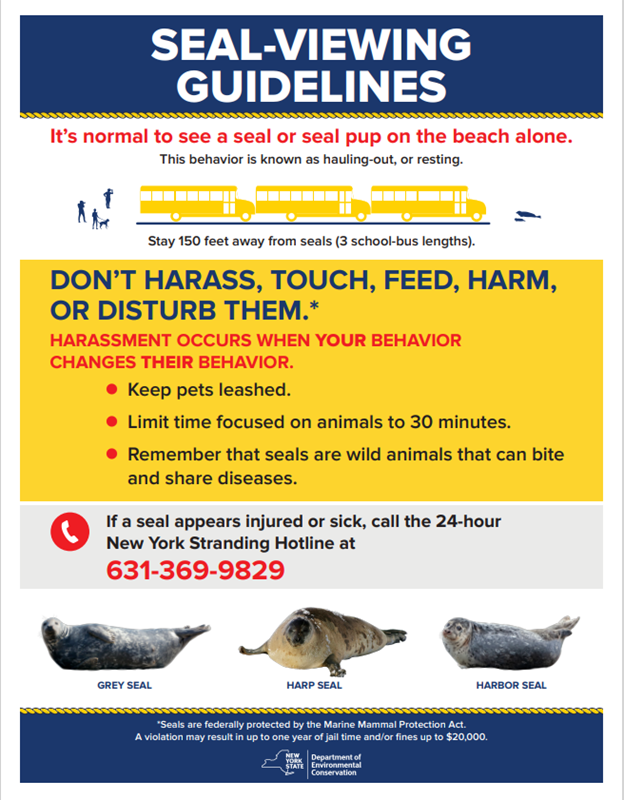
Learn more about responsible seal viewing here.
Get more local news delivered straight to your inbox. Sign up for free Patch newsletters and alerts.