Health & Fitness
We Share the Garden with Some Amazing Creatures
Adulthood is short but spectacular for dragonflies
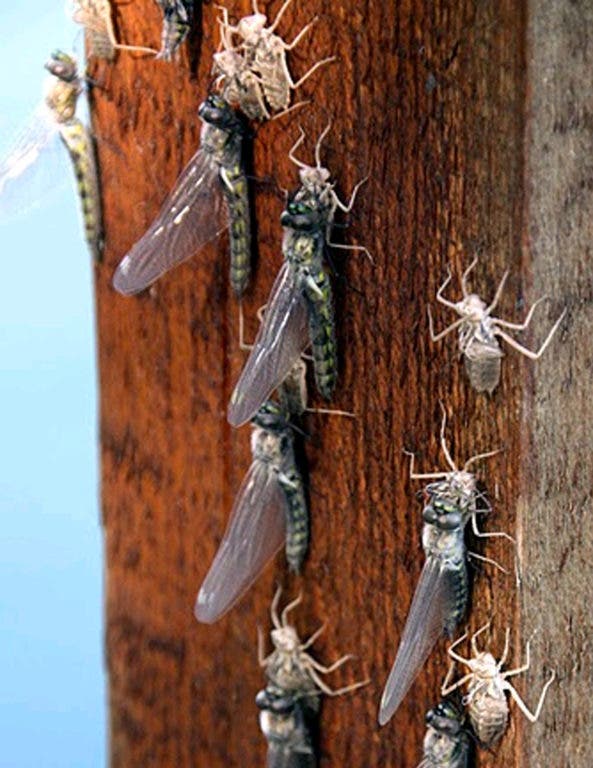


Nature’s timetable...it’s called our circadian rhythm, that built-in clock that tells us when and how to grow and rise and sleep and eat and even love. All living things have such a clock. Even the rocks answer to the call of forces beyond and within them. Some of the first studies on the subject of circadian rhythms were based on the habits of plants. Nature Photographer Carol McIntyre’s magnificent photos of emerging dragonflies prompted me to celebrate that precious gift.
Author Brandon Cornett has an interesting site 21-Facts.com that delves in depth into the private life of these beautiful creatures. For one thing, Dragonflies aren’t FLIES, but a category of insects unto themselves. They spend up to three years of their lives as larvae and only weeks as adults—a spectacular metamorphosis that leaves them with lovely iridescent wings. It is a sign that their lives are almost over and they are about to mate. The difference in size between the front and back wings are what make them so fast and highly maneuverable. Their vision is also amazing, permitting them to see 360-degrees.
Fossils of dragonflies go back some 300 million years, one variety three feet from wing tip to wing tip. Although dragonflies are predators (the young known as ‘nymphs’ have spear-like appendages with which they fish), when it comes to humans, they neither bite nor sting. Their main diet consists of mosquitos, a very good reason to encourage their presence in the garden. I caught a very blurry shot of them recently...all the more reason why photographer McIntyre’s shots are so spectacular and rare.