Community Corner
Crowd Speaks On North Fork Battery Storage Plan: 'This Is A Bad Deal'
Residents turned out in force to speak about a proposed lithium-ion battery energy storage facility in Cutchogue.


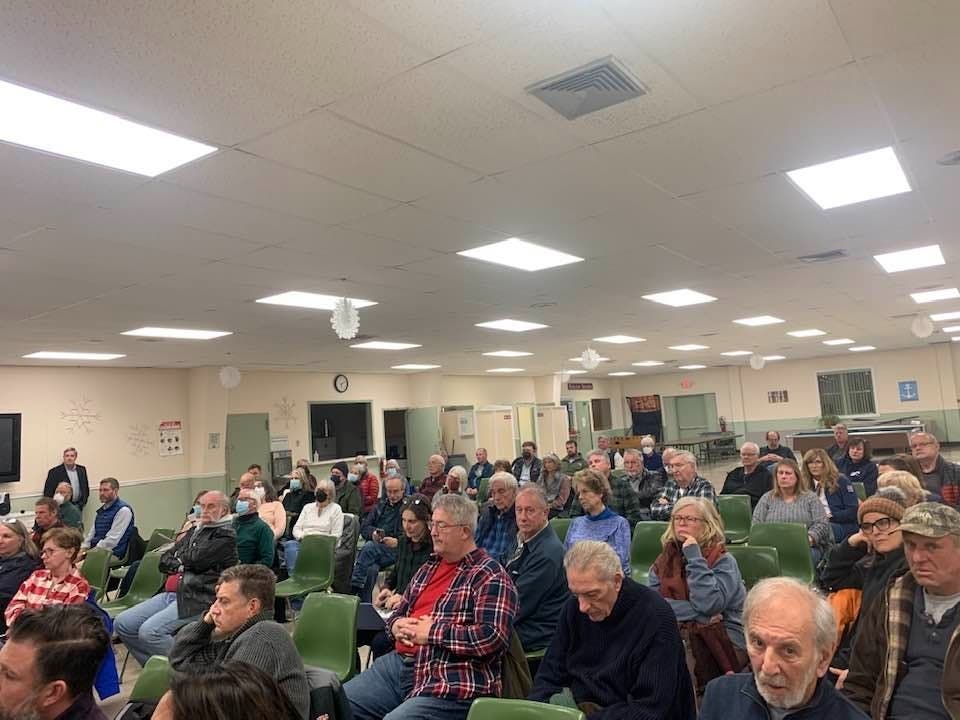
NORTH FORK, NY — The public turned out in force Thursday night to weigh in on a controversial proposal for a proposed battery energy storage facility in Cutchogue that has many seeing red.
In recent weeks, the public expressed their concerns about the project, pitched by Key Capture Energy, at a zoning board of appeals hearing, and then, a planning board public hearing, last month. The plan calls for the construction of a 60-megawatt lithium-ion battery storage facility located at 10750 Oregon Road in Cutchogue. Residents have raised concerns not just about safety but about the visual impact of the facility on a pristine greenbelt.
Eariler in the day, before the meeting organized by the Cutchogue Civic Association, Southold Town Supervisor Scott Russell announced that the town board would be considering a 12-month moratorium at their meeting next week on all such battery storage facilities townwide.
Find out what's happening in North Forkfor free with the latest updates from Patch.
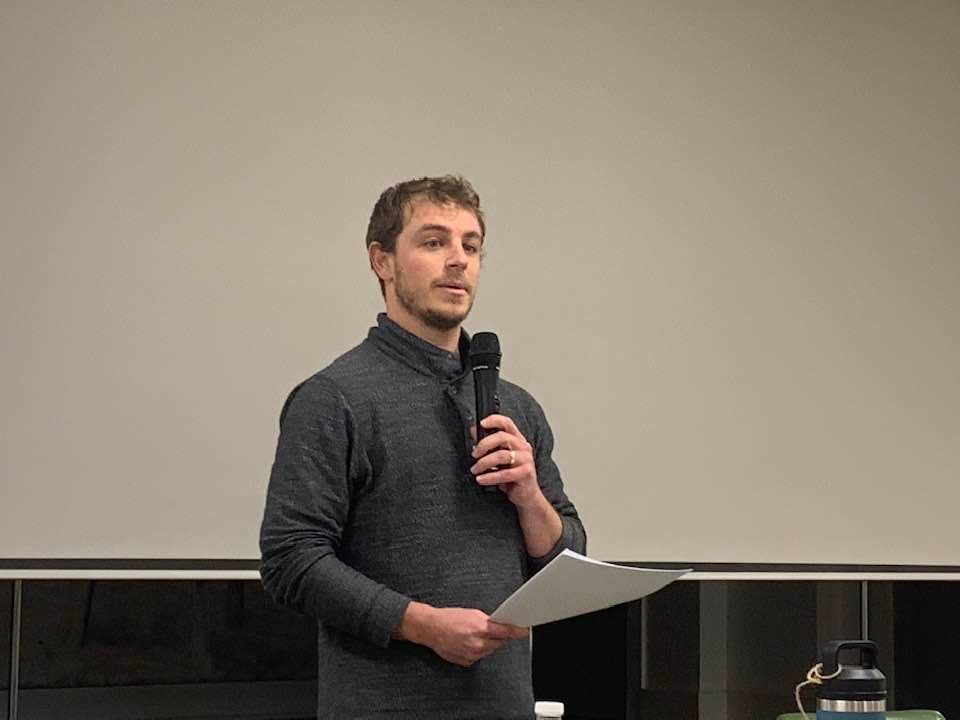
At the meeting, moderated by Mary Eisenstein and held at the Southold Town Recreation Center on Peconic Lane, Rudy Sunderman of Suffolk County Fire Rescue and Emergency Services discussed how firefighters are educated on handling fires or explosions in the event of a catastrophe.
Bill Bramble, who lives on Oregon Road, asked if the firefighters and emergency responders had been trained in how to handle that sort of fire.
Find out what's happening in North Forkfor free with the latest updates from Patch.
Nick Petrakis, representing the Energy Safety Response Group, said he worked in New York City and reviewed energy storage systems. He said his firm trains local fire departments and others in best practices for handling lithium ion emergencies.
Sunderman added that it was not possible to have trained with actual lithium ion battery fires because there have been none but that Suffolk County responders have been trained in the "event of" such an emergency.
Petrakis said New York State has stringent emergency response training and hazard mitigation analysis procedures in place.
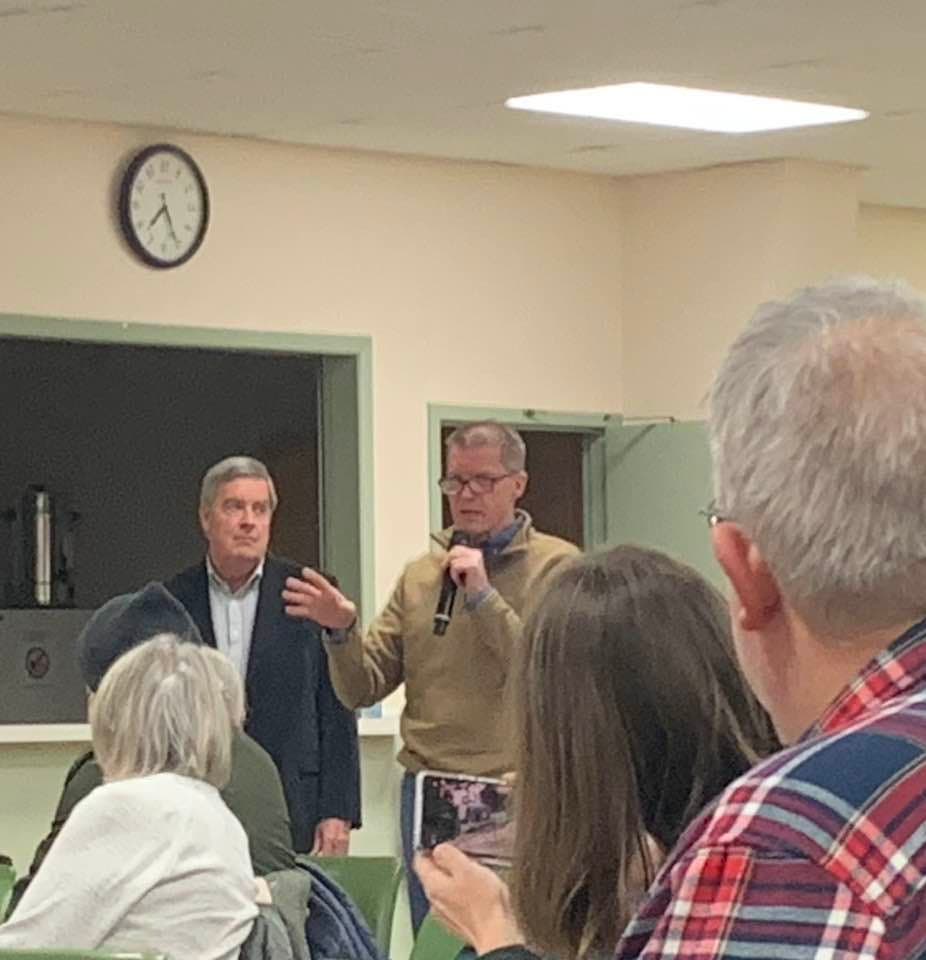
Ian Latimer, a senior project manager for the New York State Energy Research and Development Authority, or NYSERDA, also spoke to the issues, as did Joel Richardson, a civil engineer for H2M in Melville who is working with Key Capture, and Phil Denara, senior manager for development for Key Capture.
Recently, Denara reminded, Gov. Kathy Hochul has announed a goal of 6 gigawatts of energy storage by 2030.
"Energy storage is rapidly changing," said Denara, who said he has family in the area. Discussing the plan, Denara said Key Capture has listened to the comments made by the community so far and agreed to bury all transmission lines underground and commence with a "more robust" landscaping plan. Key Capture also met with fire department officials on December 20 in response to concerns raised, he said, and is planning to deliver a hazard mitigation analysis report and a co-compliance, emergency response and decomissioning plan.
"The Long Island grid is rapidly changing," Denara said at a prior ZBA hearing "The local grid will need fast response and flexible solutions like battery storage."
The facility would be unmanned and have minimal impacts on the current infrastructure, representatives for the applicant said. It would be feasible to move overhead lines underground and use local labor, meaning the creation of jobs, they said.
Richardson has said the site plan, on 27 acres, would consist of 272 battery containers installed, accompanied by 34 conversion units to charge the batteries. There would a 12-foot tall visual and sound barrier on the north and west perimeters of the parcel, with the balance surrounded by a chain link fence, he said. An access drive would be created to Oregon Road, but minimal traffic is expected, he said, with one vehicle trip on average per month for maintenance and for staff to visit, he said.
Most property at the site would be undisturbed; the project would not impact an existing sod farm, he said.
A variance would be needed to connect two substations and for lightning masts, he said. The facility would be well set off the road with plantings to mitigate the impact on Oregon Road, Richardson added.
On Thursday night, Denara added that there have been a number of technical reports outlining the advantages of battery storage and highlighting rapid response time; the project also provides ancillary services to support local grid reliability on the North Fork, which currently relies on fossil fuel peaking power plants, he said.
PSEG Long Island is already planning for future battery storage needs, he said.
As for safety concerns, Denara said, "We are working closely with the fire department to ensure that this is a safe and discreet use and ultimately, I hope you will find this is going to be a great project for the. community."
Residents stood up with a series of questions. One woman asked why KCE had Korean ownership. Denara said the company is headquartered, and does business, in the United States and is a partner with SUNY Albany. In December, 2021, the SK Group, a South Korean conglomerate, acquired majority ownership as a mechanism for deploying clean energy in New York State, Denara said.
Key Capture is its own company, funded by the parent company, he said.
Latimer added that New York currently has the first and largest lithium ion recycling facility in the United States, Li-Cycle, and that, along with President Joe Biden's prioritizing and incentivizing such investment in the United States, has led to multi-national companies setting their sites on the United States.
Louise Harrison of Peconic asked if there was a way to foresee how many such projects would be proposed locally.
Latimer said the state is investing heavily in new transmission projects, as well as offshore wind — particularly relevant on Long island — in addition to solar and energy storage programs.
"We cannot meet clean energy goals, just using one kind" of project, he said. While it was impossible to forecast the number of impending projects, he added that there is a statewide scoping plan, the Climate Leadership and Community Protection act, created by the New York State Climate Action Council.
The grid will change as people begin to use all-electric cars or power their homes with electric, he said, adding that there may be some towns on Long Island where there is minimal infrastructure, or where the load is at capacity.
The grid, Latimer said, is like rivers and creeks and needs to interconnect.
Peter Speranza, who also lives on Oregon Road, asked a question echoed throughout the night: "Is there really a need for this type of facility, in this location?" Many on the North Fork are using solar options, he said; the area never sees brown outs.
"Outside of what KCE sees as relatively cheap land, what's the benefit to Cutchogue — to the Town of Southold?" he asked.
Denara said right now, the peak load on Long Island is 5,000 megawatts but that will change as electrification occurs. Their team has done thermal load flow studies, he said, and as peakers are decommissioned there will be an increased need for energy storage.
"The North Fork is one example of a load pocket that will benefit," he said.
Latimer added that there is a high voltage transmission line that runs along the site.
One woman, who identified herself only as Emily, asked if other locations were considered and if so, why the project could not be built there.
"We have done electrical flow studies throughout the grid," Denara said. "Battery energy storage today is proposed on almost every town on Long Island."
Other companies are doing the same, he added. "This is one piece of a puzzle."
Emily went on to ask why a rural road, part of a greenway, was chosen to "build this huge structure. It doesn't fit in at all." While the parcel is industrially zoned, she said there are other sites on the North Fork more appropriate. "Many places make more sense, instead of plopping it down on one of the most beautiful places in the country."
Denara pointed out the project was proposed to sit behind a capped landfill, with much of the property left undisturbed. A commercial storage facility with the same kind of container as the battery storage facility sits nearby, he said.
"There is no comparison. That's not the same kind of danger," Emily said.
Tracy Burgess of Laurel added: "I am not for this project."
She asked when the "drop-dead" date to sign the contract with the landowner would take place.
"I won't answer that question," Denara said. "This is a multi-year agreement. it's not appropriate for me to answer that question today."
Jack Malley, an East Marion fire commissioner, asked why the Suffolk County Water Authority wasn't present at the meeting. He pointed out that more than 600 fires and at least the death of one child was attributed to lithium batteries — although most were related to toys — but said the larger batteries were created with the same componenents. He asked how the North Fork's aquifer would be protected.
"It takes a tremendous amoputn of water to put out this type of fire," he said.
Petrakis said there are "strenuous" listing regulations and safety requirements. ESRG works to contain thermal runaway, he said. "The guidance is not to use much water," and use aggressive containers to contain the fire, he said.
"We'd rather work to contain it rather than have it cascade into a larger event," Petrakis said.
He and Denara said the runoff was not toxic and was akin to what would be present at a typical house fire.
Petrakis also said just letting the fire urn is "surprisingly beneficial" to safety.
The group discussed a tragic explosion in Surprise, AZ in 2020 that sent threw firefighters 75 feet; that fire was caused by a thermal runaway, which produces a tremendous amount of flammable gas.
Latimer pointed out that the buildup of flammable gases was due to the fact that the AZ fire started in a dedicated battery room; the proposed project would use batteries in smaller containers, so there was no chance for such a large buildup of gases.
Latimer also said there has been "large scale fire testing" to see what conditions would be in an emergency.
Russell brought up the proposed moratorium and said he was not able to discuss the proposed project specifically but instead, general safety issues.
He pointed out that the American Power Association has said that many protocols have been deemed "insufficient" and said that scenarios being presented about New York City fires were not comparable because NYC has paid firefighters and Cutchogue firefighters and others on the North Fork are volunteers. "We are dependent largely on volunteers, whose numbers are shrinking," he said.
Russell asked if Key Capture was already moving forward or just getting approvals so if the request for proposal opportunity came they could submit a package to LIPA.
Petrakis said there are constant code updates in New York State.
Denara said the project as proposed is not slated to be built before 2025 and said there was no signed commercial contract at the present time.
KCE is now seeking permits to be "in a good position for a potential contract," Denara said.
Another resident asked about environmental impacts. "What's going to happen if we have a fire? It's too late? 'I'm sorry, I made a mistake?' I just want to know the environmental impact this will have if a catastrophe happens on Long island."
Petrakis said again that there is a rigorous enviorontal review with fire testing data that examines off gassing and other concerns.
Sharon Kelly of Cutchogue asked about, due to impending climate change, what would happen in the event of strong winds and lightning, and how runoff would be contained.
Denara said the project woiuld be built on an appropriate site, 50-feet in elevation, out of the flood plane. He also said the project would be designed and sited to account for those scenarios.
When asked again about hazards, Latimer said the design was created to mitigate disaster in the event of fire and keep the blaze to one unit; with the containers, not every battery would go on fire, he said.
"Can that be guaranteed?" one resident asked. "Yes or no?"
"I don't know that anything can be guaranteed," Latimer said.
Discussing how the North Fork would fare, Bramble said the North Fork would be paying infinitum and said the location was not where the facility was needed.
Denara said the proposal would mean the "cheaper cost of energy in the resource stack."
"This is a bad deal," Bramble said.
John Callan from Riverhead spoke: "You have to have a HAZMAT team to fight these fires. The closest HAZMAT team is in Yaphank — an hour away."
.
The National Fire Protection Association has listed concerns about similar projects including a "thermal runaway," which they said is "the uncontrollable self-heating of a battery cell. It begins when the heat generated within a battery exceeds the amount of heat that can be dissipated to its surroundings. The initial overheated cell then generates flammable and toxic gasses and can reach a heat high enough to ignite those gasses."
Other concerns, the site said, include "off gassing. "The gasses that are released from battery energy storage systems are highly flammable and toxic. . . If the gas is able to reach its lower explosive limit before finding an ignition source, then there is the potential for an explosion," the page said.
Richardson, at the ZBA hearing, countered that according to the Electrical Power Research Institute, there was only a 1 to 2 percent failure rate globally; the company operates other facilities in locations including Texas and "none have had a fire," he said.
In the case of a fire, he said, the company would send its own personnel, but called such a scenario "highly unlikely." A response plan would be developed with the local fire department, he said, adding that there was "no significant risk to the community" from fire or toxicity.
Cutchogue Fire Department Board of Commissioners Chair Dave Blados said, at that hearing, "Our concerns are many. I feel more conversation has to take place."
Cutchogue Civic Association Chair Dave Bergen said much had been learned but more discussion was necesssary.
"I'm glad the civic shosted the meeting," Russell said. "Itwas informative and clearly important to the community given such a large attendance. It's a good kick-off to continuing further discussion on this important topic."
Get more local news delivered straight to your inbox. Sign up for free Patch newsletters and alerts.