Community Corner
Greenport Couple's Deeply Personal Half Marathon To Fight Back Against Leukemia
Donna Giancontieri, who grew up in Hamptons Bays and worked in Southampton for years, calls the cancer she endured a "thief in the night."


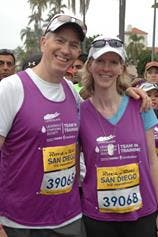
NORTH FORK, NY- Donna Giancontieri, who lives in Greenport, will be lacing up her running shoes this June for the San Diego Rock ’N’ Roll Half Marathon as a member of the Leukemia and Lymphomia Society’s Team in Training.
And for Giancontieri, the event is deeply personal.
A familiar face on the East End, Giancontieri — who now works for Cornell Cooperative Extension and was a reporter for the Southampton Press and executive assistant to former Southampton Town Supervisor Skip Heaney — and her husband Lou decided to join Team in Training after her own battle with leukemia.
Find out what's happening in North Forkfor free with the latest updates from Patch.
Team in Training, she said, ”does incredible work and is funding many critical clinical trials for patients to find new cures. Somebody, once, funded a wacky trial to see if arsenic added to a common chemo could cure a type of leukemia called APL. Guess what? It worked. Guess what? That arsenic chemo saved my life in 2009-2010. So please join Lou and I to help.”
Giancontieri and her husband have set up a fundraising page in advance of the event, which takes place in June. To date, the page has raised $4,180 of its $10,000 goal, to help fund more lifesaving projects.
Find out what's happening in North Forkfor free with the latest updates from Patch.
The couple previously participated in the event in 2012. “We were so impressed with the work LLS does to help blood cancer patients. A very large TNT group of thousands from all over the United States participate in the San Diego Marathon/Half Marathon each year, raising millions for LLS. This is my second time and Lou’s third in San Diego plus he has run two halfs in East Hampton for LLS. I promised myself that if I was still healthy at 50 I would do another half-marathon to raise money, even though I hate running — truly, really hate it.” She laughed.
Reflecting on her own journey, Giancontieri said she was diagnosed in 2009, when she was 44 years old, with APL, or acute promyelocytic leukemia.
APL is the M3 subtype of acute myelogenous leukemia, or AML, a cancer of the white blood cells. In APL, there is an abnormal accumulation of immature granulocytes called promyelocytes.
APL, she said, ”comes on very fast. I call it the thief in the night that stole my life for awhile. I felt fine one day and the next day I felt a little rundown, and the next day I was in critical condition at Stony Brook’s blood cancer ward where I stayed for a month. My husband Lou stayed with me every single night, sleeping in a chair.”
Over the next months, Giancontieri said she was back at Stony Brook a number of times for various complications and treatment.
“And then the real work began,” she said.
Her outpatient treatment required ten weeks of IV chemo treatment, five days a week, all day. Then, after a short break, two more weeks of chemo at Stony Brook and then a year of oral chemo and “massive amounts” of other medications.
“I was truly blessed to have major family support. I couldn’t drive myself to Stony Brook so a family member or a friend would take me to Stony Brook each day and wait all day with me while I was hooked up to the IV and had tests, then drive me back home: others stocked our freezer with dinners,” she said.
When she learned she had cancer, Giancontieri went into “battle mode.” she said
“I was scared, of course, because it was a long, tough fight and I felt horrible from the meds, but I told them to give me everything they had to get rid of it. I was willing to try anything. Meds that made me feel horrible, bone marrow biopsies, spinal taps. Not fun. But I had no choice and loads of support from my family and Lou’s family and friends made it much easier. And some amazing nurses at Stony Brook, one of who was later diagnosed with leukemia herself.”
Giancontieri emerged from the battle a warrior: “On March 1 it will be five years since I took any chemo or needed a bone biopsy — that is a major milestone,” she said.
Giancontieri still goes to Stony Brook for checkups regularly. She was treated with several medications, including 50 doses of an arsenic-based IV chemo that can cure just the APL form of leukemia — no other type.
“It is truly amazing. I was shocked when I heard I would be treated with arsenic — who knew? This is why clinical trials are so important .We never know what can act as a cure.”
LLS, she said, helps to fund many successful trials.
“Blood cancers are tricky to cure because they are not isolated like a tumor — its runs throughout the body and in the bone marrow and it can be difficult to treat.”
Giancontieri said raising awareness and working to help others facing the same challenging journey is critical. “The number of blood cancer patients is rising.”
She believes personally that the reason for the uptick is environmental. “It’s often a long and complicated treatment and often, patients can’t work during treatment, which can cost hundreds of thousands of dollars. Unfortunately, we all probably know someone who had fought blood cancer — or who will. Four people I know have been diagnosed since I was.”
The facts are staggering: “Every day, statistically, someone is diagnosed with a blood cancer in Suffolk County and every four minutes someone is diagnosed in the United States. It’s very prevalent and until recently, with new treatments, the survival rate was very low. Now, thankfully, it’s much higher.”
Giancontieri said she believes in supporting LLS because funds go to help patients or to research/clinical trials and the organization has been very successful at helping find cures. They have funded thousands of clinical trials that would otherwise have received no funding, and have given patients tens of millions in co-pay support, she said.
“We were lucky — we had good insurance. But some of the medicines cost thousands of dollars each month. It’s tricky because each type of blood cancer generally has a different cure/treatment and these can be very extensive and complicated — mine went on for 19 months. I met people who were in constant treatment for over two-and-a-half years. It’s very costly.”
Survival, Giancontieri said, is her life’s greatest achievement. “I fought hard and I am proud to be a survivor. I met a lot of people who didn’t make it, and it breaks my heart. But there’s nothing I can do about that except help fight for a cure. Hopefully, one day it will be 100 percent curable.”
To donate, click here.
Get more local news delivered straight to your inbox. Sign up for free Patch newsletters and alerts.