Politics & Government
Historic Preservation Commission Suggests Using CPF Funds to Offer Incentives for Landmarking Homes
Later in the day, the town preserved three properties in Southold Town.


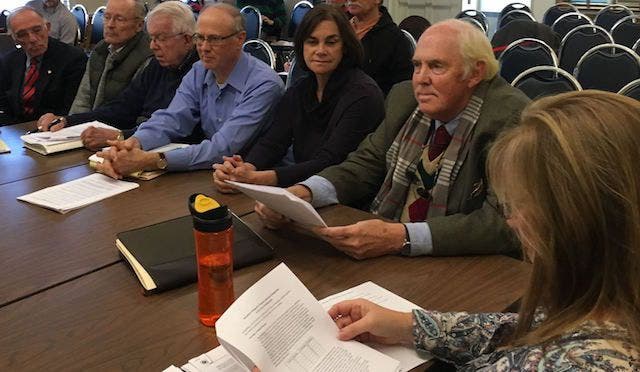
SOUTHOLD, NY — Members of Southold Town's Historic Preservation Commission would like to utilize Community Preservation Funds to offer residents willing to landmark their historic homes a "carrot," or incentive.
According to the Commission, of the 1,100 historic properties in Southold, less than 25 percent are protected; 872 homes are left without potential protections.
Members of the group suggested using a portion of the CPF funds to encourage residents to landmark historic properties they say are critical to maintaining Southold's scenic, bucolic charm and legacy.
Find out what's happening in North Forkfor free with the latest updates from Patch.
The group maintained that those preserving land in town were offered incentives; Southold Town, they say, has spent $113 million on preservation of more than 3,000 acres of open space.
A possible "token" annual incentive of $1,000 per homeowner per year was suggested. That would currently equate to $272,000, they said. Homeowners would have to apply each year, they said.
Find out what's happening in North Forkfor free with the latest updates from Patch.
"Once a historic property is lost, it's lost forever," said Jamie Garretson, chairman of the HPC.
Southold Town Supervisor Scott Russell said CPF monies used for land preservation were not "incentives. Land preservation is a straight real estate transaction," he said.
The HPC unanimously urged the Southold Town board to pass legislation allowing for the use of CPF funds for a program to help underwrite the costs of residents looking to landmark historic buildings.
No new homes have been landmarked since 2004, the group said, save three structures designated as historic at Tuesday's town board meeting.
The group maintained that the amount was merely a token; as homeowners, there are myriad costs involved but the $1,000 could possibly help to replace a window or help to maintain the property.
Landmarking a home, the HPC said, helps to improve property values for the entire town.
The HPC also discussed facade easements and said towns such as Southampton offer tax reliefs for preservation of such facades.
Southampton has a great deal more funding to work with, Russell said. "Southampton's fund balance is like power ball money," he said.
The supervisor said he might have difficulty explaining to the public why owners of a $800,000 historic home were eligible for a $1,000 incentive yearly and said there are others who are living in a $400,000 and "no one is giving them anything." He said it's critical to look at the the entire picture and consider the needs of all residents.
Russell asked if a means test would be included before awarding the grant.
He added that he did not know if there was a need to incentivize for people already living in historic districts in town.
Jim Grathwohl, former chair of the HPC, said, "Historic preservation is good business," with many tourists coming out to see Southold's rich history and its ties to Southwold in England.
There's a need to preserve historic old buildings, such as a number of churches on the chopping block currently, the HPC said.
Councilman Jim Dinizio said the town would have to commit to $1,000 per year times the 1,100 historic properties.
Councilwoman Jill Doherty suggested a possible one-time only incentive for those considering landmarking their homes.
Russell said again that CPF monies used for land preservation, when people are purchasing farmland, are real estate transactions. "It's a one shot deal," he said. "A person can't come back year after year. It's not an incentive. We don't pay them annually for the right to farm."
The HPC members argued that historic preservation is included in the CPF legislation.
"Each town has the right to govern its own program," Russell said, adding that in towns such as East Hampton, where there is no land left to preserve, elected officials have the ability to refocus those funds to other goals.
In Southold, however, he said, there are so many projects pending that some are being phased until "new money rolls in." Southold, he said, doesn't get the same amount of CPF revenue as the other East End towns. On the best year, the town may see $6 million, he said, but on a median year, that number is closer to $4.5 or $4.8 million. "We have projects pending and those singular transactions would exceed that," he said.
Russell reminded that he's long expressed a "reluctance" to use CPF money for nitrogen reduction in area waterways; that initiative passed by referendum recently.
While Russell said he believess the water improvement program is a great one, utilizing CPF funding for that purpose means there are "competing goals, and that's bad policy."
Grathwohl pointed to the town's seal behind the conference table and said it's adorned with the British pound sterling sign. "It's that history people still come out here for, the ambiance of being English, quaint and historic. That's what we're trying to preserve."
It's critical, he said, that new people sign up. With the population in Southold aging out and the next generation living across the country, selling the homes after their parents and grandparents pass away, the HPC's mission, he said is to "maintain the ambiance" of Southold Town. "We are losing these houses," he said. "You can't bring them back. I can't bring back a 1600s house. To me, this is what gives us the character we have."
Russell suggested alternate funding mechanisms be explored. He also said the HPC should go before the school boards, as the biggest incentive is the real property tax incentive.
Doherty suggested criteria be established and a means test established.
The HPC agreed to hold some discussions with board members and then come back for another work session.
Russell also suggested creating a recognition program for those landmarking their homes, something that would be beneficial to mention in an ad if an owner was selling their home.
Town preserves three structures
Later, at the town board meeting, the town board voted unanimously to give historical designations to the Race Rock Light Station, the Second Parsonage House, and the Terry House.
"This was a very good day for Southold," said Anne Surchin, architect and vice president of the landmarks preservation committee. Quoting the late attorney Tom Twomey of East Hampton, a "great advocate" of historic preservation, she said, "He used to say that when we lose the buildings as a community we lose our soul. Today was the complete opposite."
Get more local news delivered straight to your inbox. Sign up for free Patch newsletters and alerts.